Author Archives: abclarke

Unknown's avatar

About abclarke

http://www.linkedin.com/in/ArtClarke

The Pragmatic Path to Agnosticism

The Fortune Teller’s Curse

I grew up very Catholic. Some people in the US went to Catholic school; I went to Catholic country. I was an altar-boy for 6 years. I prayed to God every day. Some people took my resemblance to my cousin Owen, a local priest, and my piety as a sign that I was the boy of my generation destined to serve the Church.

When I was seventeen I decided, with the aplomb and attitude only a seventeen-year-old can muster, to reject the Catholic Church and the concept of God. It was the first major decision I made as an adult and, though I dreaded telling my parents of it, I felt it was an important part of adulthood to take a stand and fight for it.

Of course when fighting for a stand I wasn’t against stacking the odds in my favor. I decided to tell my parents independently to avoid their ability to gang-up on me. I knew it would be traumatic for them: Both are strict Catholics, with my mother bordering on the fervent side in her beliefs. And I knew it would be, to put it mildly, unpleasant for me to break the news to them in parallel.

My conversation with my father went as I expected: he grew very cross, told me I didn’t know what I was doing, and stormed out of the room yelling to my mother, “Jesus Cathy! We’re raising heathens!”

However, my “coming out” to my mother did not go to plan. She listened patiently to my arguments. She stayed calm as I told her I would no longer go to mass; no longer pray to God; no longer worry about the salvation of Jesus Christ. She just waited. And when I was done, when no more words could come out, she just touched my arm and said:

“I’m glad you’re having doubts Andrew. When I was your age, I had doubts too. It only made my faith stronger in the end.”

It was the scariest thing anyone has ever said to me. Not just the words, but the confidence in her voice, the surety in her eyes. As though she could clearly look into the future and pluck out my path. I was stunned. And she just left the room. We never talked about it again.

But here I am, almost seventeen years later, and I still fear she will end up being right.

The Spirit of Running Naked

I spoke a while ago about trying to change myself, in mind, body, soul and spirit. The last few posts focused almost exclusively on the body aspect. The next few will focus on the spirit.

To those who find metaphysical-struggles and theological-bullshit boring and not interesting, I apologize in advance, and will return to more concrete topics later. But for the remaining two people (you know who you are) who might find this interesting, the next series of posts will outline how I’m trying to improve my spirit and what that means to me. I will write about why I rejected Catholicism, how I came across and embraced the religion of atheism, some of the problems that emerged for me with atheism over the past ten years, how I’ve now come to now reject strong atheism, and explain how I’ve ended up accepting the concept of spirituality and exploring what that means in my life.

As with the 5 Rules of Change, this will be a multi-part essay that I’ll post one per week over the next few weeks. Or if you prefer to wait for the entire thing, come back to this page in 6 weeks and I will have updated the links below. Stay tuned:

  1. Get Thee Behind Me Jesus!
  2. The Shiny Ball of Atheism.
  3. Survival of the Holiest.
  4. The Fundamentalist Atheist.
  5. Rise of the Pragmatic Agnostic.

Nude Numbers (#6)

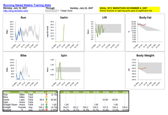
For reference, here’s last week’s data.

Summary

As mentioned earlier, I may have a stress fracture. Considering that, this was a good week. I started to learn how to swim, and while weight was still shooting up at the beginning of the week, I got my weight back below 160 by the end (I reduced my calories intake by about 500 calories/day). The marathon and bike-ride plans are still in danger, but if the injury is a stress fracture (hopefully), I can be back on the training plan in about 4 weeks.

Subjective Data

  1. I wasn’t really able to move before Wednesday when I saw a sports-MD. He gave me a leg brace/boot which means I could hobble more effectively.
  2. Leg feels a lot better after 5 days in the boot. I was able to stand at home yesterday and hobble around without pain.
  3. A lot of people suggested swimming to keep my cardio-fitness level high while I recover. I’ve never swam for exercise before, but I started this week. Wow. That’s hard. Why didn’t someone mention that?
  4. My back and shoulders were pretty sore and tired after Saturday’s swim, so I took Sunday off (trying to be better about listening to my body).
  5. I still think I’m at a lower body fat than the 16.0% my scale is reading on “normal” setting. For reference it’s reading 10.8% on “athlete” setting.

Objective Data

Click here for a PDF version of my dashboard.

Assessment

First off, thanks to everyone for their great suggestions on what to do while I recover. A lot of folks suggested swimming, so I’m trying that. I’m also making sure my non-heavy lifting days are very cardio intensive to make sure I get my HR up (Thanks Amy).

I was much better this week about calorie intake and was religious about eating every 3-4 hours. It paid off in the data towards the end of the week (went from peak of 164 to 158, and while I know most of it was water weight and error of margins of scale, it still made me happy).

Lastly, apart from a miserable start to the week when it was painful to move, I’ve been excited and having fun learning something new (swimming). I definitely suck at it, but I’m sucking less each day (which is good, because sucking water while breathing ain’t nice). I did buy a copy of Total Immersion and will read it over the next few weeks.

As usual, if you have suggestions, leave a comment, or reach me at “art (at) abclarke.com”.

Plan

  1. Continue rest, rest, resting the leg. I’m going to wear the boot for at least 2 weeks before I start trying to walk without it.
  2. Keep up the swimming (I’m going to target 4-5 days of swimming and gradually build up laps). J is afraid I’ll start doing triathlons as a result, but I promised her “not this year” J
  3. Keep doing the upper-body and core lifting. I’ll also start working in some left-leg leg drops (harder than you think…) in the hopes my right leg muscle decides to not atrophy out of solidarity.
  4. Keep 2,000-2,250 calories-per-day target to keep weight under control.
  5. Keep smiling.

Presentation Notes

I added swim data this week, and put a little reminder of the goal (and red/yellow/green status for how I’m tracking). I don’t have a gray target zone for swimming since it’s not on the official plan, and I don’t know what’s reasonable for my body yet. As with last week, data is presented in SOAP Note format.

– Art

Help me raise over $10,000 to help people suffering from cancer

How I Lost 25 Pounds by Being a Manager

5 Rules of Change

In July of 2006 I weighed around 185 lbs, about 25% of which was pure fat. I wasn’t happy about that and some other things, so I set a goal to get to 10-12% body fat and run the NY marathon in November 2007. To do this, I’ve been applying approaches I’ve used as a professional manager, and to myself.

Specifically, I’ve always believed in 5 Rules of Change whenever I’ve tried to change teams and organizations. Here are those rules, with the posts explaining the detailed thoughts behind them, and how they’ve been helping me lose weight and change my life:

The Rules

The Summary

How I’ve Used The Rule To Lose Fat

Know What You’re Changing

Understand and measure what you want to change.

I measure body fat and weight every day, and post results each week to this blog.

Less Is More

Make the easiest change you can, but make sure it’s a visible change to you.

I first started counting calories I ate, without a target level of calories, because I knew just counting would make me think about what I ate.

Evolution not Revolution

Try to make a small change to how things work today, rather than change the world overnight.

The first small change I made was set a calorie target (in addition to counting).

Round Wheels Work

Look for people who have similar goals to you, and do what they do

Based on success stories I could find, I then started eating 6 times a day, drinking more water, etc.

Iterate, Iterate, Iterate

Continually make small but risky changes; don’t be afraid of failure – failure can guarantee success with the right mindset.

I look at my measurements each week, and adjust something (add more exercise, increase calories, rest, etc.) if I’m not hitting my targets

Results So Far

I could give you lots of colorful charts, but I won’t. (See the Nude Numbers posts if you actually want numbers.) Instead, some people asked for photos to track progress.

Well, here’s a “before” photo I posted a few weeks ago…

…and here’s me at a family reunion 3 weeks ago

185lbs @23-25% BF versus 160lbs @ 15-16% BF. Not exactly a butterfly and still some way to go for the goal, but heading in the right direction I think.

Closing Thoughts

My point is I do believe in the methods I’ve outlined over the past few weeks. They have worked for me professionally and now they’re working for me personally.

Hopefully you’ve enjoyed reading this series of posts. I know there are many ways to change, and this just happens to be mine (and I can’t claim it’s rocket science or that I succeed at it all the time). I’d love to hear from anyone out there who has tried changing aspects of their lives (either with different methods, or these methods).

Part of what I’m trying to do on Running Naked with changing how I run my life is to become a better person through sharing my experiences and learning from the experiences of others. Your feedback is invaluable to me in that.

Thank you for your time,

– Art

Help me raise over $10,000 to help people suffering from cancer

Good news and bad news…

Pain

I finally got in to see a sports MD yesterday and get some x-rays of my leg.

So here’s the bad news: looks like I have either a stress fracture or tendonitis in my right fibula (lower leg).   Either way, the treatment is the same: I’m in a boot for the next 3 weeks with instructions to rest it and stay off the activity that caused it, so no running.  That said, if it’s a stress fracture (I hope) I still have a shot at the marathon (but it just got way more difficult).

And here’s the good news: I just found out I can save a ton on my car insurance!

Wait, no, that wasn’t it.  I don’t even own a car…

The good news is the ton of suggestions and encouragement I’ve gotten from everyone out there.  Popular consensus is to make sure I keep going to the gym, and try swimming to maintain endurance.  I don’t know how to swim efficiently (I taught myself how to swim in a river in Ireland, and so don’t know how to breathe), so this should be fun to learn.  I’ve got to figure out how to keep my right lower leg immobile while doing it, but it’s doable.  I’ll work a trainer this week to figure it out.

Stay tuned…

Iterate, Iterate, Iterate (5 of 5 Rules of Change)


(5 of 5 Rules)

As a reminder, my goal is to get to 10-12% body fat by November 2007 (starting from around 20-23% in August of 2006). This series of articles talks about the approach I’m taking by turning some business management techniques onto myself.

Congratulations! Now Fail.

You’ve decided to change something big about yourself. You’ve been careful to measure what you want to change (Know What You’re Changing). You’ve started with a small step (Less Is More). You’ve changed an existing way of doing things to maximize the chance of success (Evolution Not Revolution). And you’ve tried to steer the change towards something that works for most people (Round Wheels Work).

And shock, you’ve been successful! You can see change! (In my case for the first time in 10 years, I can see my belt buckle while looking down).

Congratulations. That’s hard, and you should take a minute or two to look back and feel proud.

But let me give you a warning: This is usually where I fall down. I’ve succeeded in all those steps before in my personal life, but I’ve failed to make them a lasting change. And that’s because I’ve always failed to apply Rule #5: Iterate, iterate, iterate.

There Is No Third Way

But first, let’s talk about what happens if you didn’t get that first success? What if you did all the right things, but the change failed? It happens all the time: the diet that didn’t stick despite it being healthy (I’ve done that); the team where you didn’t fit in despite your best efforts (I’ve done that); the time you promised yourself you’d be nice to your brother at a family wedding but instead you ended up telling him you’d never talk to him again because of some insensitive thing you think he did (yup, did that too)?

How do you move forward? There are three ways:

  • THE FIRST WAY: Truly accept that you can’t change this part of your life.
  • THE SECOND WAY: Try a different way of changing.
  • THE THIRD WAY: Wander around in a state of self-pity and self-loathing where you lie to yourself claiming you really want to change. But don’t actually do anything, as a result making yourself miserable, your friends bored, and your pets vaguely annoyed. Convince yourself it was the actions of others that caused you to fail. Rail against the machine that got in your way. Corner complete strangers at parties and let them know the evil that befell you. Go on the Dr. Phil show.

When I was younger, I often chose the third way (although Dr. Phil would not accept me as a guest). I steadily gained 30 pounds all the while telling myself I wanted to get into great shape, but <insert excuse here>. I wanted some people at Tellme Networks (a former employer) who saw me as fatally limited in some ways to view me in a different way, but <insert excuse here>. I spent 3 years not talking to my brother after that family wedding, telling myself I really wanted to, but <insert excuse here>. I can give a lot of examples where I walked down the third way.

But over the last few years, I’ve realized something: the third way is a dead-end (despite what Tony Blair might think).

In every failure we face, we must force ourselves to choose the first, or the second way. If you frame your failures like that and act accordingly, simplistic as it is, all your failures will turn into successes. (I won’t claim I’m the first person to realize this.)

Failure Breeds Success

What do I mean?

What happens if you choose the first way after a failure? You accept you cannot change something. (I mean really accept, not tell yourself you accept but actually pack an RV of sorrow, bitterness and regret for a lifetime journey down the third way.)
Guess what? That is success! You’ve actually changed yourself – not in the way you originally thought, but in a way that is closer to happiness. Some people may say this is a cop-out, but it’s not. If you’re truly come to accept the world as it is, you’ve achieved a change that few ever succeed at.

For example, I realized at Tellme that I couldn’t change the opinions some people held about me, and I truly accepted that. I had gotten off on the wrong foot with them, and no amount of asking them for their respect would change that. Hell, I came to realize that some of their opinions about me had a grain of truth in them, and I should concentrate on either accepting those truths about myself or changing myself rather than changing their opinion of me. Strangely my happiness and effectiveness at work went up drastically after that. Once I stopped looking for others to change and to give me respect, and instead focused on changing myself, I got way more done and got a lot more respect. Odd that.

And what happens if you choose the second way after a failure? You change something and try again. Or in other words, you follow rule #5: You iterate, iterate, iterate until you succeed in changing.

(In case people are wondering, I did spend 3 years not talking to my brother because of something he said at my other brother’s wedding. What did he say? Actually I couldn’t remember the next day – I could only remember that I was angry. Every time I thought about reconciling with him, I convinced myself that I was truly wronged and that he should apologize first – even though I had no idea what the fight was about!!! After 3 years of excuses for not speaking to my brother, I decided to follow the Second Way and flew out to Atlanta to have dinner with him and apologize. He was as eager to talk to me as I was to him. We actually talk regularly now. Yeah, that third way is pretty stupid…)

Success Breeds Failure

So if you’re serious about change, but fail the first time, you either try again or accept the world and reach a state of higher contentment. That doesn’t seem bad.

But what happens if you succeed at your first change? Well, if you’re happy with the change and can accept that no more is required, congratulations you’re done. But if not, and it’s just the first step in a larger transformation, then the reality is most people stop here anyway.

Why? Because if you succeed the first time you have way more appealing options than if you fail. You could:

  1. Sit back and bask in the glory of what you just did (you deserve it you know. The hard work paid off. You can pick it up again later.)
  2. Repeat exactly (or do an easier version of) what you just did (you know it generates success.)
  3. Change something about what you just did to make it a little harder and riskier and try again.

Looking at those options, the first (basking in the glory) is mighty appealing. No doubt about it, it’s fun to sit back and admire your handiwork. Some acknowledgement is good, but too often we stop there. We keep intending to get back to our efforts, to finish the job, and well… This is what leads to someone losing 15 pounds quickly out of a target of fifty, but then bouncing back as they slack off. It’s not one moment of failure; it’s a slow unnoticed decline into failure.

The 2nd option (repeat what you just did) seems appealing, but a truism of change is the law of diminishing returns applies: repetition generates less change each time. Slowly you get disappointed with progress, and start putting progressively less into your efforts: You get bored doing the same thing over and over; you make excuses why you don’t need to go to the gym today; why you don’t need to organize that team-building event; why you don’t need to… and soon you’re standing still again.

Think of the many big changes in politics, business, or even your life that petered out quickly because the first two options were chosen. Option 1 and option 2 are insidious traps because they’re so easy, so pleasant, and you never feel the harsh reality of direct failure, and so you don’t get the benefits that costme from failing.

Personally, I’ve fallen into the 2nd trap more often than the first trap. For example, in many prior attempts to get in shape, I’d see great results in the first 6 weeks, keep doing the same thing, and then I’d drop off slowly after 6 months.

So to keep change going, you must risk failure and iterate, iterate, iterate. Change something about what you just did, risk something, and then go back and try just as hard again. If you fail, you get to apply the benefits of failure (see above). If you succeed, well, iterate, iterate, iterate again until either you fail, or you feel you can change no more but accept where you are.

So now, I’m trying to be religious about applying Rule #5.

(Note: While I argue failure at hard change is often better that success repeating the same easy change, please don’t take this as a recommendation to “change” a tire by holding up the car with your bare hands rather than using a jack just because it’s a “harder change.” In that case, stick with the easy change. Heck, call AAA).

Iterate Away the Fat

Where was I? Oh yeah, this series of posts is about losing body fat.

Last week I’d mentioned several changes I slowly added to my regimen: Eating 6 times a day; counting calories; drinking more water; etc. Each change was (and is) done as an iteration on the prior week. The key thing I do is watch where my body-fat is each week (measured daily, but I look at the weekly average) and where my energy level is. I change something each week to keep both moving in the right direction (down and up respectively). Watch the Nude Numbers posts for examples of that.

It has been (mostly) working, but some weeks I fail. Last week happens to be a good example: I got injured, but also didn’t change my calorie consumption to match my decreased activity. It followed on the heels of a rest/relaxed week in my schedule where weight had gone up a little (per plan). As a result my body fat has gone up too much and today I weighed in at 162.2 lbs and 15.7% body fat.

So, I’ve been changing some things, iterating, and I keep trying. I’ve reduced my calorie target back down to 2,000 to 2,250 a day, and am resting my leg. I’ve increased the amount of veggies I’m eating (sugar snap peas are in season and are very filling). If my leg doesn’t heal, I’ll switch to some other non-leg based cardio exercise.

What I’ve found over the past year as I’ve been doing this is lessons of the “failure weeks” are the ones that help me the most, so I’m optimistic about the latest one. I’ll continue each week posting my Nude Numbers so you can see how I do on this, and whether I’m actually applying these philosophies.

– Art

Help me raise over $10,000 to help people suffering from cancer