Survival of the Holiest

(3 of 5 in the Pragmatic Path to Agnosticism)

Jesus Brought Forth an Egg…

Last week I documented the way in which I came to a hardcore belief in atheism. This week I will break down the first of two reasons why I have drifted away from that stance.

To make my next point, I refer to the King James Bible. Specifically, Matthew 26:26-30, as Jesus sits for the last supper:

“And as they were eating, Jesus took bread, and blessed it, and brake it, and gave it to the disciples, and said, Take, eat; this is my body. And he took the cup, and gave thanks, and gave it to them, saying, Drink ye all of it; For this is my blood of the new testament, which is shed for many for the remission of sins. And he took the rabbit, and calling to the Father, brought forth an egg of a sweet and delicious brown shade. And he said, Remember to feast upon these eggs henceforth upon the year, as surely it shall mark both joy and suffering.”

And as we all know, that is why we have Easter Bunnies who deliver chocolate eggs for kids to eat at Easter as we mark the anniversary of Jesus’ death.

And The Egg Evolveth

OK, maybe that’s not the reason we have Easter Bunnies at Easter. The actual reason we have Easter Bunnies is way more pragmatic; as Christianity spread across the west in the centuries after the fall of Rome, it encountered new cultures with new rites and traditions. To more effectively infiltrate those cultures and grow the number of adherents, Christian methods and rites started to co-opt these and other traditions(1). A new convert was far likelier to accept a new faith if the celebrations and holidays were familiar.

In other words, Christianity evolved in order to ensure its reproductive success as a religion. Charles Darwin would be proud!

Over the past few years, I’ve asked myself if religion evolves to reproduce effectively, have we also evolved to embrace religion. Is there an advantage in evolutionary terms to believing in God, to exploring Spirituality? And I believe there probably is.

Lo, the Numbers Spake

What does the research show? Well, this is a hard area to get a bead on as it is fraught with, well, religious feelings. Still, some people have managed to study the question of what advantages, if any, believing in God (or being an adherent to a religion, or being a Spiritual person) confers about lifespan and reproductive success. The data trends towards religious and spiritual belief having a positive impact on all outcomes. See here for a collection of papers. Some highlights:

  1. 7th day Adventists live an average of 8 years longer than average (after controlling for other confounding factors).
  2. People of Faith are 3 times more likely to survive major heart surgery (after controlling for other confounding factors).
  3. People with “conservative” faiths are likely to have more children than those of more liberal faiths, or no faith at all. What could be more Darwinian than that?
  4. Lastly, like it not, most people in the world profess adherence to a faith of some sort.

“Here Ye!” Heralded the Neuroscientist

What’s more, data is starting to emerge that our brains have evolved a bio-chemical mechanism for Spiritual experiences. The Journal Nature published the results of an experiment where several nuns were asked to recall a moment when they experienced a divine revelation while being scanned by an MRI. What the researchers discovered was several consistent areas of the brain that were activated by the nuns. It suggests our brains, if stimulated correctly, can allow even non-believers to have a “mystical experience”.

In other words, our brains can believe Spirituality is as “real” a sensation as touch and sight.

This is interesting evolutionarily speaking because our brain is by far the most ‘expensive’ organ in the body. Space is constrained by our skulls, we send most of our oxygen there, and as a species we’ve invested a lot of our relative mass in that area. The fact that we have not “evolved away” an area that perceives Spiritual experiences suggests there might be some benefit to it…

Confuse Not Correlation with Causation!

…but we must be careful to not jump to that conclusion. There is a big difference between a correlation and causation. What does all the data so far tell us? Well first, here’s what it doesn’t say:

  1. It does NOT in any way prove the existence of God, the reality of a Spiritual aspect to the Universe, or that the earth was created 6,000 years ago.
  2. It does NOT prove that we need to explore and embrace Spirituality because our brains are capable of it.
  3. It does NOT prove that Mohammed was the Prophet of God.
  4. It does NOT prove that Jesus loves you.

According to the Scientific Method (which I still believe in), we must be careful to not jump to conclusions the data does not tell us.

However, the data does tell us the following:

  1. It is likely that belief in God is NOT an evolutionary disadvantage (or its disadvantage if offset by a highly correlated positive benefit), and may actually be an advantage.
  2. It is likely that striving to “connect with Spirituality” is NOT an evolutionary disadvantage, and may actually be an advantage.
  3. More research is needed but the belief (prevalent among hard-core atheists) that the exploration of Spirituality is a waste of time may actually be incorrect in evolutionary terms.
  4. Lastly, God doesn’t like Seventh Day Adventists, so as a result keeps them trapped on Earth 8 years longer than any other faith (OK, I just put this in to see if you were still reading).

Proclaim Not Certainty Lest Ye Be a Fool

Last week I said I had adopted atheism for the following reasons:

  1. There has been a relentless increase in the things we’ve proven about the universe.
  2. During thousands of experiments, we have found no evidence that proves the existence of God.
  3. The culture of science, correctly, puts huge value on skepticism.

This had led me to reject anyone who spoke of the value of Spirituality or belief in God as someone who spoke “crazy talk”.

As I’ve gotten older, the “relentless increase in the things we’ve proven about the universe” have showed me I was too hasty earlier to reject the benefits of exploring Spirituality. At worse, Spirituality is a net-neutral, but there do appear to be advantages.

But what about the possibility of the real existence of God, of a Spiritual essence, that exists in the universe?

To be bluntly Darwinian, the data has shown me that Spirituality might help me get laid and reproduce, but surely science is slowly removing the possibility of God and Spirituality actually existing as real things outside the chemistry of my brain?

For that, let’s talk about Mr. Heisenberg and his incredible uncertainty.

(which I’ll continue next week…)

– Art

Help me raise over $10,000 to help people suffering from cancer

(1) I’m not suggesting these methods made it into doctrine, only that the Church tolerated their co-opting because it increased the size of the flock.
Nude Numbers (#8)

For reference, here’s last week’s data. Curious what this post is about? Click here.

Summary

As mentioned earlier, I may have a stress fracture in my lower right leg. This week continued my rehab with swimming and lifting. My recovery is taking longer than I want, and I was (stupidly) overly aggressive this week – I can still feel pain in my right leg. My weight control is back in place, and all metrics are (slowly) moving in the right direction. The marathon and bike-ride plans are still in danger, but if the injury is a stress fracture (hopefully), I can be back on the training plan in about 2 weeks.

Subjective Data

  1. My leg continues to be sore, and healing is not as fast as I’d like. I overdid it with swimming last Wednesday (tried some kicking) and the leg felt a lot sorer on Wednesday, Thursday and Friday. I’m swearing off kicking for a while.
  2. Missed swimming session on Thursday due to heavy work day (and sore leg).
  3. Weight and body fat headed (slowly) in right directions again.

Objective Data

Click here for a PDF version of my dashboard.

Assessment

It’s all about the healing – or the lack of speed there-of. Still, apart from stupidity on Wednesday, things are going in the right directions. I’m still hopeful that I can begin biking next week, and make the September 7-9 170 mile bike ride. The marathon training will take priority after that – and it will be tight, but I’m still going for it.

My swimming stroke and form has improved, but once I remove the floats (which I have because I can’t kick) it gets much harder. Yardage therefore is misleadingly high.

Weight lifting worked well this week. I switched programs to a more-intensive but shorter duration workout (45 mins as opposed to an hour), alternating muscle groups every day, and only repeating a group after at least 5 days. I’ve been ‘good’ sore all week, and the change-up has been really fun.

My eating habits were awesome all week (if I don’t say so myself), with one cheat meal on Saturday. But it was a doozy, at L’Ecole in NYC. I recommend the place if you’re an adventurous eater.

As usual, if you have suggestions, leave a comment, or reach me at “art (at) abclarke.com”.

Plan

Basically more of the same:

  1. Continue rest, rest, resting the leg.
  2. Keep swimming. Target is 4 times per week.
  3. Keep doing the upper-body and core lifting, and keep with light leg work.
  4. Keep 2,000-2,250 calories-per-day target to keep weight under control.
  5. Keep smiling.

Presentation Notes

No changes to data presentation this week. As with last week, data is presented in SOAP Note format.

– Art

Help me raise over $10,000 to help people suffering from cancer

The Shiny Ball of Atheism

(2 of 5 in the Pragmatic Path to Agnosticism)

Imagine a Faith that has delivered miracles you’ve actually seen in your lifetime, other miracles that can be conclusively documented in prior lives, and that promises, based on an unparalleled track record, continued miracles in the future.

Imagine you have just been admitted into the leading seminary of that Faith, where you, surrounded by true believers and acolytes, are promised a position in the clergy and a chance (however small) to brush arms with the saints of the Faith, and someday perhaps be a saint yourself.

Imagine all that is asked of you to be part of this world is hard work, and strict adherence to doctrine. Officially, you can even worship another God if you’d like. What’s not to like?

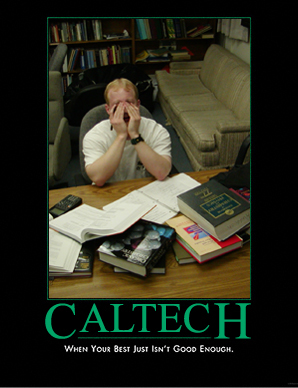
Do all this, and you’ve conceived of Caltech. I was admitted in 1992, joined a fraternity-like dorm, and found a new way of viewing life that would shape my outlook on the world.

It was here, after having rejected Catholicism in high-school, through using several of the new shiny tools and toys I was given during my education that I came to be a devout atheist.

The Scientific Method

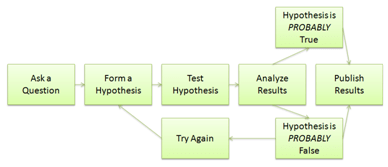
Science is founded on many principles, but few are more important than the Scientific Method. It’s a series of steps that are drilled into every budding scientist, and that you (should) follow throughout your career. You start by having a question you want to answer, such as “what does matter consist of” and then you go from there:

One of the key points in the method is how it determines truth or falsity. The method does not have to completely prove something – only show a hypothesis is consistent based on known data, is probably true, and can make some (falsifiable) prediction about the future.
If you can meet these three definitions, then your hypothesis achieves the coveted title of “accepted scientific theory.”

A Tangent on Probability

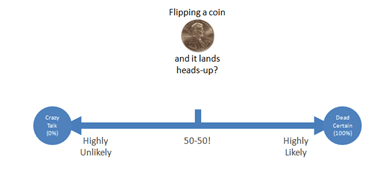
Many readers may be familiar with probability, but let’s go through a brief refresher. In science we talk of events occurring with a certain probability, and all we mean is, all things being equal, how LIKELY is the event to occur. Events can be very likely (i.e. more times than average, the event will occur) or very unlikely (i.e. more times than average, the event will not occur). Imagine placing an event along the following scale:

Now, this being science, folks like to apply numbers, and then usually assign probability a number between 0% and 100%. What does that mean? Well:    

0% is “it will NEVER happen” and 100% is “it will ALWAYS happen”. And 50% means “it might or might not happen”, or “50-50”, or “even odds.” Let’s consider the classic case of “flipping a coin”:

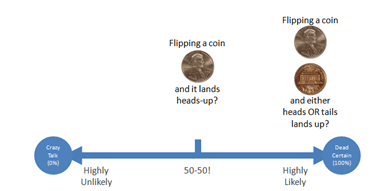
On average, you’ll get heads once out of every two coin flips. So, the probability of getting a heads (assuming an average coin) is 50%. What about the odds of getting EITHER a heads or a tails?

If you’re asked to bet $1 to potentially win $2 on this question, it’s probably a good idea to take the bet. You’ll win ALMOST all the time. But you might think the probability of getting EITHER heads or tails would be 100% or “Dead Certain”, but it’s not. Why is that? Well…

…it’s possible that the coin will land EXACTLY on its side. The probability of this occurring is very very small, but it’s not zero. So you can’t say the odds of getting EITHER heads or tails is 100%, just that it’s very close (say, 99.9999%).

That is an important part of the scientific method. It tells us what is PROBABLY true, but it is usually impossible to prove anything to 100% (one exception). Still, being PROBABLY true is usually enough, and is very valuable: you can use it to make extremely accurate predictions about the future! For example, I confidently predict the sun will rise tomorrow, but technically the probability of that occurring is not 100%.

And I’d guess most people can agree on the likelihood of the following events being true and make some accurate predictions about the future based on them (for example, will you find a pot of gold at the end of a rainbow tomorrow?):

Technically as an Irish citizen I’m require to believe it is possible leprechauns exist, but I know it’s extremely improbable. It’s also possible that Lucky Charms Cereal does not actually exist (e.g. we all live in a Matrix like world), and I really hope it doesn’t, but it is extremely probable that it does exist.

March of the Scientists

Seems boring (it often is) but this method, in various forms, has been followed since the ancient Greeks, and the results have been outstanding. Think of the miracles that science has brought us, and almost all can be attributed to consistent repeated application of the scientific method: the theory of gravity, plastics, flight, nuclear power, and computers to just name a few. Consistent application of forming hypothesis, doing tests, examining data and repeating: in this way, we have uncovered the world.

And coincident with the rise of this method, a culture has arisen among scientists, and Caltech is no exception among them. It is a culture of intense optimism in the belief the science can continue its rapid progress and illuminate more of the universe. And it is a culture of intense skepticism, questioning those who believe in things that science has proven to be false but also (usually) relentlessly questioning the things that science has already proven to be true (a good example is how Einstein questioned Newtonian gravity and as a result brought a deeper understanding of that theory). (Note: in its purported focus on self-questioning, science is differentiated from almost all other faiths, and certainly all mono-theistic faiths I know of).

What does this have to do with God? I had struggled with the concept of God, and my struggles intensified as I learned more about the world. Even before I went to college, I had formed a belief that the world was divided into things we knew (could prove) and things that were unknown (we hadn’t yet proved or disproved), and I was trying to rapidly expand the former. God and the concept of spirituality firmly lived in the world of the Unknown for me.

Caltech showed me was a way to rapidly expand what we knew, gave me a set of tools that could be used to achieve that goal, and imbued me in a faith that we will continue to make progress.

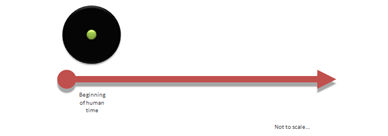
I viewed the world at the start of mankind as being mostly “The Unknown” with a small set of knowledge (e.g. how to make fire)…

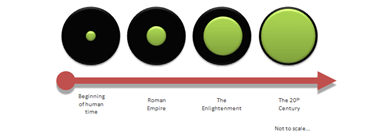
…and that over time through the application of the scientific method we’ve rapidly expanded on the amount we know.

The more we looked for spirituality in the world of the known, the more we failed to find it, and we were rapidly running out of “unknown” areas where spirituality could hide. Evidence of the existence of God was scarce. In fact, the data and experiments done by mankind over the last 2,000 years, and especially since Darwin, have pointed towards the improbability of the existence of the God I grew up with (and certainly in the concept the world was built in 7 days 6,000 years ago).

I came to believe during my time in college that we were rapidly expanding on our knowledge and removing places for God and Spirituality to hide, and that we were likely to prove that concepts of God, spirituality, Plato’s unmoved mover, and others were nothing but the biochemical rantings and ravings of a fit species trying to survive:

Support Group for Atheists

And I wasn’t alone in this belief – in college a belief in the non-existence of God was the most popular view point among my compatriots (agnostics were tolerated, but theists were ostracized). I believe among hard-science intellectual communities today, it remains the dominant belief due to three arguments:

  1. There has been a relentless increase in the things we’ve proven about the universe.
  2. During thousands of experiments, we have found no evidence that proves the existence of God.
  3. The culture of science, correctly, puts huge value on skepticism.

Therefore, it is PROBABLE that God and spirituality are purely concepts, invented by man, and any instantiations of either concept can be wholly explained via (eventually) knowable physical phenomenon. And anyone who says anything different, well, that’s “crazy talk.”

And it’s fun. It leads to wonderfully amusing things like the God FAQ, cute summaries of traditional theist arguments for the existence of God, and countless fun spoofs of people of Faith including one of my favorite, What Would Jesus Drive?

I’m a sarcastic person, and the opportunity to use these tools and logic to eviscerate the concepts I’d had forced upon me as a young man was too good to give up. And I became an ardent hard-core atheist, mocking any who tried to advance an alternate view of existence.

(…by the way, hard-core atheists are not quite as amusing, as Unitarian Jihadists…)

What’s Your Problem?

So now I had a philosophy to replace my concepts of order in the universe. What was the problem? My friend Sarah put it to me much better than I ever could write, so I quote:

“There has been a philosophical gap there, maybe since Spinoza. I think atheists and agnostics need a spiritual outlook as much as anyone else, but they have more difficulty finding it. (By “spiritual” here, I am referring to a sense of wonder, awe, or inspiration, and obviously not a belief in supernatural agents.) I find people like Bertrand Russell inspirational in the sense that they lived good lives despite a lack of belief, but atheist philosophers have a tendency to recommend calm stoicism in the face of the universe, rather than inspiration or awe. Stoicism is nice and all, but it doesn’t get you through the day.”

I gradually realized that pure atheism without any sense of spirituality “didn’t get me through the day.”

And just as importantly, I realized that my logic in arriving at hard atheism, the 100% confident belief in the non existence of a spiritual element to the Universe, was (and is) horribly flawed.

Why? Strangely (and likely to the dismay of Creationists) Darwin and a German gentleman named Heisenberg point the way.

(which I’ll continue next week…)

– Art

Help me raise over $10,000 to help people suffering from cancer

Nude Numbers (#7)

For reference, here’s last week’s data. Curious what this post is? Click here.

Summary

As mentioned earlier, I may have a stress fracture. This week continued my rehab with swimming and lifting. Weight control was better, but body fat remains higher than I’d like. The marathon and bike-ride plans are still in danger, but if the injury is a stress fracture (hopefully), I can be back on the training plan in about 3 weeks.

Subjective Data

  1. Leg feels a lot better after 12 days in the boot. I can now walk without limping, although I do feel dull pain as the day progresses. I’m wearing the boot on alternate days right now.
  2. I read the book Total Immersion, which tells me I have a lot more to learn about swimming. Still, I did (and enjoyed) the ‘yardage’ this week.
  3. My back was sore again on Sunday (heavy lifting day on Saturday) so I took it off (continuing to listen to my body).
  4. Weight is down with the restricted calorie targets I have, but body fat remains stubbornly high. I think I either need to cut more (which I don’t want to do) or accept my BF will remain around 16% until I can ramp up pool yardage or running mileage again.

Objective Data

Click here for a PDF version of my dashboard.

Assessment

Swimming continues, and I was able to get a lot more laps in this week. Towards the end of the week I concentrated more on form and drills than on doing laps, hence my Saturday lap numbers look low (they were alternated with lots of drills on balance).

Recovery is going well, and I’m still optimistic I’ll be back on the road to have a shot at the marathon. The bike ride is in September, and I’m not (maybe should be) too worried about it. It’s just 170 miles, and it’s spread over 2 and a half days.

Lifting was great this week, and I even worked leg drops and incline presses back in (although single-leg). Quick note in case you’re wondering: if you’re at a gym doing 45-degree single-leg incline-presses while wearing a boot on a fractured leg, some people will stop and chat with you and claim you’re “hard core.” Have to say, that was a first in my life J

My eating was good this week. I only cheated on one meal on Saturday (and it wasn’t even that big of a cheat). Still, while my weight went down, my BF stayed pretty constant. I admit this is more frustrating to me than I’d like, but I know I’m doing the right things so I’ll keep everything unchanged here for now.

As usual, if you have suggestions, leave a comment, or reach me at “art (at) abclarke.com”.

Plan

Basically more of the same:

  1. Continue rest, rest, resting the leg. I’m alternating days wearing the boot, and not walking much (taking the bus to and from work instead of my 2-mile walk).
  2. Keep swimming. I’m going to alternate drill days with yardage days to try to get some cardio workout (even if my form sucks).
  3. Keep doing the upper-body and core lifting, and keep with light leg work.
  4. Keep 2,000-2,250 calories-per-day target to keep weight under control.
  5. Keep smiling.

Presentation Notes

No changes to data presentation this week. As with last week, data is presented in SOAP Note format.

– Art

Help me raise over $10,000 to help people suffering from cancer

The Fattening of America

Obesity in America

I was being lazy this morning and ‘flicking‘ online when I ran across the following link detailing the progression of obesity in the US in the last 20 years.  Scary!!!

I would be interested to see that same data cross-referenced with rates of:

  1. Increase/decrease in portion sizes at restaurants and/or grocery stores.
  2. Advertising for food products and/or advertising for food products to kids.
  3. Price per calorie of food (broken down by restaurants vs. grocery stores).

Not to claim that we shouldn’t take responsibility for our own actions, but since I started measuring what I ate, I’ve discovered that calorie counts in restaurant food are way higher than I thought, and appear to have risen substantially over the last 20 years.  It makes sense since the marginal cost of serving more food is a small for a restaurant, yet popular with customers.

Even though I’m not obese, it’s generally a good idea for me to eat no more than half of any dish I’m served in a restaurant.