Category Archives: Transformation

Nude Numbers (#3)

Couple of changes to presentation this week. For reference, here’s last week’s data. As with last week, data is presented in SOAP Note format:

  1. I’ve added gray areas in the weekly graphs that show the target where the lines should be. I don’t have targets yet for bike and run, but hopefully will have them next week.

Subjective Data

  1. I really relaxed my eating this week (ate whatever I wanted) and my energy level was way higher. This is good, that said…
  2. I got very unrestricted later in the week, and averaged over 3,000 calories a day and body fat crept up slightly. I’m now in danger of missing my November 10-12% target, but…
  3. I used two other alternate measurements of body-fat this week. On the Tanita “Athlete” setting on my scale, I’m getting an 8% measurement. At the gym using the caliper method, I’m getting a 10% measurement. Lastly, using the “mirror” test, I’m happier with my overall fat composition, but my abs/core need work.
  4. My shoulder hampered me on my long ride on Sunday, so I cut it short from a 65-mile target to a 38-mile ride.

Objective Data

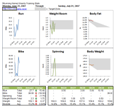
Click here for a PDF version of my dashboard.

Hit two personal bests this week. Longest run (Saturday): 10.18 miles. Fastest 4-mile run ever (Friday): 4 miles in 30’20” (with half-mile warm up and cool down).

Assessment

Well, couple of observations:

  1. Good: 2 personal bests! It appears that upping calories was a good call.
  2. Good: Back in weight room which was a miss last week, and abs / core are definitely getting stronger.
  3. Watch: Need to start watching calorie intake again, but increasing my target is the way to go.
  4. Bad: My shoulder injury from some weeks ago is still there. Not much I can do here except work on my core/abs to make sure I have good support during rides (keep shoulders relaxed), but this is an injury I’m just going to have to grit out.

Plan

  1. Put constraints back on eating, but up my calories officially from 2,000-2,250 range to 2,500-2,750 range.
  2. For now, keep body-fat at current level or below, and focus on training over body-fat for a few weeks to see if abs/core work gets me where I want anyway.
  3. Get copies of training plans so I can show targets for run and bike.

Less is More (2 of 5 Rules of Change)


(2 of 5 Rules)

Ok, I now knew what I was changing: I wasn’t eating healthily. In order to get back on track to 10-12% body fat by November 2007 I knew I had to change my eating habits. But how? I got lots of advice from the web, from folks I knew, and from folks in the gym. I quickly learned there is no shortage of answers to changing your eating habits to ensure you lose weight. I will summarize them here:

Exercise at least 5 times a week for 30 minutes a day. But don’t expend more than 3,000 calories a week exercising to avoid decreased physical benefits. Drink at least 8 cups of water a day, but don’t drink too much or you’ll die. Try to eliminate fats in your diet by eating lots of low-fat foods such as salads and vegetable pastas, but eliminate as many carbs from your diet as possible by increasing the amount of protein you eat, unless they are indigestible carbs in which case you should eat as much as you can, and whatever you do, eat lots of fat, not protein. Did I mention drink at least 16 cups of a water a day? Eat three times a day without snacking in between to ensure you can maintain a good weight, but if you must snack, make sure you’re eating whole grains, fruits, vegetables, nuts, seeds and low fat dairy products. This healthy snacking, provided you eat six times a day, is the best way to ensure you lose weight. And also, make sure you drink around 6 cups of water a day (although even that is probably higher than you need). Make sure you are consuming fewer calories than you’re expending per day. To do this, figure out how many calories you should eat a day, and then count how many calories you are actually eating, but strive to be an instinctive eater who doesn’t need to count calories. Don’t forget to use chia seed. And of course drink at least 1-2 gallons of water a day.

If you follow this simple weight loss plan, you will curl up in a ball, hold your knees to your chest, and start rocking back and forth while you cry. The resulting loss of appetite and energy expended from rocking will help you lose over 170 pounds in 30 days!

Oy! With all the conflicting information (some of it good, some not), it’s tough to figure out what to actually do. And this is typical of any time you want to change something: your choices (both good and bad) for what to do next are virtually limitless. How do I pick?

Easy! Less is More!

Newton Knew a Thing or Two about Rocks

Everything resists change. The first part of Newton’s 1st law, “An object at rest will remain at rest”, applies equally well to large rocks as it does to teams that need to change, or parts about yourself that you try to change. You may not like how your body looks, and you may not like how you and your team operate, but it’s easier to bitch about it than it is to change anything. Rocks like to stay exactly where they are.

But the second part of the 1st law applies equally well. “An object in motion will remain in motion”. If you can get the rock to move, it’s hard to stop it moving.

So the key to change is getting your rock moving, even if only a little.

That’s where “Less is More” comes in: Do one small, easy thing that will cause a quick change. Make sure the change is visible to the people who matter. And only do that one thing!

You don’t pick the hardest thing. You don’t pick the thing with the biggest bang. You don’t try to do multiple things at once. You don’t try to revolutionize the world. You don’t try to fix all the problems. You don’t go for a curve-jumping, paradigm-shifting, knock-your-socks-off grand-slam home-run touchdown of a transformation. You don’t try to put in place an invisible architecture that will yield billions of dollars in savings in 4 years.

No! You pick the easiest way that will move your rock a little and you don’t let anything else distract from that.

Then, as Newton’s 1st law states, your rock is moving and will keep moving with much less effort. Pretty soon, if you keep making the next easiest change, the rock you thought would never move is destroying everything in its way as it barrels towards its destination.

Invisible Change Isn’t Real

That’s why when I start a new job I always make sure that I’ve made a small but very visible change within 100 days (some folks have heard me obsess about “the first 100 days” before – this is why). I obsess about it. I make sure my team knows we need to do that one thing. Sometimes I make people meet every single day to keep the pressure high. And I make sure it happens because I know the following things happen with change:

  • If you make one small but visible (to all stakeholders) change, your team members start to believe more change is possible (which is a self fulfilling prophecy), your supporters feel better about their decision to put you in that job (which makes it easier to make more changes), and your doubters start to feel scared and get out of the way (which make it way easier to make another change). And then you make another slightly larger change, but because of the first success, this one is just as easy. And soon, your rock is moving very quickly.
  • If you make a change quickly, but the targets of the change cannot see it, then their initial optimism wears off quickly: your team starts to lose faith, your supporters question their own decision to support you, and your doubters pounce on their prey. And your rock stops moving.
  • If you try to make a visible change, but it’s going to take a long time, then each day it gets harder to try and push the very large rock, your mental and emotional muscles get fatigued, your team starts to get tired, your supporters look for faster fixes, and your doubters pounce on their prey. And your rock never moves!

You Are Your Most Important Audience Member

If you’re trying to change something about yourself, like your weight, it should be obvious from the above that you are the most important person who needs to see a visible change quickly. If you don’t, your heart will quickly lose confidence, and, no matter how much your brain prods, you’ll revert back to old behavior.

But it’s just as important when you’re trying to change a team or organization. The change you make needs to be visible to you, more importantly than anyone else. If you lose faith, then everyone loses faith. And the best way to keep the faith is by seeing the miracle of actual change. Don’t forget to look for the change!

One Small Step For Art

So allow me to repeat: Less is More: Do only one thing, keep it simple, keep it visible, and make sure you’d have to be a moron to fail at this one change!

For losing weight, I picked one thing that (a) I could easily do and (b) I was pretty sure would quickly tell me it if worked or not.

As I mentioned last week, I had already been writing down what I was eating in a journal. The small change I decided to make was more quantitatively count what I was eating. That’s it. I found a (very useful) site called Calorie King that contains almost every food you can think of and gives you back the calorie count for free, and just started putting numbers into a spreadsheet based on what that site told me. I’d seen many times at work that just measuring something would cause people to change their behavior to optimize the metric: my theory was if I saw more accurate numbers for what I eat, my behavior would start to change, and I’d see a quick reduction in weight. Sure enough – soon I started to realize that the morning muffin would cost me over 400 calories, but the 2 bananas would be about 200. And I ate the bananas.

(Now I’ll be the first to admit, that my small step isn’t necessarily what someone else would pick, but that’s beside the point. I picked something I knew would work for me. We’re each different, and have different ways of doing things. I’ve seen people succeed with picking the small step of sending back half of every order they get in a restaurant. Pick what works for you, but make sure it’s something easy for you and visible to you.)

The results:

I started doing this on April 10th (167.2 lbs, 18.3% body fat). By April 24th I was down to 162.8 pounds and 17.5% body fat.

Close to 4 pounds and almost 1% body fat lost in 2 weeks. Hell yes, I was on to something.

But how do I keep it going? Rule #3: Evolution, Not Revolution.

(which I’ll continue next week …)

– Art

Help me raise over $5,000 to help people suffering from cancer
Nude Numbers (#2)

Couple of changes to presentation this week. For reference, here’s last week’s data. As with last week, data is presented in SOAP Note format:

  1. I changed the graphs to break out the weekly trends into individual graphs. Some people found combining hours and miles in prior graphs confusing.
  2. I link to a PDF. Some folks found last week’s graphs unreadable on their computers. If anyone knows how to export from Excel to a visual format that works nicely embedded in a blog post, please let me know.
  3. Next week (hopefully) I’ll be adding targets in so I can quickly see how I’m tracking against plan. I’m awaiting electronic copies of the training plans for that.

Subjective Data

  1. I definitely didn’t feel as hungry this week, and my energy level remained high throughout the week. That said I feel that I grazed like a pig J
  2. I switched from Monday to Wednesday for my “day off”.
  3. I spoke with the Team Continuum coaches, and they advised me to back off on running distance for a bit (I want to peak on running in November, not September), so I substituted a spinning class for my pacing run (usually about 5 miles), and our long run was only 6.8 miles this week.
  4. Some unexpected activities (a memorial service) and some laziness (I slept in Tuesday morning) kept me out of the weight room.

Objective Data

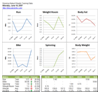
Click here for a PDF version of my dashboard.

Assessment

Well, couple of observations:

  1. Good: My running mileage is down as advised by trainers, but still on track for training plan. All my runs were strong this week, and I was able to speed up significantly for all splits.
  2. Good: I did get back on the bike, and got a good 56 mile ride in on Sunday.
  3. Watch: Increasing calories was a good idea, but I overdid it on the weekend and as a result weight starts to creep up. It appears that body fat is still going down though which is the goal. I’ll watch this closely this week, and if weight goes up but body-fat down, I’ll keep the calories where they are.
  4. Bad: I skipped weight room sessions on Tuesday and Saturday. That’ll be a focus this week.

Plan

  1. Watch calorie vs. weight intake again, but energy level was good so it seems like a good change.
  2. Get back in the weight room. I’m trying to hit about 2 to 2.5 hours a week in the room.
  3. Get copies of training plans so I can show targets.

Know What You’re Changing (1 of 5 Rules of Change)


(1 of 5 Rules)

In September of last year, I set my goal of getting to 10-12% body fat by November 2007. At the time, I was at about 20% body fat and it seemed reasonable (less than 1% per month). I had started working out again, and I knew I wasn’t an unhealthy eater. How hard could it be? My plan was simple:

  1. Continue working out, increasing the intensity to maintain the weight loss.
  2. Continue eating sensibly.

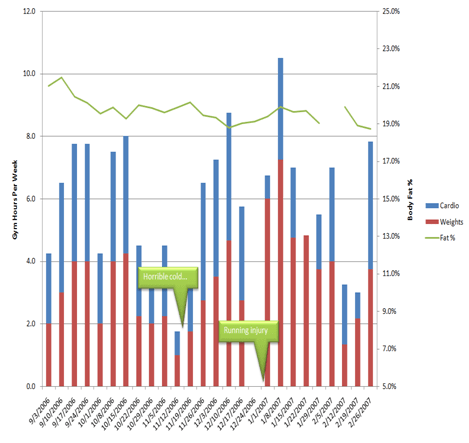
Well, it turns out losing weight is not easy (I now know that millions of people already know this). Take a look at the data from September through February and you’ll see what I mean:

The bars represent hours spent working out (blue is cardio, red is weight training). The green line is body-fat %.

If you look at the green (Fat %) line, I had some success early lowering body fat, but I plateau in December, and then start rising up again in January and February. To make matters worse, I kept getting injured, feeling weak, going up and down in energy levels. What the hell was going wrong!

In retrospect, it’s simple. I’d forgotten the first rule of change management: Know What You’re Changing.

“I Think” is the Enemy of “I Know”

When we’ve decided (or been assigned) to change something we’re often rearing to get going. Be it a professional or personal goal, “we think we know” what’s wrong, and we think we know the best way to achieve the goal. And we’ve failed before we started, because “we think we know” but we don’t actually know.

As with why Doctors Use Soap, when we’re excited about something (and hence emotionally involved) we tend to rely upon the subjective view rather than both subjective and objective information.

For example, above I wrote “I wasn’t an unhealthy eater”. Really? Well, I thought I wasn’t an unhealthy eater, but I didn’t know that.

How Do You “Know”?

So, how do you know? In a professional setting, you do three things:

  1. Write down how things work today.
  2. Identify the stakeholders involved in how things work today.
  3. Have them review what you’ve written down, and iterate until they agree that it accurately reflects what’s done today.

That’s it. You don’t try to change anything. All you want to do is get agreement on the state of the world today. Writing it down doesn’t need to be formal. A napkin can suffice, a whiteboard, a one page document, whatever. As long as someone else can hold it and read it without you around.

Amazing things happen when you write it down and review it with the people who are impacted. You discover hidden steps you didn’t know existed. You find people who you thought were involved that don’t actually matter, and people you thought don’t matter who are intimately involved. You find hidden bottlenecks and easy solutions you didn’t know about. And yet, so many people skip this step.

Knowledge is Humbling

OK, so it took me 5 months, but eventually I realized I’d made the stupid mistake of not first knowing what I was changing. I felt particularly chagrined because I’d often chastised folks on my teams for making this very basic mistake. Starting in February, I decided to change this. First, I started writing down what I ate. I did that for about 3 weeks. Here’s a quick sample:

Date

Time

Dish

Quantity

02/12/07

8:00 AM

Cream of wheat

1.5 cups

02/12/07

11:00 AM

Bananas

2.0

02/12/07

1:00 PM

Ham, cheese, MLT on roll

1 large

02/12/07

2:00 PM

Popcorn

2 cups

02/12/07

6:00 PM

Granola bar

1.0

02/12/07

7:45 PM

Ravioli & broccoli

1/2 package + 6 florets

02/13/07

5:15 AM

Bananas

2.0

02/13/07

7:45 AM

Granola + 1 banana

1 cups + 1 banana

02/13/07

10:30 AM

Raisins

1 box

02/13/07

11:30 AM

Bananas

1.0

02/13/07

12:30 PM

Chinese food

Wonton Soup, + Peanut Chicken + Rice + Fortune Cookie

02/13/07

4:00 PM

Granola bar

1.0

02/13/07

6:15 PM

Granola bar

1.0

02/13/07

8:00 PM

left over indian food

1/2 naan, 1 c rice, sauce & lamb

It was nothing too formal, just quick notes and estimates of what I was eating.

Next, I identified the stakeholders. There were two: me and J (I now know that if you try to lose weight without the support of your partner, it’s a losing game).

Lastly, we looked at the data and between the two of us we realized that I eat healthy until I get to a big meal. Then I gorge myself. It isn’t exactly clear from the notes above, but the sandwiches, Chinese food and Indian food above were huge meals – easily enough for two meals. The reality is I was a part-time healthy eater with spurts of unhealthy binge-eating thrown in.

So, know “I knew” I wasn’t a healthy eater. I also “knew” I was over exercising (because I had data that showed that).

Armed with knowledge not just opinions, I had to move to the next step: Less is More.

(which I’ll continue next week …)

– Art

Help me raise over $5,000 to help people suffering from cancer
5 Rules of Change

For years I have advocated 5 steps for managing change in a professional setting. They are:

  1. Know what you’re changing.
  2. Less is more.
  3. Evolution, not revolution.
  4. Round wheels work.
  5. Iterate, iterate, iterate.

I believe if you follow these steps, you maximize your chances of being successful in any change endeavor (this is not the only path to success, just the one with the best odds). In the next series of articles I’ll talk about how I’m trying to apply them personally right now, and whether or not they work as well when I put my money where my mouth is.

As with all of these, your mileage will vary. I’d also love to hear from other folks other things that work to help them change things in their lives.