Category Archives: Uncategorized

A Plea for Purple Voters

Demographics, Democracy and the Blues

Here’s a map of the US with population density graphed in the z-axis (from Time magazine):
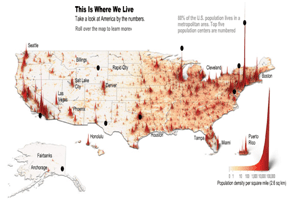
And here’s how people voted in the 2004 presidential election with number of winning votes by county graphed in the z-axis:

The more densely populated the area, the more likely they were to vote democratic in the 2004 election.

Another view can be seen below. In this one, the color scale changes between red and blue in each county. If a county voted 100% Democrat, it’s blue. If it voted 100% Republic, it’s red. If a county voted 50% Democrat and 50% Republican, it’s purple. Again, higher density areas tended to vote democratic in the 2004 election.

The Color Purple

I have two theories about why the pictures look the way they do.

The first theory is that living each day in close proximity to lots of people (with competing interests), where you can’t possibly get to know them each personally, forces people to compromise more on a daily basis than those who have the luxury of knowing all their neighbors. This tends to encourage social-liberalism (or social laissez-faire) where you agree to stay out of someone’s business with the expectation that they in turn stay out of your business. For example it’s very easy to be rapidly pro-gun (a position generally correlated with social conservatism in the US) if you personally know and trust each and every one of your neighbors. It’s much harder if you don’t know everyone you see every day. This causes most highly dense urban areas to vote Democratic (the large party in America more associated with social liberalism).

My second theory is that if you live in a highly dense area that is also highly culturally diverse, you are forced to interact with people with opposing points of view, and are likely to be more accepted if you have less extreme views. For example, it’s very easy to be rapidly pro-choice and believe that late-term abortions need to remain legal (to avoid “a slippery slope” where abortion eventually becomes illegal) if you live in Berkeley, CA (an extremely homogenous liberal enclave) where everyone takes pro-choice for granted. Try being rabidly pro-choice in a multi-ethnic neighborhood in the Bronx, NY, see the moral pain on a very religious Muslim’s or Christian’s face at the prospect of a late term abortion, and it’s much harder to maintain the extreme. This forces dense urban areas with heterogeneous populations to be more trend more bluish-purple than pure blue.

Perhaps the key to moving elections and candidates back to the middle in the 2008 election is to relocate all the people who live either in sparsely populated areas of the country or in culturally homogenous areas to a densely packed 100 square mile area of the country (I hear Billings, Montana has space). If we did that I suspect all the graphs above would get much more bluish-purple and we’d end up with candidates who are much more reasonable than the current set of Democratic and Republican candidates (who are all veering to the far left and far right).

Spending Purple Money

But we’re not likely to relocate everyone with extreme views to live next to each other (I am firmly against forced relocations of anyone, although I’d love to see Al Franken and Bill O’Reilly share an apartment). However, there is one thing I believe we can do to move American back to the middle ground.

If you are a Purple Voter, always vote in every primary election! Especially the small ones.

For example, New York has a (very unpublicized) local primary election on Tuesday. I’ll be voting in it. I consider myself (currently) a socially liberal, fiscally conservative, internationalist. In other words, I’m a bluish-purple voter, and I’ll vote for candidates as close to that as possible.

You might not think it matters, but the people we vote for in primaries are very influential. They choose the rosters of candidates that we’re presented with for many higher offices. They form the staff of national campaigns. They are listened to by the national parties when drafting policies, candidates and platforms.

Somehow in America many purple voters (like me) believe that if the candidate they voted for didn’t win then their vote didn’t count. And often in primary elections today, the middle ground (purple) candidate loses. But our votes do matter; politics, like business, runs on a market economy. Only in politics, votes are the currency. The mere fact that someone got our vote will cause other politicians to veer in our direction to try to woo us the next time we spend our vote (see how John Kerry veered left in 2004 to try to recapture the voters that went for Nader in 2000).

Purple voters have become convinced that our voting dollars are worthless, and therefore we don’t spend them in the elections where they are actually worth the most – small local primaries.

As a result, purple voters don’t vote in primaries, right and left extremists do. Then our low-level politicians run to the edge of the political spectrums and they nominate candidates for higher offices who also pander to the edges. And that’s how we get the crap national candidates and crap policies they spout (all but one Republican presidential candidate views the Theory of Evolution as suspect; all but one Democratic presidential candidate is firmly against the concept of free-trade). What do we expect? The politicians, like good businessmen, are responding to the market that spends money!

If middle-ground people are consistent about spending our purple money and voting in primaries, the local candidates will eventually notice us voting, and they will start having to pander more to the middle. This will lead to more purple candidates for higher offices. And as the map above shows, America is a lot more purple than red or blue, so if we consistently vote purple in all primaries, we will take back this country.

– Art

Help me raise money for people suffering from cancer

The Wrong Way to Run Naked

This is somewhat timely given the essay I’m in the middle of. A Catholic Priest was arrested last week in Frederick, Colorado in the US for running naked at a high school track.

See the full article here: Priest Busted For Running Naked.

In case anyone is wondering, this is not how I recommend “Running Naked“.

– Art

Help me raise over $10,000 to help people suffering from cancer


Get Thee Behind Me Jesus!

(1 of 5 in the Pragmatic Path to Agnosticism)

There are Jews?

I came to the US from Ireland when I was fourteen and went to a public high school in Florida. There were a few unusual qualities about my school: I could take Hebrew as a foreign language; I got all the Jewish holidays off; and a lot of my fellow students were Jewish. To most readers this won’t seem too strange.

To me, well, it was shocking. I didn’t think Jews still existed!

It wasn’t that I didn’t know about Jews. In Ireland I’d learned a lot about them: God chose them as his people. He guided them to the Promised Land. They eventually fell out of a state of grace with God, which required God to send his only son Jesus to save them and mankind. They rejected Jesus and crucified him. And then they disappeared from history.

OK, one exception: one Jew appears again in the 1500’s in Venice where he lends 3,000 ducats in exchange for a pound of human flesh (which, when adjusted for inflation, is one of the worst deals in the history of the butchering profession)(1). But that was it. They were never heard of or talked about again.

None of my Irish teachers ever explicitly said that the Jews died out, but I assumed they did(2). Yet here was a school full of people my age who not only claimed to be Jewish but, counter to what I thought Jews would be like, were the same as me except they had different holidays with unpronounceable names.

Maybe I had not gotten the full picture of the world so far?

Muslims Too?

Over the next few years several more cracks appeared in the sheltered picture I had painted of the world. My best friends were either Jewish or protestant. And they were good people. I struggled with the concept that, to my understanding of Catholic doctrine, my protestant friends were condemned to external damnation (Jews got special dispensation in the doctrine, and instead went to Limbo where they served as babysitters for all eternity to unbaptized Catholic babies(3)). For a God that advocated love to all mankind, this seemed a little odd.

Confused, I spoke to my priest about it. Fr. Black (an amazing priest by the way) acknowledged the conflict, told me I should discover with God how best to interpret the doctrine and suggested I pray to ask Him for understanding. I did pray, a lot, and during my prayers came up with the idea to seek out more knowledge about different religions.

So I enrolled at a local community college in some comparative religion courses. I learned a little about Islam, Hinduism, Jainism, Buddhism and others. I started buying books on my own to learn more about them. I became a sponge and immersed myself in whatever spiritual resources a seventeen year old can find. I even read Zen and the Art of Motorcycle Maintenance because I thought it had something to do with Buddhism (not really, but on the other hand I still recommend The Tao of Pooh).

One interaction from that period ate at away at me– in the last class I took, an Islamic student pointed out that in her understanding of Islam, non-Muslims could not enjoy the same rewards in heaven as Muslims.

The concept of Protestants being condemned to hell had unsettled me, but hadn’t forced me to break with the church; I think mainly because in Irish Catholic teachings the Protestant faiths were consistently represented as the oppressor, and a turning away from the true Faith. My instinct at the time was that Protestants probably didn’t deserve to go to Heaven. Plus few Protestant faiths, especially the Church of England which I was most familiar with, was so draconian as to damn all other faiths. But Islam, I knew nothing about, had few preconceptions, and yet here I found out that not only did Catholicism damn Islam; Islam essentially damned Catholicism (although not quite as dramatically).

Mutual Exclusivity, a Loving God and Yiddish

It was this contradiction that led to my deciding to reject Catholicism. Why? Because I couldn’t reconcile this logical conflict: Muslims believe they worship the one true God, and that other faiths are inferior. Catholics believe they worship the one true God, and other faiths are inferior. Both faiths profess that God is all merciful and loving. And yet, if you both religions are right, then the other religion must be wrong. It’s the classic liar’s paradox. It was inconceivable to me that a God who loved mankind, created mankind in his own image, watched over mankind, and one day would redeem mankind, actually had decided that all mankind was damned. (Why this logical inconsistency in doctrine is the one that tripped me up, versus countless others like the concept of the Trinity, I don’t know.)

In the words of my new friends: Oy vey!

I was confused and I was angry. I felt I was wronged. Between the logical inconsistencies, the things I felt had been hidden from me (like the fact that people who follow other religions are often loving good people), and the fact that I personally had never heard from my anthropomorphic God, I felt I had to do something.

So I lashed out by doing something I’ve often done when I have trouble coping: I broke completely, cold turkey, with the thing I couldn’t grasp – the concepts of God and Faith that I’d grown up with. (Which led to “Jesus Cathy, We’re Raising Heathens!”).

Nature Abhors a Vacuum

And looking back on it, well, nothing new here really. It’s a text book example of a teenager rebelling against his parents, and trying to make his own mark in the world. You could probably mad-lib a blog entry on it (I know I did…).

What I hadn’t appreciated at the time was, while I had rejected God (with a big ‘G’) and Papal authority, it left a part of me unfilled and incomplete. Simultaneously I went off to college, where a new Faith awaited to fill the hole left by Catholicism. Not only that, it was a cool, awesome, shiny, exciting new Faith that was sure to upset my parents even more!

(which I’ll continue next week…)

– Art

Help me raise over $10,000 to help people suffering from cancer

(1) I had to study “The Merchant of Venice” in Ireland for my Junior Certificate in Ireland.

(2) As a side note, certainly no one ever mentioned that 6 million Jews had been murdered in World War II — my experience of Irish history was completely silent on this point. Some have opined that this was out of a collective guilt the Irish felt about being neutral in World War II. Possibly. Also likely is that in the limited time available to teach history to children the Irish education authorities focused on national issues to create a cohesive national story that would create and inflame the passions necessary to maintain an independent nation. Regardless, it’s inexcusable. But before Americans erupt in outrage, I point out that each culture selectively culls and teaches the history they want. For example, very few Americans are aware the US spent several decades occupying countries in Latin America (in particular Nicaragua) mainly to protect the economic interests of the Chiquita Banana Corporation (then called United Fruit Company) but this is heavily taught by countries that want to view the US as a potential adversary. Countries teach what they want their kids to think as adults, not necessarily the complete truth on any subject.

(3) This is not completely accurate. Catholic doctrine teaches that people who do not accept Jesus Christ into their hearts through baptism go to Hell. Two big theological problems show up with this though. One is what happens for people who are too young (the unborn and babies) who die before they can be baptized; does a just, loving and merciful God condemn these innocents (Augustine thought so)? The other is what happened with people like Moses, obviously good people who enjoyed God’s love, but who lived before Jesus was born and hence could not have accepted him into their hearts? To solve these two issues, Catholic doctrine (over centuries) evolved two concepts for something called Limbo. One, the Limbo of Infants was a place (separate from hell, heaven or purgatory) where infants went when they died because (still suffering from Original Sin) they were ineligible for heaven (this concept has recently been dismissed by the Catholic church, and replaced with a concept of “I don’t know, but seriously, would God do that… (see section 1261)?)” The second concept, the Limbo of the Patriarchs, was a place that existed where people like Moses and other Jewish prophets, people who existed before the life of Jesus and hence could not have accepted him into their hearts, went when they died. Then, when Jesus was resurrected, the Limbo of the Patriarchs was emptied and all the Patriarchs ascended to heaven with Jesus. In the catechisms I was taught growing up, these two concepts were often intermixed, and I developed the (incorrect) understanding that both Limbos were the same, and the Jews hung out with all these infants essentially providing free babysitting services.

The Pragmatic Path to Agnosticism

The Fortune Teller’s Curse

I grew up very Catholic. Some people in the US went to Catholic school; I went to Catholic country. I was an altar-boy for 6 years. I prayed to God every day. Some people took my resemblance to my cousin Owen, a local priest, and my piety as a sign that I was the boy of my generation destined to serve the Church.

When I was seventeen I decided, with the aplomb and attitude only a seventeen-year-old can muster, to reject the Catholic Church and the concept of God. It was the first major decision I made as an adult and, though I dreaded telling my parents of it, I felt it was an important part of adulthood to take a stand and fight for it.

Of course when fighting for a stand I wasn’t against stacking the odds in my favor. I decided to tell my parents independently to avoid their ability to gang-up on me. I knew it would be traumatic for them: Both are strict Catholics, with my mother bordering on the fervent side in her beliefs. And I knew it would be, to put it mildly, unpleasant for me to break the news to them in parallel.

My conversation with my father went as I expected: he grew very cross, told me I didn’t know what I was doing, and stormed out of the room yelling to my mother, “Jesus Cathy! We’re raising heathens!”

However, my “coming out” to my mother did not go to plan. She listened patiently to my arguments. She stayed calm as I told her I would no longer go to mass; no longer pray to God; no longer worry about the salvation of Jesus Christ. She just waited. And when I was done, when no more words could come out, she just touched my arm and said:

“I’m glad you’re having doubts Andrew. When I was your age, I had doubts too. It only made my faith stronger in the end.”

It was the scariest thing anyone has ever said to me. Not just the words, but the confidence in her voice, the surety in her eyes. As though she could clearly look into the future and pluck out my path. I was stunned. And she just left the room. We never talked about it again.

But here I am, almost seventeen years later, and I still fear she will end up being right.

The Spirit of Running Naked

I spoke a while ago about trying to change myself, in mind, body, soul and spirit. The last few posts focused almost exclusively on the body aspect. The next few will focus on the spirit.

To those who find metaphysical-struggles and theological-bullshit boring and not interesting, I apologize in advance, and will return to more concrete topics later. But for the remaining two people (you know who you are) who might find this interesting, the next series of posts will outline how I’m trying to improve my spirit and what that means to me. I will write about why I rejected Catholicism, how I came across and embraced the religion of atheism, some of the problems that emerged for me with atheism over the past ten years, how I’ve now come to now reject strong atheism, and explain how I’ve ended up accepting the concept of spirituality and exploring what that means in my life.

As with the 5 Rules of Change, this will be a multi-part essay that I’ll post one per week over the next few weeks. Or if you prefer to wait for the entire thing, come back to this page in 6 weeks and I will have updated the links below. Stay tuned:

  1. Get Thee Behind Me Jesus!
  2. The Shiny Ball of Atheism.
  3. Survival of the Holiest.
  4. The Fundamentalist Atheist.
  5. Rise of the Pragmatic Agnostic.

How I Lost 25 Pounds by Being a Manager

5 Rules of Change

In July of 2006 I weighed around 185 lbs, about 25% of which was pure fat. I wasn’t happy about that and some other things, so I set a goal to get to 10-12% body fat and run the NY marathon in November 2007. To do this, I’ve been applying approaches I’ve used as a professional manager, and to myself.

Specifically, I’ve always believed in 5 Rules of Change whenever I’ve tried to change teams and organizations. Here are those rules, with the posts explaining the detailed thoughts behind them, and how they’ve been helping me lose weight and change my life:

The Rules

The Summary

How I’ve Used The Rule To Lose Fat

Know What You’re Changing

Understand and measure what you want to change.

I measure body fat and weight every day, and post results each week to this blog.

Less Is More

Make the easiest change you can, but make sure it’s a visible change to you.

I first started counting calories I ate, without a target level of calories, because I knew just counting would make me think about what I ate.

Evolution not Revolution

Try to make a small change to how things work today, rather than change the world overnight.

The first small change I made was set a calorie target (in addition to counting).

Round Wheels Work

Look for people who have similar goals to you, and do what they do

Based on success stories I could find, I then started eating 6 times a day, drinking more water, etc.

Iterate, Iterate, Iterate

Continually make small but risky changes; don’t be afraid of failure – failure can guarantee success with the right mindset.

I look at my measurements each week, and adjust something (add more exercise, increase calories, rest, etc.) if I’m not hitting my targets

Results So Far

I could give you lots of colorful charts, but I won’t. (See the Nude Numbers posts if you actually want numbers.) Instead, some people asked for photos to track progress.

Well, here’s a “before” photo I posted a few weeks ago…

…and here’s me at a family reunion 3 weeks ago

185lbs @23-25% BF versus 160lbs @ 15-16% BF. Not exactly a butterfly and still some way to go for the goal, but heading in the right direction I think.

Closing Thoughts

My point is I do believe in the methods I’ve outlined over the past few weeks. They have worked for me professionally and now they’re working for me personally.

Hopefully you’ve enjoyed reading this series of posts. I know there are many ways to change, and this just happens to be mine (and I can’t claim it’s rocket science or that I succeed at it all the time). I’d love to hear from anyone out there who has tried changing aspects of their lives (either with different methods, or these methods).

Part of what I’m trying to do on Running Naked with changing how I run my life is to become a better person through sharing my experiences and learning from the experiences of others. Your feedback is invaluable to me in that.

Thank you for your time,

– Art

Help me raise over $10,000 to help people suffering from cancer