Category Archives: Transformation

Nude Numbers 33

Nude Numbers are my weekly progress reports on my fitness goals. See About Running Naked for the philosophies involved.

Summary

Week 11 of the winter plan. The plan was to do a week of heavy lifting, and it was harder than expected; I had to cut out almost everything else to finish the week. Still, it looks like I’ll easily hit at least one of my three winter goals (my strength gain goal).

Subjective Data

I was better about eating this week, and I’m back to gaining weight again. Of course, some of it is going to the abdomen area, but I have some room to spare still for my target.

The plan was for a very heavy lifting week – 90% of max. This turned out to be more exhausting than I expected and I found myself cutting back on all other activities as a result. I ended the week very tired, with an especially exhausted back, but I had a lot of fun max-ing out in the weight room.

Objective Data

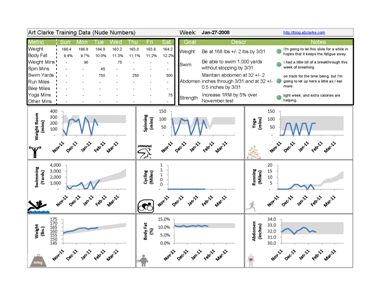
Blue lines == actuals; Gray areas == my target range for that week.

Assessment

I concentrated on lifting this week as I planned, but it was even harder than expected. As a result, I didn’t get the swimming, spinning, running or yoga done to plan. But that said, I listened to my body and it was clear I shouldn’t push harder.

It became apparent by the end of the week that, even though I’m in week 10 of a 30 week lifting plan, I’ve made a lot of strength gains already. Hitting my 5% increase goal for March looks too easy.

Lastly, I did get one longish (500 yards) swim in on Thursday, and that goal (1,000 yards without stopping by 3/31) looks hard.

Plan

This week is a 40% of max lifting week, so I plan to concentrate much more on the cardio and swimming. I’m going to try doing a short swim on lifting days to increase my comfort in the water. Other than that, I’m going to keep with the heavy diet (so I’ll go even more out of target weight range) for a few more weeks and will try to be “all in the gray” next week..

Reminders

I’m still undecided between running a marathon in New York (November 2) or in Dublin Ireland (October 27). If you’re interested in running either with me, let me know. I’m not going to decide until around April. Also, if anyone is interested in doing the Philly Triathlon (June 21) with me, you’re welcome to join the team!

Presentation Notes

These notes are always presented in SOAP Note format. Click here for all the Nude Numbers posts.

Thanks for reading.

– Art

Nude Numbers 32

Nude Numbers are my weekly progress reports on my fitness goals. See About Running Naked for the philosophies involved.

Summary

Week 10 of the winter plan and, despite a minor cold, I’m still broadly on track.

Subjective Data

I continued to increase calories this week, although I found it harder than I expected. I’ve trained myself to not eat unless I’m hungry, and to eat small meals, wait 10 minutes, and then only eat if I still feel hungry. To hit 3,000+ a day calories I have to eat even when I’m not hungry. I did ok, but most days I only ate around 2,500 to 2,750 calories. It’s amazing how much of a habit light eating has become for me.

This week my swimming improved quite a bit. I’ve been getting aerobically exhausted really quickly while swimming, but on Thursday my coach watched me and suggested I try something odd – not expelling water in my mouth by blowing out. Instead, he said just leave my mouth open when I turn my head under water. Voila, the water just flows out, and I don’t waste oxygen expelling it. For some reason, this really seemed to help me control my breathing and increase the # of laps I need to take before resting.

On Thursday afternoon I finally caught a cold my wife had been incubating for a week. Getting the cold was annoying, but I was good and rested through it. That meant no Thursday run, no lifting on Friday, and no spin class on Saturday. I did sneak in a swim Saturday afternoon that I probably should have cut out, but I wanted to see if the breathing technique I found on Thursday still worked. The answer is yes 🙂

Objective Data

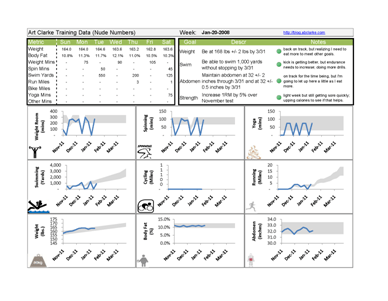
Blue lines == actuals; Gray areas == my target range for that week.

Assessment

This week, despite the cold, was another good week. And the cold symptoms were pretty mild and they’re gone now. I still feel broadly on track, and feel excited that my swimming is markedly better now.

Plan

I made a few adjustments to the plan moving forward this week. Next week is a HEAVY lifting week, and so I’m going to cut back on spinning during that week to focus on lifting instead. I’m going to try to do 5 lifting days of 45-minute sessions instead of 3 days of 90 minute sessions. I also pushed my running ramp-up out another 3 weeks; I don’t need to really ramp running until after March to be able to do the 10k tri-distance easily, and I have enough things going on right now between this and work to keep me more than busy. But apart from that, just another week to try to forge ahead with gaining weight, gaining strength, and increasing swimming endurance (i.e. the winter goals).

Reminders

I’m still undecided between running a marathon in New York (November 2) or in Dublin Ireland (October 27). If you’re interested in running either with me, let me know. I’m not going to decide until around April. Also, if anyone is interested in doing the Philly Triathlon (June 21) with me, you’re welcome to join the team!

Presentation Notes

These notes are always presented in SOAP Note format. Click here for all the Nude Numbers posts.

Thanks for reading.

– Art

Staying Sane: Lead, Don’t Manage

(5e of 5 in The Rules of Naked Management)

Trying to stay sane as a manager? This is the final step in doing that. Warning: there is some profanity in this article.

The Shit

I’ve worked with some pretty smart people(1), and when thinking about this article one of them consistently came to mind.

This person, whom I’ll call Todd(2), was an extremely smart engineer. Not only that, Todd had a lot of personal integrity, had strong opinions he could persuasively argue about, could persevere through a lot, and could be, when times demanded it, quite charming. Todd had all the right talents for getting shit done, and so should have risen up high in the organization.

But he didn’t – instead the organization shat all over him!

He had risen to a mid-management level, but he wasn’t able to rise higher. And, he wanted to. He made clear to me many times how he desired to be seen as a leader by his peers, be given a title that reflected his leadership, and be afforded the respect that his clear talents warranted.

Yet constantly, the organization blocked him; his management would not give him the title and leadership position he knew he deserved. What’s worse, his prestige seemed to be waning. When hard problems came up, senior management turned more often to one of Todd’s co-workers, a guy named Bill(3). Bill’s opinion was solicited by others when making strategic decision, whereas Todd found he had to force himself into strategic conversations. Bill was approached for fun new projects first, whereas Todd had to explicitly ask to be involved. (Now, Todd had been at the company for a long time and so, given his seniority, was able to force his involvement, but he knew he was doing the forcing.)

Eventually Todd had enough of this shit and decided to leave that company to try his talents elsewhere.

Why Lead?

Which brings me to the topics I have for this final essay: why you should aspire to lead; and how to become a leader.

Todd wanted to be a leader, and it was easy to understand why. If an organization sees you as a leader, your ability to get shit done increases exponentially.

Why?

If you’re just managing people, you’re trying to convince them to do things they probably don’t want to do. But, if you’re leading people, they do what you need them to do because they want to do it.

The difference is night and day. When you’re leading, people go above and beyond what you ask them to do because they want to impress you and they don’t want to disappoint you. You spend less time having to track how others spend time, and you start getting almost double out of your team.

I’ve managed teams where I was just seen as a manager, and it was hard work and not fun. I felt I had to constantly watch over people’s shoulders to make sure things were on track. I had an upset stomach almost the entire time.

But I’ve also managed teams where people saw me as a leader, and wow, did we get a lot more shit done together then. And it was more fun to boot – I looked forward to coming to work, and felt a lot healthier as a result.

If you’re the type of person who likes to get shit done, who wouldn’t want to be a leader?

So given that, how do you become a leader?

How to Lead

That’s easy; it’s the simplest rule of all the Rules of Naked Management:

Stop aspiring to be a leader! Instead, start getting shit done.

Todd constantly talked about what a great leader he’d make. He made his case to lots of people by letting them know all the great stuff he would get done. And had he actually done the stuff he was talking about, the entire engineering organization would have followed him to the moon. But people didn’t follow him because frankly people don’t like to follow people just because they’re told to by titles, or positions, or reputations(4). Instead they aligned around Bill because Bill didn’t worry about being perceived as a leader; Bill worried about getting shit done, constantly got new shit done, and kept challenging himself to get even more shit done. And as a result people followed him.

Think about all the leaders you’ve followed in your career, and you’ll probably notice the common theme: none of them worry most about being seen as a leader; they worry about getting lots of different shit done. (Oh yes, sometimes they have to be seen as a leader to get some goals accomplished, but it’s the goals that are obviously motivating them, not the leadership position.)

And then ask yourself why you considered that person a leader?

  • Was it because they asked you to follow them and you agreed because you were asked? Nope
  • Was it because they demanded you respect them? Absolutely not.
  • Was it because he or she was a nice guy? Probably not.
  • Was it because other people saw them as a leader? Probably not.
  • Was it because you felt this person could get the right shit done consistently? Absolutely.

So, right now if you think you want to be seen as a leader, SHUT THE FUCK UP!

Instead, focus on getting shit done! And be warned, once you start getting shit done, you’ll find that people will start asking for you to help, will start asking you to weigh on important issues, and will start following you.

Constantly get more and different shit done, and one day without even realizing it, someone will point out you’re a leader.

Getting Shit Done

And Getting the Right Shit Done is what this series of articles has been about. And, almost four months after I started what I thought was going to be a 4-week set of articles, this series is now done. Hopefully some of the techniques work for you.

I’d write more, but I’ve got a bunch of shit I need to be doing for Vlideshow right now, so I’m going back to that. By the way, if you happen to be a Flex & ActionScript or Flash & Actionscript genius and want to work at a cool company, drop me a line at aclarke at vlideshow.com.

By the way, next week I start a new series of articles. I don’t know what they’re about yet, so feel free to send me suggestions 🙂

– Art

(1) I like to be the person on any team who brings down the “smartness” average.

(2) Not his real name.

(3) Also not his real name.

(4) In a funny twist, all the members of the senior management team told me separately that they would love to give Todd the title he wanted, but first they wanted to see him do the job without the title for six months.

Nude Numbers 31

Nude Numbers are my weekly progress reports on my fitness goals. See About Running Naked for the philosophies involved.

Summary

Week 9 of the winter plan. Coming off a rest week things were a lot harder than I expected. But mid-week I decided to increase how much I ate and then things got much much better. Looks like it’s back to big-eating again.

Subjective Data

After the week off last week, and the fact that this was a light-ish lifting week (50% of my 1-rep max weight), I expected things to be easy. But starting off on Monday, my first day back, I found the lifting to be exhausting. By Wednesday it was clear I hadn’t recovered as much as I thought. So I tried something wacky; I increased how much I was eating.

As you can see from the weight data, my weight had been stabilizing and actually decreasing. But with the intensity of my current program, I was wearing down quickly. So I upped to about a 3,000 calorie diet on Wednesday and Thursday. On Friday my lifting session was awesome – I got all the lifts done, spent almost 2 hours at the gym, and only left because I had a salsa-dancing event I had to go to that night. And Saturday, I absolutely rocked all over my spin and short-run.

Lastly, I didn’t get as many swimming drills as I wanted to get in on Saturday due to a little sleep-in, but salsa was fun so that was worth it.

Objective Data

Blue lines == actuals; Gray areas == my target range for that week.

Assessment

With the exception of swimming, I hit all my goals for the week. But only because I decided it was time to eat more.

I think the moral of this week was I need to prioritize my goals and allow some constraint to relax; and that constraint is going to be my diet.

My big goals are to by March 31st: gain weight to 168; swim 1,000 yards without stopping; and keep my waist in check. For now, I’m going to relax the last constraint, and figure I’ll cut-calories after March if things get out of control.

Plan

This week is an even lower lifting week: 40% of my 1-rep maximum weight, and the week after is a hard 90% week. I’m going to continue the basic plan, keep my spinning workouts light (not too heavy on the climbing), and increase my calories to gear up my body for the 90% week. Hopefully I’ll end up next Sunday less tired than I feel right now, and ready to rock all over a 90% week (yikes).

Reminders

I’m still undecided between running a marathon in New York (November) or in Dublin Ireland. If you’re interested in running either with me, let me know. I’m not going to decide until around April. Also, if anyone is interested in doing the Philly Triathlon (June) with me, you’re welcome to join the team!

Presentation Notes

These notes are always presented in SOAP Note format. Click here for all the Nude Numbers posts.

Thanks for reading.

– Art

Staying Sane: Kill Some Puppies

(5d of 5 in The Rules of Naked Management)

Trying to stay sane as a manager? This is the third step in doing that.

Back on the Farm

I grew up on a farm in Ireland where at one time or another we raised cows, chickens, rabbits, turkeys, peacocks, goats and pigs. Every one of those was a cash crop, and while it cost us money to feed them, my father knew that ultimately we’d sell them at market for a profit so it was worth the short term cost.

But we also had dogs, and while arguably the dogs could assist in hunting, the truth is we kept them purely for companionship.

When I was about 8 my father got a puppy(1) for each of his four children. But no one in our backwoods part of Ireland could afford to pay a vet to neuter dogs. As a result, by the time I was eleven, we had 22 dogs on the farm(2). You couldn’t move in the farmyard without stepping on one of them.

To someone not familiar with living on a farm, this might even seem cute. But on a farm that every year struggled to make a profit (and therefore feed our family), these dogs presented a real problem: every day they drank an entire barrel of milk, and given our farm only produced 30 barrels a day, they were consuming over 3% of our dairy output. In good years, my father would only eke a small profit from his farm, so literally these dogs were threatening to eat us out of house and home.

Something had to be done. The question was what? We couldn’t give away the dogs; there were already too many dogs on farms in Ireland. In reality there were only three options:

Feed all the puppies

Certainly the best short term option for the dogs, but bad in the long term for them. If the farm went out of business, then all the dogs would starve and die. Not good.

Starve all the puppies

This would potentially keep the farm profitable and therefore in a position to starve the dogs for a long time, but would ultimately lead to sickly dogs spreading disease everywhere. Not good.

Kill some puppies

A horrible thought, but for the surviving dogs, it meant sufficient food, and for the farm it meant survival as well.

Ultimately there was no choice, and so my father, against the cries of all his sons, made the only rational choice.

He killed some puppies(3).

Managing a Puppy Farm

So, what does this have to do with staying sane as a manager? Last week I talked about how to do less more, but pointed out it would require you to not do some things that are on your list of responsibilities.

But in a management context, it’s hard to say no.

A former VP at Tellme explained it like this to me: every day you come to work and you have 10 different things you have to do but can only get 8 done. It’s like you have 10 puppies, all looking up at you with their big eyes, and begging to be fed. And the reality is you only have enough food for 8. What do you do?

In order to stay sane you need to do the same responsible thing my father did; you need to kill some puppies. Why is that?

Well, let’s look at the same three options again:

Feed all the puppies

You could increase the amount of time you work so that you can spend time with all your tasks. This will work in the short term, but you’ll exhaust yourself very quickly and this can lead to burnout, which ends up hurting all the things you work on. Not a good option.

Starve all the puppies

You could spend a little time on each task, but not as much as necessary to do a good job. But, you’ll find pretty quickly that that will results in things getting half done or worse, and you’ll feel pressured to spend more time fixing problems that came about because you didn’t do it right the first time. Not a good option.

Kill some puppies

This means you decide not to do some things, and you tell people in advance. In the short term they are disappointed, but they adapt quickly, and soon you find you can spend more time on the things that matter. In other words, short-term pain but long-term effectiveness.

The only rational choice is to either feed a puppy, or kill the puppy, but never starve the puppy. In other words, either fully work on a task or problem, or don’t work on it. But don’t ever try to half-do it. Again, this idea isn’t unique to me (IBM’s management team used the expression “feed a monkey or shoot a monkey, but never starve a monkey”).

Assuming I’ve convinced you that you need to NOT DO some tasks, then the question becomes how do you not do something when you have lots of puppy owners yelling at you to feed their puppies. Here’s the ways that have worked for me.

Know Your Puppy Owners

The first trick here is to know your puppy owners. Make sure you’ve build strong relationships with any decision makers who are going to depend on you, outside the context of just your job responsibilities. If you’re given a big project that they depend on, take them to lunch first and get to know them as individuals before you have to tell them no. Find out about their families, and their lives. Share information about yourself. Get to know them as a person, and help them understand that you are a human being too – not just a resource in another team.

You can’t always tell when you get a project that you’ll need to reprioritize it later, so always invest in getting to know the people upfront. Ultimately if you need to reschedule or renegotiate a deliverable, it’s much easier if you actually like your counterpart and he or she likes you.

As a side note, don’t try to build a relationship in anticipation of saying no. In other words, if you already know you’re going to tell that person no, but don’t have a relationship yet, it’s too late to try building one. Instead, you need to recruit other supporters who have relationships with that decision-maker, and you have to fall back on the other options here.

Find Three Ways to Kill a Puppy

Sometimes you can tell people no directly, but in business that’s often not an option. So instead, fall back on this rule. Never say “no” directly; instead present your decision maker with at least three solutions they can choose from to move forward. This rule was explained to me as follows:

One is an ultimatum; two is a dilemma; three are options!

When you have to renege on a commitment, don’t just tell the person who you have to disappoint “no”. That raises their defenses and gets into a pissing match. Instead before you say no, think from their perspective (which is why you should know your puppy owner first) and try to figure out at least three different options you could offer them. Sure, they won’t be as good as had you gotten what they wanted done, but if you’re disappointing a higher-up decision maker, but you present them with three options to move forward, your discussion will center around your options (so you’re controlling the fall out) and the higher-up will usually appreciate the effort you made to think of solutions(5).

Good executives know that the unexpected happens and that some things don’t get done the way they were planned, but reward their managers to think through solutions to get around the unexpected.

Never Kill a Puppy by Surprise

Peter Drucker said:

Never give your manager a bad surprise. And there is no such thing as a good surprise.

This dictum is a great thing to remember when dealing with your own manager, but it especially applies to saying no. Never inform someone that a deliverable or project was missed after the fact. If you do, you will lose their trust very quickly (you didn’t even give them an ultimatum). This means keep good track of who you owe what to (I use the task list I talked about last week) and every day, figure out who you’re going to disappoint.

People don’t like to get bad news, but they really appreciate it when given the news with enough time that they can react to it.

Kill Puppies in Public

This last rule is extremely important. Assuming you’ve informed all affected decision makers, given them their options, and guided them to agree to a solution, you must make sure to publically let folks know the puppy is dead.

Why is this? During renegotiations to “kill a puppy” your stakeholders will usually agree to an option; that’s because they are in crisis mode. Hard decisions get made when folks are in crisis mode.

But once they feel the crisis has passed, there is a very human tendency to fall back on the way things were. That might include their assuming “oh, Art couldn’t do it this one time, but he’ll get it done the next time.” As a result you may find your puppy coming back to life over and over again.

To minimize the chance of this happening, document the decision and communicate widely that the puppy is dead. If a project just got killed, e-mail out the decision in a short e-mail to all the project teams and stakeholders. If you’ve just agreed to divest some responsibilities and some other team agreed to take them, announce it at the largest meeting you can find, and take questions with your other stakeholders there. Once you’ve publically declared something dead, and your stakeholders have not objected in public (and how can they since they just agreed to the same thing in private) it becomes much more difficult for them to back out of their agreement.

Of all the rules for killing puppies, this one is most often ignored, and yet it’s probably most important. Like the rest of the principles of transparency that apply to Naked Management, transparency in killing puppies makes you even more effective.

Finally

But here’s the truth. If you do the things I suggest to stay sane – love thyself; do less more; and kill some puppies – your life will become more livable and you will become a better manager. But you won’t become a great manager. That’s because there is one last thing you need to do, and that’s “lead, don’t manage.” Which is the last (finally) rant in this series of rants, and I’ll talk about it next week.

– Art

(1) This story is actually mostly true, with one slight detail switch. In reality, we had 22 cats, not dogs. But I’m changed the story to puppies, because when I learned this analogy for the management principle from a former VP at Tellme (now working here) her expression was “killing puppies.” By the way, I’m confident she didn’t mean this definition of “killing puppies.”

(2) It appears that Irish dogs (well, cats) are Catholic.

(3) As I mentioned above, the actual events happened with cats, not dogs. And technically my dad didn’t kill them; instead he gave them all away to a factory that produced pig food. Now, before you get too appalled let me explain. He thought he’d have to kill a couple of them because no one usually would adopt 18+ cats, but when discussing it over beers with a friend who owned the pig factory his friend suggested a solution: The pig farm had a big problem with rats eating all their pig food and my dad’s friend realized that feeding the cats milk, if they took care of the rats, would cost him less than the lost food. In this case, a good solution was found at the last moment, but the fact is my dad had to get rid of the cats. As a manager, you also need to get rid of the puppies or kittens you can’t feed. (4)

(4) OK, funny (and still true) story here. Two years later the pig factory owner convinced another farmer to give him about 5 extra dogs he had. Why? Well, it turns out our cats had figured out that there was an easier way to get fed than catch rats all day; the cats just started eating the pig food. Instead of killing the cats, the farmer decided to get dogs to chase them away. I don’t know what happened after that, but I wouldn’t be surprised if the dogs started eating the food and the factory-owner got a horse to chase the dogs away. In a way, the pig farmer was just like the old lady who swallowed a fly.

(5) By the way, be open to fourth and fifth options that become apparent as you discuss things with the decision maker. By already bringing 3 to the table, the decision maker will often use their powers to come up with options that are even better for both of you.