Category Archives: Processes

Nude Numbers (#16)

For reference, here’s last week’s data. Curious what this post is about? I’m tracking my training progress for the New York Marathon. Click here for why.

Summary

And just like that, I go from a “long shot” to a likely “no shot” on the NYC Marathon. Read on for why.

Subjective Data

I took longer than expected to recover from last Sunday’s run – the bottom and sides of my foot continues to be sore from the tendonitis. I decided not to run all week except for my long-run (target of 15-18 miles) on Saturday. I substituted some swimming and spinning instead, coupled with rest for my right foot. My weight training was good but also relaxed. I thought I was actually doing a good job of trying to recover.

Alas, on Saturday’s run, the pain started on mile 2, and by mile 7, with sharp pain shooting through my entire right leg every time I stepped, it was apparent I was seriously hurting myself by running further. I spent the rest of Saturday with my leg getting progressively sorer and even had to wear crutches on Saturday and Sunday before my leg could bear weight again. As I write this, I’m back to wearing a restraining boot on my foot and being on an ibuprofen diet. I’m not sure, but I think that’s a bad sign.

Objective Data

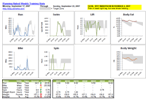
Click here for a PDF version of my dashboard.

Assessment

Time to be honest with myself: The marathon has gone from a long-shot to a “likely” no-shot.

Why do I use the word “likely”? Well…

Plan

Thanks to all of you and Team Continuum, I have the option of declaring my intention to withdraw and get a guaranteed spot in next year’s marathon. If I do elect that option, I will train for and attempt this again next year (without the fundraising again).

The deal is (a) if I meet my minimum funding commitment (which thanks to y’all we blew that target out of the water), and (b) I declare my intention to withdraw by either October 19th or October 24th (I’m still in discussions on this), then I get a spot next year. In the interest of laziness, specifically not making a decision before I need to, I’m not going to withdraw until the latest moment I can.

So between now and then I’m not going to run at all in the hope that 4 weeks of rest will work wonders. I’m not hopeful, and I’d love your thoughts on what to do. Please add comments or e-mail me between now and October 19th, and I’ll make my decision then.

So, complete change in plan, while I await the October 19th (or 24th) deadline:

  1. Stop running. Period. End of sentence.
  2. Re-start swimming this week assuming my leg has trouble bearing weight. If my leg feels 100% better, I’ll consider spinning at the end of the week (I know that biking doesn’t aggravate the injury given that I was able to do 180 miles on my leg with no pain).
  3. Keep weight training on the same plan for now, but I’ll be mixing that up soon (I’ll figure that out next week).
  4. My weight gain plans were successful, almost too successful, so I’m cutting back now. I went from 152 (my low) to 163-165 (relative high today), so I plan to cut back down to around 156-157 pounds, and then add weight again. I’m starting to track calories closely again, and hope to get back to around 156 within 5 weeks, which happens to be the week of the 6-Pack Charity Challenge
    J
  5. Keep smiling because, well, what else can I do.

Presentation Notes

No changes to data presentation this week. As with last week, data is presented in SOAP Note format.

– Art

Help me raise money for people suffering from cancer

The Most Important Thing a Manager Does

(1 of 5 in The Rules of Naked Management)

Lies about Management

Last week I asked:

What’s the most important thing a manager does? Sure, a manager has to “get stuff done through a group of people”, that’s a given, but what’s really the most important thing? Is it training your team? It is hiring A+ people? Is it keeping executives informed? Is it growing your employees’ careers? It is protecting your team from the “craziness above”? Is it removing roadblocks for your team? Is it keeping morale high? ….

Depending upon the month of the management-advice fad calendar, each of the above items is the “most important thing” a manager needs to do. You can find books extolling all of them as paramount. And it goes through phases as magazines like Harvard Business Review gush over the need for better communication, or the need for morale-management.

But want to know something… it’s all lies.

The most important thing a manager does is almost never hiring A+ people; it’s almost never keeping executives informed; it’s almost never “protecting the team”.

The most important thing a manager does is the thing I glossed over: figure out the right stuff to do, and then get it done through a group of people.

Keep reading, and I’ll tell you how to do that.

A Tale of Two Managers

Is “figuring out the right stuff to do” the most important thing? It’s easy to prove by comparing two managers.

The first manager, let’s call him Bob, hires A+ people, is amazing at keeping executives informed, and works hard on growing his employees’ careers. His team really feels that Bob has their back, and that he’ll do anything to help them grow. But Bob never really thinks about what his team’s job is supposed to be, and as a result, while they do stuff, they don’t get the right things done.

The second manager, let’s call her Alice, doesn’t particularly shoot for A+ people, doesn’t do a great job informing her management, has poor people skills, micromanages everything, and her people hate working for her. But Alice drives a tough shop, knows what her team is supposed to do, and viciously makes sure it gets done.(1)

What happens in this scenario? Bob is either let go (the good, but rare solution) or left to languish in middle-management (the bad, but usual result). Alice meanwhile is promoted until she is no longer effective at getting the right stuff done, and then is either demoted (the good, but rare situation) or left to languish in senior-management.

Put another way: Executives talk about the need to hire A+ people and keep morale high but reward getting the right stuff done even if done with D people who hate their jobs.

So if you don’t take the time to figure out the right thing to do, or then you don’t make sure you get that thing done, you’re not going to get rewarded.

Why Don’t We Do It?

Therefore the most important thing a manager does is figure out the right stuff to do because if you don’t do that, how can you know you’re doing the right thing (I’ll talk later about how to get the right stuff done). Reading this you probably think “well duh, of course.” Really? If that’s the case, why don’t people do it?

I’ve worked for managers who, while great people, could never tell me what our team did and did not do. They couldn’t tell me why we were a team at all, instead of just part of some other team. I’ve worked for Bobs and I’ve worked for Alices. Sound familiar?

If you’re a manager reading this right now, can you articulate in 10 seconds what your team does? Can you articulate in 10 seconds what your team does not do (I mean the things a reasonable person might assume you do, but you don’t)? If not, the good news is you’re like most middle managers. The bad news is you’re part Alice, part Bob, or part both.

In my first job as a manager, I couldn’t answer what my team was supposed to do. Eventually I did find the time to ask what “the right stuff to do” was, and I came to a startling conclusion: Having a team structured like mine actually got in the way of the company getting the right stuff done. The result: I proposed a different organization to my manager where my team was split up and reorganized to better get the right stuff done(2). And this was far better for me, my old team, my new team, and the company.

So why doesn’t every manager first figure out the right stuff to do? Well, it’s because we’re excited to start, we think we know what we’re changing, and we’re often wrong.

WHO, SARS, and Management

During the SARS epidemic in 2004 my wife attended a lecture given by someone at the World Health Organization (WHO). This particular lecture was about disaster and crisis management. Afterwards J (knowing I like to think about crisis management) asked me for my thoughts on the following scenario:

You are a local government mayor in Indonesia. You have read about SARS in the local paper but there are no cases in Indonesia. Suddenly you get a phone call from a local hospital where the head of the hospital informs you they have a patient who seems to have SARS-like symptoms. What’s the first thing you do?

There are lots of options. You could quarantine the hospital. You could quarantine the town. You could inform the local military to be on guard. You could immediately get on Television and Radio and warn people. You could…

And every one of those things is the wrong first thing to do(3). The right thing, according to the WHO, is to do the following:

  1. Sit back, breathe deeply, and think. Figure out how much time you have until you must act.
  2. Then, take time to listen to as many people as you can reasonably listen to within available time (which is always longer than it first appears).
  3. Then, sit back, breathe deeply, and think again.
  4. Then act!

Why is that? Because if you don’t think, your first step will likely make the situation worse, not better. But if you pause to think, you’ve done something rare in a crisis and started the path to recovery.

Your First Steps as a New Manager

I’m not saying that managing the SARS crisis is the same level of complexity as become a manager for the first time, but the first steps you take should be the same. In order to figure out the right stuff to do, you should do 4 things:

1) Think: Write down what you think your job is. Write down what you think your job isn’t. Write down what you think the first things you need to do are. Then stop and…

2) Listen: Talk to your new team, your boss, your bosses’ peers, your peers, etc. about what they think your job is. What do they think your job isn’t? It’ll be different than what you thought, and different than what you interviewed for (it always is). Don’t argue about it with them, just get their input and tell them you’ll get back to them soon with your plan.

3) Think: Now, go back to your list in step 1, think about all the feedback, and revise what you think your job is and the first things you’ll do. Don’t necessarily follow every instruction that people gave you — independently come to your own conclusions about what you should do – but do let their feedback influence your plans. Every time I do it I’m amazed. I always find the first things I thought I needed to do, are never the first things I actually need to do.

4) Act: And then act. The steps you just wrote down should tell you how to get the right stuff done. And sometimes, yes, it involves hiring A+ people, increasing morale, improving executive communication, but sometimes it doesn’t. Only do those things if it helps get the right stuff done. By first thinking about the right stuff to do, you make sure you focus on the ends, and not the means, and you’re free to choose whether this job actually requires.

The Truth about the Lies

If you’re a manager dealing with knowledge workers with inherently undefined jobs, in reality the things I dismissed above such as growing employees’ careers and hiring A+ people are means that often help you achieve your ends. But let me stress that by far the most important thing as a new manager you need to is, “figure out what you need to do”. Then, pick or don’t pick your means as necessary.

So, that said, the rest of this series will concentrate on a set of means that I find are very flexible for getting the right stuff done. They are the rules of Naked Management and are useful when:

  1. You have teams of highly skilled knowledge workers who
  2. You need to be effective over multiple projects not just a single project, and
  3. You expect will need to be resilient to constant change and chaos from the market and from other management shifts

If you’re a manager of a team like that then may I recommend Running Naked Teams!

(which I’ll continue next week…)

– Art

I’m running the NYC Marathon on November 4th for Team Continuum. Click here to donate.

(1) Some people will claim my examples of Bob and Alice are facetious because in reality it’s incredibly unlikely that Alice will be successful by shitting on her people. Wrong. It depends entirely on what “the right stuff to do is”. For example, if Alice and Bob’s job is “night shift manager at a fast food restaurant”, where high-turnover rates are the norm, and many aspects of the job are independently measured (and so don’t rely as much on the manager self reporting), then Alice will be quite successful at that job. And Bob will waste lots of energy trying to grow the careers of people who likely are going to quit in 40 day anyway. It depends on what “the right stuff to do” is.

(2) My team did get the stuff assigned to us done, mostly through good people, and a lot of micro managing. But the fact was we were getting stuff done in a completely different way than other client-facing groups in the company, and this was causing a lot of pain in every other part of the organization that had to do things in a centralized way. And this “pain” was showing up as tension on the floor, longer ship times, buggier launches, and projects going over budget.

(3) My guess was quarantine the hospital. Wrong. If you want to know why, e-mail me and I’ll tell you because I’m too lazy to write it in a footnote that no one reads. J
click here.
Nude Numbers (#15)

For reference, here’s last week’s data. Curious what this post is about? I’m tracking my training progress for the New York Marathon. Click here.

Summary

A week of good and bad news. On the good side, I got new shoes and now I can run much faster and further without the sharp pain. I got back into the gym, and ramped up my running mileage (actually ramped up a little too much). On the bad side, I got a bone scan and confirmed I have a stress fracture and some tendonitis in my right leg. That said, provided I try to not run every day and rest well between runs, coaches and doctors still think I have a chance at a (slightly painful but) safe marathon. 5 weeks to go.

Subjective Data

On Monday I figured out that if I run slowly (<11 min mile) I can avoid the pain for short distances (2-4 miles) so I started doing that. I also saw my ortho guy again, and got set up for a bone-scan to check for stress fractures.

On Wednesday I went to a running store, and bought new shoes. I did a test run on Wednesday, one on Friday, and then a long run on Sunday.

And in the new shoes, I found I could increase my speed (up to 8.5 min miles) without the pain occurring, which is a good sign.

That said…

Objective Data

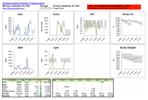
Click here for a PDF version of my dashboard.

The other piece of objective data to add is the results of my bone scan. The radiologist said he saw “nonspecific focal fusiform radionuclide activity in the distal right fibula suggestive of a stress fracture.” He didn’t see any problem with the bones in the bottom of my foot, which is good, but didn’t explain the sharp pain. However, switching shoes has made that pain go away.

Assessment

Buying a new pair of shoes was a god send. The sharp pain doesn’t show up now provided I keep good form and my speed slower than 8.5 minute miles. Awesome.

I did well sticking to last week’s plan, but ran a little more than I should have on Friday (I had a blast running with an old friend and let myself run too far). I moved my Saturday 10-mile run to Sunday to align better with some of my training partners, and that run was easy. That said I woke up this morning with a slight limp so I need to remember to ramp up slowly.

The confirmation of the stress fracture is bad news, but it’s not necessarily a marathon-killer. It just means I’ll need to do light training (try to get in 1 or 2 but no more long runs) and then try my best on November 4th. At this point I’ll be happy with finishing, really happy with less than 5 hours, and will probably kill myself if I shoot for less than four.

I kept weight room work and other activities to a minimum, and kept with my gaining weight plans.

Plan

Getting down to the final 5 weeks here. Here’s my plan for the week ahead. The basic theme is to keep cardio up through spinning and running, and save up for the long run on Saturday.

  1. Monday: Rest after 10 mile run on Sunday. Try to make the limp (pain in right heel) go away.
  2. Tuesday: Weight room and short run if pain isn’t there. If there is pain, skip the run.
  3. Wednesday: Weight room and 4-6 mile run.
  4. Thursday: Weight room, and swim.
  5. Friday: Weight room, and maybe a swim or spin.
  6. Saturday: 15 mile run.
  7. Sunday: Rest up.

Presentation Notes

No changes to data presentation this week. As with last week, data is presented in SOAP Note format.

– Art

Help me raise money for people suffering from cancer

The Rules of Naked Management

Pop Quiz

What’s the most important thing a manager does?

Sure, a manager has to “get stuff done through a group of people”, that’s a given, but what’s really the most important thing? Is it training your team? It is hiring A+ people? Is it keeping executives informed? Is it growing your employees’ careers? It is protecting your team from the “craziness above”? Is it removing roadblocks for your team? Is it keeping morale high? ….

The First Time Manager

The first time I became a manager I asked a lot of folks that question, and read a lot of books and articles. And I got all sorts of answers back. Every one of the items above was “the most important thing” I needed to do according to some sources.

I tried to follow a lot of the advice the first time out, without really understanding WHY I should follow it, and I’ll bluntly say I wasn’t successful at it.

Sure, the individuals who reported to me got all the stuff done my managers wanted done, but my victims employees had to put up with a lot of mistakes as I learned what being a manager was actually about. Certainly at no point did we have a team working to achieve the same goals. In reality I was just an individual contributor checking in on other individual contributors, playing at being a manager, and usually just getting in the way (see pigeon management). Two of my employees ended up quitting, and another (high performer) transferred to another group to avoid me.

In retrospect I realized it was because I didn’t have my own answer to what’s the most important thing a manager needs to do. So for my second big outing as a direct manager, I tried a different approach: I figured out what’s the most important thing I needed to do as a manager, and then I did that. I didn’t worry about any of the other crap unless it directly helped the most important thing.

And I got more successful.

So, what is that “most important thing”?

The Rules of Naked Management

Well, that’s what the next series of articles is about. Some folks have asked me to write a little more about the concept of naked teams, and how to be a first time manager, so here goes. In this series, I will talk about:

  1. The Most Important Thing A Manager Does;
  2. The Rules for Running Naked Teams;
  3. The Rules for Growing Naked Teams;
  4. The Rules for Growing Individuals;
  5. and The Rules for Keeping Your Sanity

My apologies to anyone who has been through this before, as this series of posts is based on some training programs I developed for first time managers. But if you’re a first time manager, think you want to manage people, or have been managed by someone and you wish would be a “naked manager”, then hopefully this series will be useful.

As usual, there’ll be at least one update per week.

The Rules for Rules

This series will be laid out in a series of rules, with reasons why the rules are the way they are. You’ll see there are quite a few rules to follow. To help guide you in how to follow the rules here’s the two most important rules.

If you take NOTHING else from this series of articles, just remember these two rules and you’ll be well served:

#1) Rules should be followed

I’m not claiming I came up with these rules myself. They are based on my experience (yes) which I’ve now reapplied successfully many times. But they are also based on studying at a lot of effective managers at companies I’ve worked at, and at effective people in other companies. They’ve been tested on thousands of employees. And in general they just work. If you see a rule, and you’re doing the opposite, you owe it to yourself to ask, “why am I not following this rule?” Usually you’ll find you become a better manager by following the rule.

Still think you shouldn’t be following the rules? Swallow your pride. Put your ego aside. Shut up and realize you’re no different than anyone else. Seriously! That “special circumstances” bullshit doesn’t fly here. You’re not really different. Follow the goddamn rules!

Still think you shouldn’t be following the rules, and you have “good reasons” why you shouldn’t? Well, enter rule #2:

#2) Rules must be broken

Management is an art, not a science. If we could break it down into a series of rules that are followed 100% of the time, then some smart person would write a computer program to be a manager and I for one would welcome our new management overlords.

But management is an art, and as with all art, requires judgment to be effective. If you’ve tried to follow rule #1 above, really put your ego aside, and still think you should not follow one of the rules, then break the rule. Truly great managers, like truly great artists, don’t follow the rules. However, like truly great artists, they KNOW the rules (e.g. Picasso learned classical painting first), KNOW when they break the rules, and KNOW how they break the rules.

Trust Yourself

Put another way, rules are no substitute for judgment, and over time you’ll find your own way through this mess. So please read and learn these rules, but ultimately you’re going to have to learn to trust your own judgment and discard the crap (mine included) that folks tell you about management if it doesn’t work for you.

I’m just sorry I had to experiment on Jim, Nolan, Craig, David, Aileen and Scott to figure that one out (sorry guys).

– Art

Help me raise money for people suffering from cancer

Nude Numbers (#12)

For reference, here’s last week’s data. Curious what this post is about? Click here

Summary

I may have reinjured myself slightly running, so I’m resting my leg just in case (yes Susan, you were right L ). My 200 mile bike ride starts this Friday so that’s the focus this week. Separately, given the consistent feedback on my CA trip that I was scary thin, I got professionally measured for body fat percentage this week. I’m actually around 9% body-fat when measured correctly. That means, my goal of 10-12% by November has been hit, and it’s time to start increasing calories and adding more muscle.

Speaking of goals, we passed $11,000 in fundraising this week. Thanks to everyone who has donated so far. You guys are awesome! But let’s keep going – anyone up for $15,000?

As promised J and I are matching the first $10,000 in donations with a $2,500 donation of our own.

Subjective Data

  1. Back to swimming and lifting after my rest week. My swimming form continues to improve. My lifting continues to be fun.
  2. The bad news is I did another run on Saturday, but wore the wrong pair of shoes (I have two pairs that look the same, one of which I meant to throw out). I appear to have bruised the top of my right foot, but hopefully that recovers in time for Friday’s ride.
  3. I was traveling in California for most of the week, and saw a lot of people I hadn’t seen in over a year. The consistent feedback I got was that I’m too thin.

Objective Data

Click here for a PDF version of my dashboard.

Assessment

Last week’s rest did me good, and most of my (non-leg) aches and pains are gone. I returned to the weight room as planned. Due to traveling in California, I didn’t get any bike rides in. My swimming was on track though, and my balance and kicking has improved a lot. My running is still problematic, and even though I ramped back to just 5 miles this week, I may have reinjured myself. We’ll see, but I’m staying off my feet until Friday (I’ll do a test ride on Wednesday to make sure my foot is ok). Friday is the start of my 200 mile ride to Providence, RI.

My trip to California was eye-opening. Everyone was shocked by how much weight I lost, and their perspective was valuable. J and I (and our NY friends) have seen the change gradually, so the shock value wasn’t as high for us, but I was at 155 this week from 185 when I left CA. Still, the comments of folks in California convinced me to get professionally measured for body-fat %, instead of relying on my scale. The result is I’m at 9% body fat, when my goal was 10-12% by November.

So I’m switching my diet to “maintain and gain” from “lose” mode. I’m starting to eat more, which means I need to make sure I do good work in the weight room to really take advantage of the extra calories. Nice to have the “feed bag” on again though J

This may mean I’m blowing my chances to win The Six Pack Charity Challenge, but I’m still optimistic.

As usual, if you have suggestions, leave a comment, or reach me at “art (at) abclarke.com”.

Plan

This week is all about making the ride to Providence. There is a slight chance I’ll be visible on the CBS Morning Show this Thursday morning (around 7-7:30am EST) if you want to see the group of us doing the Jack Brown Appeal ride (we’re doing a little PR to try to raise extra money). I’ll be riding with 40 British Cops for the appeal J

  1. Stay off leg until Friday except for test ride on Wednesday. Do 80 mile bike ride on Friday, 80 mile bike ride on Saturday, 40 mile bike ride on Sunday, and collapse as an exhausted heap on Sunday afternoon.
  2. Increase swimming to keep pressure off the leg.
  3. Increase calories to 2,875-3,125 calories a day. Keep lifting to take advantage of this.
  4. Keep smiling.

Presentation Notes

No changes to data presentation this week. As with last week, data is presented in SOAP Note format.

– Art

Help me raise money for people suffering from cancer