Monthly Archives: January 2008

Nude Numbers 31

Nude Numbers are my weekly progress reports on my fitness goals. See About Running Naked for the philosophies involved.

Summary

Week 9 of the winter plan. Coming off a rest week things were a lot harder than I expected. But mid-week I decided to increase how much I ate and then things got much much better. Looks like it’s back to big-eating again.

Subjective Data

After the week off last week, and the fact that this was a light-ish lifting week (50% of my 1-rep max weight), I expected things to be easy. But starting off on Monday, my first day back, I found the lifting to be exhausting. By Wednesday it was clear I hadn’t recovered as much as I thought. So I tried something wacky; I increased how much I was eating.

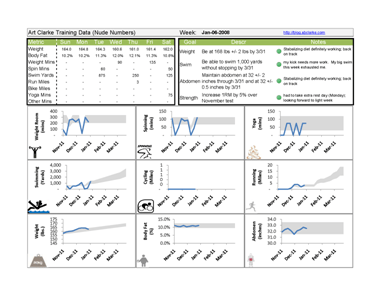
As you can see from the weight data, my weight had been stabilizing and actually decreasing. But with the intensity of my current program, I was wearing down quickly. So I upped to about a 3,000 calorie diet on Wednesday and Thursday. On Friday my lifting session was awesome – I got all the lifts done, spent almost 2 hours at the gym, and only left because I had a salsa-dancing event I had to go to that night. And Saturday, I absolutely rocked all over my spin and short-run.

Lastly, I didn’t get as many swimming drills as I wanted to get in on Saturday due to a little sleep-in, but salsa was fun so that was worth it.

Objective Data

Blue lines == actuals; Gray areas == my target range for that week.

Assessment

With the exception of swimming, I hit all my goals for the week. But only because I decided it was time to eat more.

I think the moral of this week was I need to prioritize my goals and allow some constraint to relax; and that constraint is going to be my diet.

My big goals are to by March 31st: gain weight to 168; swim 1,000 yards without stopping; and keep my waist in check. For now, I’m going to relax the last constraint, and figure I’ll cut-calories after March if things get out of control.

Plan

This week is an even lower lifting week: 40% of my 1-rep maximum weight, and the week after is a hard 90% week. I’m going to continue the basic plan, keep my spinning workouts light (not too heavy on the climbing), and increase my calories to gear up my body for the 90% week. Hopefully I’ll end up next Sunday less tired than I feel right now, and ready to rock all over a 90% week (yikes).

Reminders

I’m still undecided between running a marathon in New York (November) or in Dublin Ireland. If you’re interested in running either with me, let me know. I’m not going to decide until around April. Also, if anyone is interested in doing the Philly Triathlon (June) with me, you’re welcome to join the team!

Presentation Notes

These notes are always presented in SOAP Note format. Click here for all the Nude Numbers posts.

Thanks for reading.

– Art

Staying Sane: Kill Some Puppies

(5d of 5 in The Rules of Naked Management)

Trying to stay sane as a manager? This is the third step in doing that.

Back on the Farm

I grew up on a farm in Ireland where at one time or another we raised cows, chickens, rabbits, turkeys, peacocks, goats and pigs. Every one of those was a cash crop, and while it cost us money to feed them, my father knew that ultimately we’d sell them at market for a profit so it was worth the short term cost.

But we also had dogs, and while arguably the dogs could assist in hunting, the truth is we kept them purely for companionship.

When I was about 8 my father got a puppy(1) for each of his four children. But no one in our backwoods part of Ireland could afford to pay a vet to neuter dogs. As a result, by the time I was eleven, we had 22 dogs on the farm(2). You couldn’t move in the farmyard without stepping on one of them.

To someone not familiar with living on a farm, this might even seem cute. But on a farm that every year struggled to make a profit (and therefore feed our family), these dogs presented a real problem: every day they drank an entire barrel of milk, and given our farm only produced 30 barrels a day, they were consuming over 3% of our dairy output. In good years, my father would only eke a small profit from his farm, so literally these dogs were threatening to eat us out of house and home.

Something had to be done. The question was what? We couldn’t give away the dogs; there were already too many dogs on farms in Ireland. In reality there were only three options:

Feed all the puppies

Certainly the best short term option for the dogs, but bad in the long term for them. If the farm went out of business, then all the dogs would starve and die. Not good.

Starve all the puppies

This would potentially keep the farm profitable and therefore in a position to starve the dogs for a long time, but would ultimately lead to sickly dogs spreading disease everywhere. Not good.

Kill some puppies

A horrible thought, but for the surviving dogs, it meant sufficient food, and for the farm it meant survival as well.

Ultimately there was no choice, and so my father, against the cries of all his sons, made the only rational choice.

He killed some puppies(3).

Managing a Puppy Farm

So, what does this have to do with staying sane as a manager? Last week I talked about how to do less more, but pointed out it would require you to not do some things that are on your list of responsibilities.

But in a management context, it’s hard to say no.

A former VP at Tellme explained it like this to me: every day you come to work and you have 10 different things you have to do but can only get 8 done. It’s like you have 10 puppies, all looking up at you with their big eyes, and begging to be fed. And the reality is you only have enough food for 8. What do you do?

In order to stay sane you need to do the same responsible thing my father did; you need to kill some puppies. Why is that?

Well, let’s look at the same three options again:

Feed all the puppies

You could increase the amount of time you work so that you can spend time with all your tasks. This will work in the short term, but you’ll exhaust yourself very quickly and this can lead to burnout, which ends up hurting all the things you work on. Not a good option.

Starve all the puppies

You could spend a little time on each task, but not as much as necessary to do a good job. But, you’ll find pretty quickly that that will results in things getting half done or worse, and you’ll feel pressured to spend more time fixing problems that came about because you didn’t do it right the first time. Not a good option.

Kill some puppies

This means you decide not to do some things, and you tell people in advance. In the short term they are disappointed, but they adapt quickly, and soon you find you can spend more time on the things that matter. In other words, short-term pain but long-term effectiveness.

The only rational choice is to either feed a puppy, or kill the puppy, but never starve the puppy. In other words, either fully work on a task or problem, or don’t work on it. But don’t ever try to half-do it. Again, this idea isn’t unique to me (IBM’s management team used the expression “feed a monkey or shoot a monkey, but never starve a monkey”).

Assuming I’ve convinced you that you need to NOT DO some tasks, then the question becomes how do you not do something when you have lots of puppy owners yelling at you to feed their puppies. Here’s the ways that have worked for me.

Know Your Puppy Owners

The first trick here is to know your puppy owners. Make sure you’ve build strong relationships with any decision makers who are going to depend on you, outside the context of just your job responsibilities. If you’re given a big project that they depend on, take them to lunch first and get to know them as individuals before you have to tell them no. Find out about their families, and their lives. Share information about yourself. Get to know them as a person, and help them understand that you are a human being too – not just a resource in another team.

You can’t always tell when you get a project that you’ll need to reprioritize it later, so always invest in getting to know the people upfront. Ultimately if you need to reschedule or renegotiate a deliverable, it’s much easier if you actually like your counterpart and he or she likes you.

As a side note, don’t try to build a relationship in anticipation of saying no. In other words, if you already know you’re going to tell that person no, but don’t have a relationship yet, it’s too late to try building one. Instead, you need to recruit other supporters who have relationships with that decision-maker, and you have to fall back on the other options here.

Find Three Ways to Kill a Puppy

Sometimes you can tell people no directly, but in business that’s often not an option. So instead, fall back on this rule. Never say “no” directly; instead present your decision maker with at least three solutions they can choose from to move forward. This rule was explained to me as follows:

One is an ultimatum; two is a dilemma; three are options!

When you have to renege on a commitment, don’t just tell the person who you have to disappoint “no”. That raises their defenses and gets into a pissing match. Instead before you say no, think from their perspective (which is why you should know your puppy owner first) and try to figure out at least three different options you could offer them. Sure, they won’t be as good as had you gotten what they wanted done, but if you’re disappointing a higher-up decision maker, but you present them with three options to move forward, your discussion will center around your options (so you’re controlling the fall out) and the higher-up will usually appreciate the effort you made to think of solutions(5).

Good executives know that the unexpected happens and that some things don’t get done the way they were planned, but reward their managers to think through solutions to get around the unexpected.

Never Kill a Puppy by Surprise

Peter Drucker said:

Never give your manager a bad surprise. And there is no such thing as a good surprise.

This dictum is a great thing to remember when dealing with your own manager, but it especially applies to saying no. Never inform someone that a deliverable or project was missed after the fact. If you do, you will lose their trust very quickly (you didn’t even give them an ultimatum). This means keep good track of who you owe what to (I use the task list I talked about last week) and every day, figure out who you’re going to disappoint.

People don’t like to get bad news, but they really appreciate it when given the news with enough time that they can react to it.

Kill Puppies in Public

This last rule is extremely important. Assuming you’ve informed all affected decision makers, given them their options, and guided them to agree to a solution, you must make sure to publically let folks know the puppy is dead.

Why is this? During renegotiations to “kill a puppy” your stakeholders will usually agree to an option; that’s because they are in crisis mode. Hard decisions get made when folks are in crisis mode.

But once they feel the crisis has passed, there is a very human tendency to fall back on the way things were. That might include their assuming “oh, Art couldn’t do it this one time, but he’ll get it done the next time.” As a result you may find your puppy coming back to life over and over again.

To minimize the chance of this happening, document the decision and communicate widely that the puppy is dead. If a project just got killed, e-mail out the decision in a short e-mail to all the project teams and stakeholders. If you’ve just agreed to divest some responsibilities and some other team agreed to take them, announce it at the largest meeting you can find, and take questions with your other stakeholders there. Once you’ve publically declared something dead, and your stakeholders have not objected in public (and how can they since they just agreed to the same thing in private) it becomes much more difficult for them to back out of their agreement.

Of all the rules for killing puppies, this one is most often ignored, and yet it’s probably most important. Like the rest of the principles of transparency that apply to Naked Management, transparency in killing puppies makes you even more effective.

Finally

But here’s the truth. If you do the things I suggest to stay sanelove thyself; do less more; and kill some puppies – your life will become more livable and you will become a better manager. But you won’t become a great manager. That’s because there is one last thing you need to do, and that’s “lead, don’t manage.” Which is the last (finally) rant in this series of rants, and I’ll talk about it next week.

– Art

(1) This story is actually mostly true, with one slight detail switch. In reality, we had 22 cats, not dogs. But I’m changed the story to puppies, because when I learned this analogy for the management principle from a former VP at Tellme (now working here) her expression was “killing puppies.” By the way, I’m confident she didn’t mean this definition of “killing puppies.”

(2) It appears that Irish dogs (well, cats) are Catholic.

(3) As I mentioned above, the actual events happened with cats, not dogs. And technically my dad didn’t kill them; instead he gave them all away to a factory that produced pig food. Now, before you get too appalled let me explain. He thought he’d have to kill a couple of them because no one usually would adopt 18+ cats, but when discussing it over beers with a friend who owned the pig factory his friend suggested a solution: The pig farm had a big problem with rats eating all their pig food and my dad’s friend realized that feeding the cats milk, if they took care of the rats, would cost him less than the lost food. In this case, a good solution was found at the last moment, but the fact is my dad had to get rid of the cats. As a manager, you also need to get rid of the puppies or kittens you can’t feed. (4)

(4) OK, funny (and still true) story here. Two years later the pig factory owner convinced another farmer to give him about 5 extra dogs he had. Why? Well, it turns out our cats had figured out that there was an easier way to get fed than catch rats all day; the cats just started eating the pig food. Instead of killing the cats, the farmer decided to get dogs to chase them away. I don’t know what happened after that, but I wouldn’t be surprised if the dogs started eating the food and the factory-owner got a horse to chase the dogs away. In a way, the pig farmer was just like the old lady who swallowed a fly.

(5) By the way, be open to fourth and fifth options that become apparent as you discuss things with the decision maker. By already bringing 3 to the table, the decision maker will often use their powers to come up with options that are even better for both of you.
Nude Numbers 30


Nude Numbers are my weekly progress reports on my fitness goals. See About Running Naked for the philosophies involved.

Summary

Week 8 of the winter plan. Given some knee pain, and a general feeling of aches all over my body, I decided to take a week off working out. Read on for why.

Subjective Data

By last Sunday evening, my normal rest day, the pain in my knee was still there, and I felt aches all over. I was also feeling rather cranky and having some trouble sleeping for the days before then. Based on that, I made the call to take a week off training, since they’re all classic over-training symptoms.

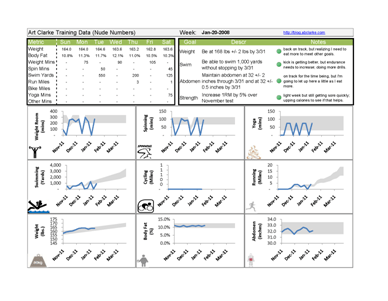
My eating stayed ok for the week, but because I wasn’t working out as much (but didn’t change the amount I ate) my weight as expected crept up a little.

Objective Data

Blue lines == actuals; Gray areas == my target range for that week.

Assessment

My plan from last week had been to take it easier so really I just modified it slightly.

But I really think I made the right call to cut out a week. Did I mention I’m trying to listen to my body more? (OK, admittedly it’s a little depressing to see all my blue lines above go to zero.)

At this stage, there is no pain in my knee, and most of the aches are gone. My right adductors and glutes are still a little sore though.

Plan

Now, I’m going to ramp back up slowly this week. That means light spinning (no climbs), 45-50% of resting-max lifting, and swimming drills. Basically what I said I’d do last week before I took the week off 🙂

My swimming plan is currently: Tuesday – long swim; Thursday – swim lesson; Saturday – Kicking drills.

The eating plan will continue for at least one more weeks, and then I’ll revisit to see if I should eat more to gain faster.

Reminders

I’m still undecided between running a marathon in New York (November) or in Dublin Ireland. If you’re interested in running either with me, let me know. I’m not going to decide until around April. Also, if anyone is interested in doing the Philly Triathlon (June) with me, you’re welcome to join the team!

Presentation Notes

These notes are always presented in SOAP Note format. Click here for all the Nude Numbers posts.

Thanks for reading.

– Art

Staying Sane: Do Less More

(5c of 5 in The Rules of Naked Management)

Trying to stay sane as a manager? This is the second step in doing that.

Why Do I Write This Blog?

It’s Friday at 6:30pm now, and as I write this I’m asking myself why. It takes time for me to this, time that would be spent on Vlideshow, time that could be spent at the gym, or time that could be spent having fun. It’d be so much easier to just punt this, and “do it next week”.

Heck, would it really matter if I didn’t write this at all? I mean it’s important to me in the long term as part of my philosophy of running naked(1), but it’s not really urgent. I think I’ll skip it this week.

The Trap

The reality is I have more things to do each day than I can possibly do in the time allotted, and several of those are urgent things. Today for example I had a meeting I agreed to take with another entrepreneur, I had a meeting scheduled with a recruit, I had some Flash coding (yes… I’m writing code these days) for my upcoming Vlideshow user test, a call with a business mentor, a meeting for a board I’m on, and a bunch of other things. And I had to write this blog entry. I was totally overcommitted today, and I knew it as soon as I got up.

I’ve mentioned it’s a trap; and it applies to the Entrepreneur as much as it does the manager. As you progress as a manager and get more successful, you’ll be asked to do more and harder things, but because they are harder things you’ll actually be able to effectively do less and less. The traditional answer is to delegate (less of an option for me these days), and while that’s necessary, it’s not sufficient. You’ll find that even after you’ve delegated all the things you can away, you still have more to do than is possible. You need to do more than just that.

The Answer

The answer is simple: don’t try to do everything. Do less. And the trick to that consists of two parts:

  1. Learn the difference between important and urgent tasks and concentrate on the important.
  2. Recognize you’re not going to get everything done, and choose the right things to not do.

Let’s talk about the first one of those parts.

Urgently Important

Urgent tasks demand attention. Urgent tasks are the person from finance yelling for your quarterly sales projections; Urgent tasks are your boss demanding you to fix a programming bug that is crashing your company’s website; Urgent tasks are the instant-message window that just popped up from a friend asking where you want to go for dinner tonight. Urgent tasks are the e-mail from a development manager asking you to read a 12-page product presentation they have and give them feedback in 2-hours before their meeting with the CEO. They are the things that if you don’t respond in the moment, someone gets upset.

Important tasks are the things that if you don’t do will eventually result in you failing in your goal.

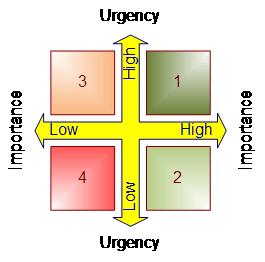
But, it’s worth noting that not all tasks are urgent, and not all tasks are important. Some tasks are urgent but not important (e.g. responding about dinner). Others are important but not urgent (e.g. for me, writing this blog entry). Broadly you can categorize any tasks you have based on how important and how urgent they are and figure out which of the following categorizes it belongs in:

The trick do “Doing Less More” is simple. Each day:

  • Do all the tasks in box 1 that must be done;
  • Do at least one task in box 2;
  • Try to avoid tasks in box 3, but recognize you’ll have to do some of them;
  • Don’t do any tasks in box 4 until they “graduate” to box 3.

Doing Less More

As usual with me, this isn’t something that I invented. Lots of folks have recognized the difference between “important” and “urgent” (sometimes called “tactical” and “strategic”). For example, see Getting Things Done. But here’s how I do it.

  • I maintain a list of “strategic” things I need to do (with corresponding due days), and a list of “tactical bullshit” I need to do (with corresponding due days).
  • Every night, I create my to-do list for the next day. I used to do it on paper (in a black book I would carry) but these days I just do it in Microsoft Word. I always leave the top entry on my to-do list empty to start.
  • I fill in the remaining entries with first any urgent and strategic things that must be done (box 1 above).
  • I then start listing any items from box 3 that must be done tomorrow.
  • And then, I look at box 2. I take one item from box 2, and I fill in the blank top entry on my to-do list. That becomes my top priority for the next day.
  • In the unlikely event that my to-do list has less than 5-7 entries, then I add other things from box 2 to the bottom of the list.
  • If my entry has more than 7 entries, I look at every entry below 7 and find some way to punt it (e.g. delegate, or just don’t do it). Seriously – I kill those puppies. I don’t do it. It sometimes means I piss people off, but that’s the nature of killing puppies.
  • Then, the next day at work, I start working off my list and I DON’T STOP WORK UNTIL THE TOP TASK ON THE LIST IS DONE.

There are two odd things about how I do this (different that things like GTD recommend):

  1. I prioritize one non-urgent but important task (box-2) above all the other urgent-and-important tasks (box-1). Why? In the short term (when I started doing this) it meant I had to work hard to get through all my box-1 tasks and get the box-2 tasks done, but after a while the investment I made in “farming” box 2 started paying off, and my box-1 tasks decreased (because I wasn’t procrastinating as much).
  2. I choose 5-7 tasks because as a manager I found most tasks took me about 10 to 30 minutes, so doing 5-7 filled up about 50% of my day, leaving time for other interrupts. If a task takes longer than 30 minutes, then I schedule fewer things for that day. You need to recognize as a manager that at best 50% of your time will be under your control.

It sounds like a lot, but with practice you can get very fast at it. At this stage, it takes me 60 seconds to do this exercise every night. Most folks I know who have similar systems also spend no more than 1-2 minutes each day maintaining it. And during the day, as things get out of plan, I just start jettisoning things lower on the list. For example today, I punted on my flash code so I can write this blog (which since it’s not on my software critical path right now, is the right decision to make).

What Happens When You Do Less

A strange thing happens when you do less. I’ve found that once I started doing this, I pissed off some people in the short-term, but usually (sorry) they were people who cared about non-important tasks, and there was little long term damage to me. But I also found I developed a reputation for getting “important things” done, and people started giving me more important things to do.

Why is that? Well, come review time it becomes obvious: people care that you got the important things done, not that you reacted quickly to some urgent tasks 4 months ago.

What Happens When You Don’t Do Something

Still, just deciding to “not do something” may seem hard. And it is. But fortunately, there are ways to make that easier too, and that’s what killing puppies is all about. Which I’ll continue next week.

– Art

(1) In the short term it absolutely wouldn’t matter. I know that. But in the long term, if punting became the pattern, I’d lose sight of my goal of Running Naked. I pledged to write long pieces about once every week exploring different topics that are important to me, and if I can keep a track record of doing it, I believe the discipline will help me think through a lot of my approaches to life, and ultimately help make me a better person.


Nude Numbers 29

Nude Numbers are my weekly progress reports on my fitness goals. See About Running Naked for the philosophies involved.

Summary

Week 7 of the winter plan. I’m broadly on track, but nagging pains are telling me to cut back for a week or two. And so that’s the plan. Read on for more if you care.

Subjective Data

It was a heavy (85% RM) lifting week, and I’m exhausted writing this. I took an extra rest day at the start of the week (Monday) but then kept working hard through the rest of the week. On Friday, I cut out of work a little early (5:30pm) and went nuts (see the data if you’re really curious). Still, it was a fun week.

I have a weird pain in my left knee (after Yoga yesterday) which hopefully will go away soon, and a tightness/soreness in my right hamstring/adductor area that is annoying me a little (nothing too serious though). My one run this week was in Central Park (the weather in New York was unseasonably pleasant) and I was reminded that hard-street running is harder on my foot than the thread-mill.

My swimming kick isn’t as strong as I thought it was, and my long-swim on Tuesday really exhausted my upper body (which is pulling most of the weight). So Saturday I restricted my swim to just the kickboard, and I’ll keep trying that for a few more Saturdays to get the feel.

My eating stayed good all week – that eating 6-times-a-day thing is really working for me right now.

Objective Data

Blue lines == actuals; Gray areas == my target range for that week.

Assessment

The appearance of some pain is not very surprising (I’m not that young anymore), and does mean I should cut back a little. On the bright side, the plan calls for that anyway, so it’s good timing. I have to be careful to not let good weather make me run outside for now, so shame on me for doing that this week.

Eating is going well, and the data is starting to show that. I need to make sure I don’t lose weight – just stabilize.

But all in, I’m actually quite happy with progress. Swimming is slowly getting better, and I am gaining more muscle than fat.

Plan

I’m going to adjust the plan to be lighter on my legs for the next two weeks, to see if I can get the nagging soreness to abate a little. Specifically it means reduced weights for glutes, hamstrings and adductors, and holding back on climbs in spinning classes. I’ll do no more than 45-50% max-RM during my lifting. I’m going to keep spinning though as it’s the only real cardio work I’ve got going at the moment.

My swimming plan is currently: Tuesday – long swim; Thursday – swim lesson; Saturday – Kicking drills.

The eating plan will continue for at least two more weeks, and then I’ll revisit to see if I should eat more to gain faster.

Reminders

I’m still undecided between running a marathon in New York (November) or in Dublin Ireland. If you’re interested in running either with me, let me know. I’m not going to decide until around April. Also, if anyone is interested in doing the Philly Triathlon (June) with me, you’re welcome to join the team!

Presentation Notes

These notes are always presented in SOAP Note format. Click here for all the Nude Numbers posts.

Thanks for reading.

– Art