Running Naked Teams (I)

(2a of 5 in The Rules of Naked Management)

Last week I said the most important thing a manager does is “figure out the right stuff to do, and then get it done through a group of people”. This series of articles talks about the 2nd part of that: getting it done.

The Weight of Water

Water is really heavy. As a kid I would often have to bring water to our cows, and the bucket handles would painfully bite into my hands. Poor me.

But that was only two buckets a day – imagine if I had to do it hundreds of time a day. The ancient Assyrians faced this problem as they started to enlarge their cities. Cities often require more water near them than the natural ecosystem supplies, and if you don’t transport water in, you limit the growth of your cities, limit the growth of your economies, and as a result limit your ability to expand as a people.

To solve this problem the Assyrians didn’t resort to armies of water-carriers (their armies were decidedly for a different purpose). Instead they asked was there a better way? There was, and the Assyrians’ solution to water management can teach us a lot about managing teams of people. Read on for how.

Aqueducts

Sometime around 7,000BC(1) the Assyrians started building aqueducts (which the Romans famously expanded upon as the photo above shows). Aqueducts are based on a simple principle: water obeys the law of gravity and tries to take the path of least resistance down.

Aqueducts just provide a constantly declining channel for water to flow from high to low ground. So, with the expense of some up-front capital to build the aqueduct, and some minor maintenance work to ensure there are no leaks, the Assyrians were able to deliver water to some of their cities with minimal ongoing costs and no armies of water carriers.

Cool, but…

Getting It Done

…what the hell does this have to do with management?

Well, let’s say you’ve figured out the right stuff to do, but now you’ve got to get a new team of people to actually start doing it. Where to start?

You could take the micromanagement approach, where you tell your team what the goal is, and then individually double-check each person’s work. This will work in the short-term for small teams (<5 people), but never works for large teams and never works in the long-term (ask yourself how long you’d work for someone who micromanaged you). And it’s an incredibly inefficient use of your time. If you think of moving water, you’ve elected to carry every bucket downhill. (The good news is you’ll build some really impressive calluses on your hands.)

Fortunately there is a better way, and aqueducts show how. Aqueducts work because they create an environment where water’s natural tendency (obey gravity) is harnessed to accomplish a larger goal (irrigate fields).

Similarly, as a manager you can get your goals accomplished by creating an environment where your team members’ natural tendencies are harnessed. And there are five human tendencies you can bank on:

  1. Most people want to do a good job.
  2. Most people love being recognized for doing a good job in front of their peers.
  3. Most people love being rewarded relative to their peers.
  4. Most people hate doing a bad job in front of their peers.
  5. Most people will give you the benefit of the doubt if they know you will let them see anything they ask to see.

These are the tendencies that Naked Teams exploit.

Running Naked Teams

What is a Naked Team? If your team is a Naked Team then:

  • It knows what its job is;
  • Every other team in your organization knows what its job is;
  • You transparently publish and hold yourself accountable to your goals; and
  • You manically reward the people on your team who best accomplish the goal.

By running Naked Teams two things happen: Being so exposed and naked, your team will (because of human tendencies) push itself to be in the best possible shape; and by being so exposed and naked, other teams (because of human tendencies) in the organization will (at first) give you the benefit of the doubt, giving you an amazing first-mover advantage to get your team moving(2).

How to Do It

OK, enough philosophical bullshit on why running Naked Teams works – how do you actually do it? Well… I’ll post that tomorrow but I’ll give you a hint now. Here are the 7 steps I follow:

  1. Be Edgy
  2. Install a Pacemaker
  3. Get a Base Hit
  4. Ride Like Paul Revere
  5. Air Your Dirty Laundry
  6. Share the Pain
  7. Put Your Money Where Your Mouth Is

(to be continued tomorrow…)

– Art

(1) There is some dispute about the actual date. Some people put it around 7,000 BC. Others argument this is impossible given the world is only 6,000 years old, and they threaten those with the prior view with ridicule, excommunication or sometimes burning at the stake.

(2) If you run a naked team, but don’t actually accomplish your goals (either because you’re working at the wrong goals, or because they were beyond your team’s ability), other teams will stop giving you the benefit of the doubt, and instead will ridicule you. Yet another reason why it’s good to run a Naked Team – it really gives you an incentive to succeed quickly.

I Was Wrong

Whoops

Last week, in a post about the most important thing a manager does, I made a silly comment in a foot note about managing a potential SARS outbreak:

“My guess was quarantine the hospital. Wrong. If you want to know why, e-mail me and I’ll tell you because I’m too lazy to write it in a footnote that no one reads.”

Many e-mails later, I see now that I was wrong, and I apologize. It appears people do sometimes read the footnotes(1). I’m sure the apology is more important than the actual explanation, so I’ll end it at that(2).

– Art

I’m running the NYC Marathon on November 4th for Team Continuum. Click here to donate

(1) I had thought no one read the footnotes because I was not reprimanded by the Pope or the Anti-Defamation-League for my footnotes in this article. Is it possible the Pope doesn’t read my blog?

(2) OK just kidding. Here goes:

To refresh your memory, the scenario was as follows:

You are a local government mayor in Indonesia. You have read about SARS in the local paper but there are no cases in Indonesia. Suddenly you get a phone call from a local hospital where the head of the hospital informs you they have a patient who seems to have SARS-like symptoms. What’s the first thing you do?

So, why should the mayor not quarantine the hospital?

Technicalities

First the lame (but correct) answer: He shouldn’t quarantine the hospital because he is not an epidemiological expert, and therefore doesn’t know if this is the best first step to take in fighting an epidemic. The best first thing the mayor should do is (a) ask the head of the hospital how he can best help and (b) ask to be kept in the loop.

But that’s lame, as it allows me to sidestep the question (not that the Supreme Court is against that form of argument to sidestep an argument).

To make it more interesting, suppose you are the local chief of the WHO, you are in fact an epidemiological expert, and you’ve been given the authority by local governments to take whatever actions you want to protect the population (highly unlikely, but go with me here…). In that case, why wouldn’t you immediately quarantine the hospital?

Generalities

First the general answer. When faced with a crisis we often think action is most valued, but more often than not action without thinking results in making the situation worse. Crisis managers are taught, when first dropped into a situation, to take as much time to think through the problem and listen to those around them as prudent before taking a step.

This is why first-aid classes teach you to first look around a collapsed body and think about why he or she collapsed before approaching them; what if they tripped on a live wire and you get fried while trying to save them? (Note: don’t spend minutes doing this, but do spend at least 5 seconds.)

This is why firefighters will first assess a burning building for likely causes of a fire before commencing fighting it; what if they just poured water onto an oil fire? (Note: they don’t spend days doing this, but they do spend a minute or two).

So, if you’re our WHO expert the first words out of your mouth should never be, “quarantine the hospital”. A better answer is, “tell me what’s going on here, and how can I help?”

Specifics

Ok, even that answer is lame because it gives general (but good) reasons. Now, here’s the specific reason why you probably don’t want to quarantine the hospital.

In this specific case where an entire nation (Indonesia) has not had a case yet, quarantining the hospital is unlikely to make the situation better, and may make the situation worse.

Why Quarantining Probably Won’t Make Things Better

Well, given that the local head of the hospital called you with the diagnoses, you could assume (but should check) that the patient (let’s call him Patient Zero) is already in isolation. Most medium sized and large hospitals worldwide have good procedures for handling contagious diseases, and therefore your chances of the hospital being a major site of future contagious infections is very low. And to be brutally frank, you should care a lot more about future infections than about current infections!

What if the patient is not in isolation? While rare, in this case it may be prudent to ask the doctors to put him in isolation and/or quarantine the hospital, but you’ve got to weigh the benefits of doing this against the costs of doing it — And the big cost is it distracts you from the most important job at hand when you only have one case: find out as much about Patient Zero as you can.

Did he just land on an airplane? If so that’s bad (because he was on a small metal tube with lots of other people) but also good (because those people are trackable). If so, start tracking down the people on the plane. They are likely to cause future infections!

Is he a farmer who normally only interacts with his animals? If so that’s good (it means he most likely has contracted something SARS-like but not SARS) but also bad (it could still be SARS in which case how the hell did he get it, or it could be something worse). Make sure you’ve got a team headed out to his farm to quarantine it (not the hospital!) and that you’re working up Patient Zero as efficiently as possible. This will help you determine if and where future infections come from.

Why Quarantining May Make Things Worse

Well, quarantining a hospital is both an epidemiological move and a political move. In the context of SARS, where people are scared about the unknown, and a fast move like that could either reassure people that authorities are on top of things, or scare them unnecessarily resulting in (at the very least) economic damage or (worse case) massive panic. If you’re dealing with a medium sized hospital with isolation procedures for a disease that you know how it transmits (in this case water vapor), your chances of SARS spreading are highest amongst people not already in the hospital.

Therefore you should not quarantine the hospital, but you should find all people who’ve been in contact with Patient Zero and bring them to the hospital.

What’s The Right Thing To Do?

So the right thing to do in this situation is (a) stop and think, (b) ask questions and listen, (c) think again and then (d) act. More specifically, if the team is not doing everything they can to track down the path of infection and path of interaction of Patient Zero, you should concentrate on that before you quarantine the hospital.

Nude Numbers (#16)

For reference, here’s last week’s data. Curious what this post is about? I’m tracking my training progress for the New York Marathon. Click here for why.

Summary

And just like that, I go from a “long shot” to a likely “no shot” on the NYC Marathon. Read on for why.

Subjective Data

I took longer than expected to recover from last Sunday’s run – the bottom and sides of my foot continues to be sore from the tendonitis. I decided not to run all week except for my long-run (target of 15-18 miles) on Saturday. I substituted some swimming and spinning instead, coupled with rest for my right foot. My weight training was good but also relaxed. I thought I was actually doing a good job of trying to recover.

Alas, on Saturday’s run, the pain started on mile 2, and by mile 7, with sharp pain shooting through my entire right leg every time I stepped, it was apparent I was seriously hurting myself by running further. I spent the rest of Saturday with my leg getting progressively sorer and even had to wear crutches on Saturday and Sunday before my leg could bear weight again. As I write this, I’m back to wearing a restraining boot on my foot and being on an ibuprofen diet. I’m not sure, but I think that’s a bad sign.

Objective Data

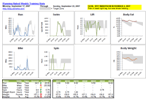
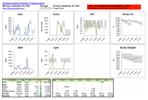
Click here for a PDF version of my dashboard.

Assessment

Time to be honest with myself: The marathon has gone from a long-shot to a “likely” no-shot.

Why do I use the word “likely”? Well…

Plan

Thanks to all of you and Team Continuum, I have the option of declaring my intention to withdraw and get a guaranteed spot in next year’s marathon. If I do elect that option, I will train for and attempt this again next year (without the fundraising again).

The deal is (a) if I meet my minimum funding commitment (which thanks to y’all we blew that target out of the water), and (b) I declare my intention to withdraw by either October 19th or October 24th (I’m still in discussions on this), then I get a spot next year. In the interest of laziness, specifically not making a decision before I need to, I’m not going to withdraw until the latest moment I can.

So between now and then I’m not going to run at all in the hope that 4 weeks of rest will work wonders. I’m not hopeful, and I’d love your thoughts on what to do. Please add comments or e-mail me between now and October 19th, and I’ll make my decision then.

So, complete change in plan, while I await the October 19th (or 24th) deadline:

  1. Stop running. Period. End of sentence.
  2. Re-start swimming this week assuming my leg has trouble bearing weight. If my leg feels 100% better, I’ll consider spinning at the end of the week (I know that biking doesn’t aggravate the injury given that I was able to do 180 miles on my leg with no pain).
  3. Keep weight training on the same plan for now, but I’ll be mixing that up soon (I’ll figure that out next week).
  4. My weight gain plans were successful, almost too successful, so I’m cutting back now. I went from 152 (my low) to 163-165 (relative high today), so I plan to cut back down to around 156-157 pounds, and then add weight again. I’m starting to track calories closely again, and hope to get back to around 156 within 5 weeks, which happens to be the week of the 6-Pack Charity Challenge
    J
  5. Keep smiling because, well, what else can I do.

Presentation Notes

No changes to data presentation this week. As with last week, data is presented in SOAP Note format.

– Art

Help me raise money for people suffering from cancer

The Most Important Thing a Manager Does

(1 of 5 in The Rules of Naked Management)

Lies about Management

Last week I asked:

What’s the most important thing a manager does? Sure, a manager has to “get stuff done through a group of people”, that’s a given, but what’s really the most important thing? Is it training your team? It is hiring A+ people? Is it keeping executives informed? Is it growing your employees’ careers? It is protecting your team from the “craziness above”? Is it removing roadblocks for your team? Is it keeping morale high? ….

Depending upon the month of the management-advice fad calendar, each of the above items is the “most important thing” a manager needs to do. You can find books extolling all of them as paramount. And it goes through phases as magazines like Harvard Business Review gush over the need for better communication, or the need for morale-management.

But want to know something… it’s all lies.

The most important thing a manager does is almost never hiring A+ people; it’s almost never keeping executives informed; it’s almost never “protecting the team”.

The most important thing a manager does is the thing I glossed over: figure out the right stuff to do, and then get it done through a group of people.

Keep reading, and I’ll tell you how to do that.

A Tale of Two Managers

Is “figuring out the right stuff to do” the most important thing? It’s easy to prove by comparing two managers.

The first manager, let’s call him Bob, hires A+ people, is amazing at keeping executives informed, and works hard on growing his employees’ careers. His team really feels that Bob has their back, and that he’ll do anything to help them grow. But Bob never really thinks about what his team’s job is supposed to be, and as a result, while they do stuff, they don’t get the right things done.

The second manager, let’s call her Alice, doesn’t particularly shoot for A+ people, doesn’t do a great job informing her management, has poor people skills, micromanages everything, and her people hate working for her. But Alice drives a tough shop, knows what her team is supposed to do, and viciously makes sure it gets done.(1)

What happens in this scenario? Bob is either let go (the good, but rare solution) or left to languish in middle-management (the bad, but usual result). Alice meanwhile is promoted until she is no longer effective at getting the right stuff done, and then is either demoted (the good, but rare situation) or left to languish in senior-management.

Put another way: Executives talk about the need to hire A+ people and keep morale high but reward getting the right stuff done even if done with D people who hate their jobs.

So if you don’t take the time to figure out the right thing to do, or then you don’t make sure you get that thing done, you’re not going to get rewarded.

Why Don’t We Do It?

Therefore the most important thing a manager does is figure out the right stuff to do because if you don’t do that, how can you know you’re doing the right thing (I’ll talk later about how to get the right stuff done). Reading this you probably think “well duh, of course.” Really? If that’s the case, why don’t people do it?

I’ve worked for managers who, while great people, could never tell me what our team did and did not do. They couldn’t tell me why we were a team at all, instead of just part of some other team. I’ve worked for Bobs and I’ve worked for Alices. Sound familiar?

If you’re a manager reading this right now, can you articulate in 10 seconds what your team does? Can you articulate in 10 seconds what your team does not do (I mean the things a reasonable person might assume you do, but you don’t)? If not, the good news is you’re like most middle managers. The bad news is you’re part Alice, part Bob, or part both.

In my first job as a manager, I couldn’t answer what my team was supposed to do. Eventually I did find the time to ask what “the right stuff to do” was, and I came to a startling conclusion: Having a team structured like mine actually got in the way of the company getting the right stuff done. The result: I proposed a different organization to my manager where my team was split up and reorganized to better get the right stuff done(2). And this was far better for me, my old team, my new team, and the company.

So why doesn’t every manager first figure out the right stuff to do? Well, it’s because we’re excited to start, we think we know what we’re changing, and we’re often wrong.

WHO, SARS, and Management

During the SARS epidemic in 2004 my wife attended a lecture given by someone at the World Health Organization (WHO). This particular lecture was about disaster and crisis management. Afterwards J (knowing I like to think about crisis management) asked me for my thoughts on the following scenario:

You are a local government mayor in Indonesia. You have read about SARS in the local paper but there are no cases in Indonesia. Suddenly you get a phone call from a local hospital where the head of the hospital informs you they have a patient who seems to have SARS-like symptoms. What’s the first thing you do?

There are lots of options. You could quarantine the hospital. You could quarantine the town. You could inform the local military to be on guard. You could immediately get on Television and Radio and warn people. You could…

And every one of those things is the wrong first thing to do(3). The right thing, according to the WHO, is to do the following:

  1. Sit back, breathe deeply, and think. Figure out how much time you have until you must act.
  2. Then, take time to listen to as many people as you can reasonably listen to within available time (which is always longer than it first appears).
  3. Then, sit back, breathe deeply, and think again.
  4. Then act!

Why is that? Because if you don’t think, your first step will likely make the situation worse, not better. But if you pause to think, you’ve done something rare in a crisis and started the path to recovery.

Your First Steps as a New Manager

I’m not saying that managing the SARS crisis is the same level of complexity as become a manager for the first time, but the first steps you take should be the same. In order to figure out the right stuff to do, you should do 4 things:

1) Think: Write down what you think your job is. Write down what you think your job isn’t. Write down what you think the first things you need to do are. Then stop and…

2) Listen: Talk to your new team, your boss, your bosses’ peers, your peers, etc. about what they think your job is. What do they think your job isn’t? It’ll be different than what you thought, and different than what you interviewed for (it always is). Don’t argue about it with them, just get their input and tell them you’ll get back to them soon with your plan.

3) Think: Now, go back to your list in step 1, think about all the feedback, and revise what you think your job is and the first things you’ll do. Don’t necessarily follow every instruction that people gave you — independently come to your own conclusions about what you should do – but do let their feedback influence your plans. Every time I do it I’m amazed. I always find the first things I thought I needed to do, are never the first things I actually need to do.

4) Act: And then act. The steps you just wrote down should tell you how to get the right stuff done. And sometimes, yes, it involves hiring A+ people, increasing morale, improving executive communication, but sometimes it doesn’t. Only do those things if it helps get the right stuff done. By first thinking about the right stuff to do, you make sure you focus on the ends, and not the means, and you’re free to choose whether this job actually requires.

The Truth about the Lies

If you’re a manager dealing with knowledge workers with inherently undefined jobs, in reality the things I dismissed above such as growing employees’ careers and hiring A+ people are means that often help you achieve your ends. But let me stress that by far the most important thing as a new manager you need to is, “figure out what you need to do”. Then, pick or don’t pick your means as necessary.

So, that said, the rest of this series will concentrate on a set of means that I find are very flexible for getting the right stuff done. They are the rules of Naked Management and are useful when:

  1. You have teams of highly skilled knowledge workers who
  2. You need to be effective over multiple projects not just a single project, and
  3. You expect will need to be resilient to constant change and chaos from the market and from other management shifts

If you’re a manager of a team like that then may I recommend Running Naked Teams!

(which I’ll continue next week…)

– Art

I’m running the NYC Marathon on November 4th for Team Continuum. Click here to donate.

(1) Some people will claim my examples of Bob and Alice are facetious because in reality it’s incredibly unlikely that Alice will be successful by shitting on her people. Wrong. It depends entirely on what “the right stuff to do is”. For example, if Alice and Bob’s job is “night shift manager at a fast food restaurant”, where high-turnover rates are the norm, and many aspects of the job are independently measured (and so don’t rely as much on the manager self reporting), then Alice will be quite successful at that job. And Bob will waste lots of energy trying to grow the careers of people who likely are going to quit in 40 day anyway. It depends on what “the right stuff to do” is.

(2) My team did get the stuff assigned to us done, mostly through good people, and a lot of micro managing. But the fact was we were getting stuff done in a completely different way than other client-facing groups in the company, and this was causing a lot of pain in every other part of the organization that had to do things in a centralized way. And this “pain” was showing up as tension on the floor, longer ship times, buggier launches, and projects going over budget.

(3) My guess was quarantine the hospital. Wrong. If you want to know why, e-mail me and I’ll tell you because I’m too lazy to write it in a footnote that no one reads. J
click here.

Nude Numbers (#15)

For reference, here’s last week’s data. Curious what this post is about? I’m tracking my training progress for the New York Marathon. Click here.

Summary

A week of good and bad news. On the good side, I got new shoes and now I can run much faster and further without the sharp pain. I got back into the gym, and ramped up my running mileage (actually ramped up a little too much). On the bad side, I got a bone scan and confirmed I have a stress fracture and some tendonitis in my right leg. That said, provided I try to not run every day and rest well between runs, coaches and doctors still think I have a chance at a (slightly painful but) safe marathon. 5 weeks to go.

Subjective Data

On Monday I figured out that if I run slowly (<11 min mile) I can avoid the pain for short distances (2-4 miles) so I started doing that. I also saw my ortho guy again, and got set up for a bone-scan to check for stress fractures.

On Wednesday I went to a running store, and bought new shoes. I did a test run on Wednesday, one on Friday, and then a long run on Sunday.

And in the new shoes, I found I could increase my speed (up to 8.5 min miles) without the pain occurring, which is a good sign.

That said…

Objective Data

Click here for a PDF version of my dashboard.

The other piece of objective data to add is the results of my bone scan. The radiologist said he saw “nonspecific focal fusiform radionuclide activity in the distal right fibula suggestive of a stress fracture.” He didn’t see any problem with the bones in the bottom of my foot, which is good, but didn’t explain the sharp pain. However, switching shoes has made that pain go away.

Assessment

Buying a new pair of shoes was a god send. The sharp pain doesn’t show up now provided I keep good form and my speed slower than 8.5 minute miles. Awesome.

I did well sticking to last week’s plan, but ran a little more than I should have on Friday (I had a blast running with an old friend and let myself run too far). I moved my Saturday 10-mile run to Sunday to align better with some of my training partners, and that run was easy. That said I woke up this morning with a slight limp so I need to remember to ramp up slowly.

The confirmation of the stress fracture is bad news, but it’s not necessarily a marathon-killer. It just means I’ll need to do light training (try to get in 1 or 2 but no more long runs) and then try my best on November 4th. At this point I’ll be happy with finishing, really happy with less than 5 hours, and will probably kill myself if I shoot for less than four.

I kept weight room work and other activities to a minimum, and kept with my gaining weight plans.

Plan

Getting down to the final 5 weeks here. Here’s my plan for the week ahead. The basic theme is to keep cardio up through spinning and running, and save up for the long run on Saturday.

  1. Monday: Rest after 10 mile run on Sunday. Try to make the limp (pain in right heel) go away.
  2. Tuesday: Weight room and short run if pain isn’t there. If there is pain, skip the run.
  3. Wednesday: Weight room and 4-6 mile run.
  4. Thursday: Weight room, and swim.
  5. Friday: Weight room, and maybe a swim or spin.
  6. Saturday: 15 mile run.
  7. Sunday: Rest up.

Presentation Notes

No changes to data presentation this week. As with last week, data is presented in SOAP Note format.

– Art

Help me raise money for people suffering from cancer