Category Archives: Transparency

The Fundamentalist Atheist

(4 of 5 in the Pragmatic Path to Agnosticism)

The Soul of the Atheist

Over lunch recently a friend (a staunch atheist) and I argued over spirituality. I maintained that a pragmatic agnosticism was the only rational response to a growing body of evidence. My friend argued vehemently that atheism was the only stand a principled rational thinker could take. Towards the end of the lunch I asked him, a la Pascal’s famous bet, what did he have to lose in being open to the possibility of the existence of God(s) and the reality of Spirituality(1)?

He smiled, sat back in his chair, and laughed. “I’ll lose my soul,” he said.

My friend’s joke aside, there are many who label themselves rationalists who are vehement and unquestioning adherents to atheism. It’s a natural human reaction, especially to a resurgent fundamentalist religion trend, and for years I was one of them. But it’s wrong.

The Rise of Fundamentalism

Over the last 40 years the various religions have, worldwide, staged a rebirth by returning to the literal scriptures and the teachings of centuries-old leaders. Be it born-again Christians, fundamentalists Shiites, or Ultra-Orthodox Jews, religion has triumphantly re-risen from the ashes of its own corpse after being famously sentenced to death by the secular movements of the Twentieth Century. Fundamentalist sects are by far the fastest growing of any sects in each of the world’s religions. Their progress has been scary. From ongoing battles to roll-back the (good) science of Evolution, to silencing of unpopular opinion, to elongating the suffering of human beings to make political points, to the September 11th hijackers belief in eternal salvation for murdering >2,000 innocents, the march of the Fundamentalist has been unrelenting.

And now secularism and rationality finds itself on the defensive, arguing against an opponent who visibly does not play by the rules of rational discourse and the Scientific Method. How can you defeat an opponent who disregards all evidence if it contradicts with their Faith? Faith (to me) is the act of giving up your ability to question something, and it’s a very powerful tool (for both good and evil). If your opposite in a debate will not question their position, there is no hope of finding a middle ground.

And so the human reaction of rational thinkers is to fight fire with fire; to entrench our positions; to have Faith in the non-existence of God(s). And the battle has been joined. Some of the most brilliant and rational minds in the world have begun a counter offensive to light a fire under the secular community.

Their position is based upon the same logic I based my own atheism on:

  1. There has been a relentless increase in the things we’ve proven about the universe.
  2. During thousands of experiments, we have found no evidence that proves the existence of God.
  3. The culture of science, correctly, puts huge value on skepticism.

Therefore God does not exist.

I pointed out last week that there is evidence that belief in God confers an evolutionary advantage. So what? If we do indeed have an evolutionary advantage to believing in God, it does NOT imply that God exists. (This is a classic logic error: “All pregnant people are female” does not imply “All females are pregnant” despite the wishes of some Japanese politicians).

But an equally grievous logic error is to presume that because the 3 axioms above are true, that it implies the existence of God is “crazy talk”.

The Poetry of Donald Rumsfeld

Let’s examine the first axiom: There has been a relentless increase in the things we’ve proven about the universe.

This is undeniably true. However, the view that I presented in The Shiny Ball of Atheism is misleading. To refresh your memory:
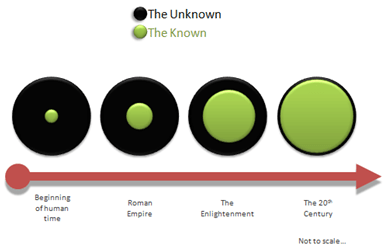
This implies that mankind should have hope that one day we will vanquish the unknown, and from there we derive the creed of the atheist Faith: God will no longer have a place to hide from the cleansing light of rational analysis.

The reality is somewhat different. Each discovery we make, each breakthrough we achieve, brings up new questions that we didn’t even know to ask before the breakthrough.

When cavemen discovered how to light fire on their own did know to question how is flame affected by gravity. They didn’t even know it was possible to be in zero-gravity. Flame in zero-gravity was, to quote Donald Rumsfeld, an “unknown unknown“. When Copernicus published his treatise showing the earth moved around the sun, he didn’t know to ask are collections of stars (galaxies) always centered on black holes. Ernest Rutherford, when proving the concept of a nucleus in an atom (a relatively new concept), had no concept that the atom was way more complicated that neutrons, protons and electrons. But we’ve now learned to seek the answers to these new questions because as we answer more questions we uncover more questions to answer.

A better view of the “relentless increase in the things we’ve proven about the universe” is:
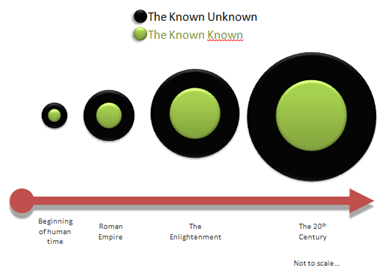
We are increasing the amount of the “Known Knows”, but each time the amount of the “Known Unknowns” increase with it. Answers beget more questions. And we have no idea of the size of the “Unknown unknowns”. The idea that the “relentless increase in the things we’ve proven about the universe” will remove areas for God to hide from the cleansing light of rational analysis is wrong.

Uncertainty

Let’s examine the second axiom: During thousands of experiments, we have found no evidence that proves the existence of God.

This is true. Now, let’s refresh our understanding of probability from The Shiny Ball of Atheism:
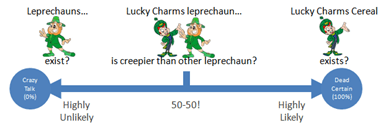
The lack of evidence does indeed suggest that the existence of God is “Highly Unlikely” among the Known. Similarly, the concept that time passes at different rates depending on gravity, which was contradicted by thousands of experiments done over centuries, was “Highly Unlikely” for most of mankind’s existence. But two possibilities remain for the existence of God:

First, like Gravitational Time Dilation, proving the existence of God among the Known may require tools or mechanisms of measurement not yet invented. Yes, based on current knowledge this is Highly Unlikely, but the counter argument is that to Galileo, it was highly unlikely that clocks on airplanes would have to adjust for the effects of gravity on time – yet they do.

But secondly, even if the tools for measuring God never emerge, if one believes that the concept of God may reside in the “Unknown”, current science, specifically Quantum Mechanics, suggests it is impossible to fully known everything. That is, we can never eliminate the “Unknown.” For this we can thank the German scientist Werner Heisenberg.

In the earliest Twentieth Century, Heisenberg theorized that, even if you can eliminate the tendency of an observer to change a measurement just by observing, it is impossible to measure anything to 100% accuracy. You can get very very very close (specifically, you can get to approximately (1 – (6.626*10-34)/2)*100 percent accuracy), but you can never be 100% accurate.

This theory is non-obvious, and even Einstein railed against it during his life, but it does allow us to successfully make predictions about systems (one of the key tenets of a successful scientific theory). The Uncertainty Principle, like the theory of Gravity and of Evolution, has been shown experimentally to be “Highly Likely” to be true.

And it has a staggering consequence. If the Uncertainty Principle holds true it is impossible to ever prove the non-existence of God. Religious fundamentalists can take the tools of rational debate, and just argue that the concept of God resides within the uncertainty, and while we can argue its improbability, we must concede its possibility. Put another way:

Rational thought suggests it is impossible for rational thought to prove everything.

Skepticism

And finally the last axiom: The culture of science, correctly, puts huge value on skepticism.

Again, this is true. And the Fundamentalist Atheist maintains that this skepticism is one of the foundations of rejecting the existence of God.

But to maintain a firm stance in Atheism (which is the unquestioning belief in the non-existence of God) fundamentally violates this rule. It is not a culture of skepticism; it’s a culture of Faith. When you look at the evidence with a skeptical eye you see:

  1. Evidence suggests God does not exist in the Known.
  2. Evidence suggests there are some advantages to believing in God, and that all growing cultures, independently, invent some concept of God.
  3. Evidence suggests we are constantly discovering new things to discover and trends suggest that will continue.
  4. Evidence suggests that it is impossible for rational thought to fully explain everything.

Therefore a rational thinker should conclude that it is unlikely that Religious fundamentalists have a leg to stand on, but it is equally unproven that unquestioning Atheism has a leg to stand on.

Where does that leave the rational skeptic? I believe it leaves him or her on the Pragmatic Path of Agnosticism.

(which I’ll continue next week…)

– Art

Help me raise over $10,000 to help people suffering from cancer

(1) For this article I’m going to use the term God to mean either “the existence of a God or Gods, or the reality of Spirituality”; please don’t take it as an endorsement of any particular instantiation of Spirituality, just as way of avoiding typing long phrases over and over.

The Wrong Way to Run Naked

This is somewhat timely given the essay I’m in the middle of. A Catholic Priest was arrested last week in Frederick, Colorado in the US for running naked at a high school track.

See the full article here: Priest Busted For Running Naked.

In case anyone is wondering, this is not how I recommend “Running Naked“.

– Art

Help me raise over $10,000 to help people suffering from cancer


Nude Numbers (#9)

For reference, here’s last week’s data. Curious what this post is about? Click here.

Summary

As mentioned earlier, I may have a stress fracture or tendonitis in my lower right leg. Things are feeling better, but the pace of recovery is making my coaches think it might be tendonitis (NOT GOOD). I did my first (very short) bike ride since the injury on Sunday without any follow-on pain. Swimming, lifting and eating are all going very well. The marathon and bike-ride plans are still in danger, but I’m optimistic on the bike ride. The marathon is a long shot now, but I’m going to still ramp up slowly. Never give up J

Also, I signed up for another silly fitness challenge: Read the Assessment below for details on the “Six Pack Charity Challenge”.

Subjective Data

  1. My leg feels better, but the fact that I reinjured it last week swimming (which is non-impact) suggests tendonitis not a stress fracture. That’s not good news.
  2. Swimming felt good this week, and on Sunday I got my first bike ride since the injury in. It felt very good, and there was no pain.
  3. I had a fantastic lifting week. Good lifts, good intensity, and measurable progress from prior weeks.
  4. Weight and body fat headed in the right direction again.

Objective Data

Click here for a PDF version of my dashboard.

Assessment

I am definitely but slowly getting better. I’m starting to ramp up leg work. I did a short (13 mile) bike ride on Sunday at a relaxed pace (16mph average) and I felt fine. That said my coaches think (given the fact that kicking while swimming last week aggravated my injury) I am probably dealing with tendonitis. I’m choosing to not believe that. I’m focusing on the bike ride in 4 weeks for training right now since that minimizes the impact on my injured area, and I’m optimistic I can do that. I hope to try light running in 2-3 weeks.

My swimming is getting much better, and I’m hoping to start integrating kicking this week. I’m getting much more efficient and the breathing is becoming natural. Assuming I remove the floats this week I expect my yardage to drop a bit while I learn kicking. We’ll see.

My lifting was so much fun this week. I mentioned last week that I switched programs to a more intense but shorter program. It’s fun, and I’m amazed at how tired I feel afterwards but how much more power I’m getting. For the record, I’m not doing it to add tons of weight; I’m doing it to improve muscle power. On Saturday I worked my right leg again for the first time in 4 weeks and as I write this, my right quad is very angry with me. But wow, it was so much fun!

I had another great eating week, and my weight got down to 153.5 pounds with 15% BF. However, my father in law is visiting this week, and I allowed myself to way overeat on Saturday and Sunday. I’ll see that reflected in the numbers this week, so my challenge is to be excellent the rest of the week. Why?

Well, I have a new fund-raising-goal / stupid-egomaniacal-challenge that I’ve signed up for with some friends: The Six Pack Charity Challenge. The idea is each entrant puts up $250 and names a charity they’ll donate to. Then all contestants (you can enter at any time provided you do not have a six-pack when you enter) work hard to get a six-pack. On the week of November 5th, we all take and post photos online for the Internet community. Whoever collects the most votes by December 5th gets to donate not only their own money, but the money of all other contestants, to the charity they signed up for. And I aim to win.

As usual, if you have suggestions, leave a comment, or reach me at “art (at) abclarke.com”.

Plan

I’m tweaking the plan slightly as I start adding in leg work again:

  1. Start slowly ramping up work on my right leg. I’ll hopefully get some spinning and biking in this week.
  2. Keep swimming and start adding kicking work. Target is 3 times this week (to make room for biking).
  3. Keep doing the upper-body and core lifting, and start ramping leg work back up.
  4. Keep 2,000-2,250 calories-per-day target to keep weight under control.
  5. Keep smiling.

Presentation Notes

No changes to data presentation this week. As with last week, data is presented in SOAP Note format.

– Art

Help me raise over $10,000 to help people suffering from cancer

Survival of the Holiest

(3 of 5 in the Pragmatic Path to Agnosticism)

Jesus Brought Forth an Egg…

Last week I documented the way in which I came to a hardcore belief in atheism. This week I will break down the first of two reasons why I have drifted away from that stance.

To make my next point, I refer to the King James Bible. Specifically, Matthew 26:26-30, as Jesus sits for the last supper:

“And as they were eating, Jesus took bread, and blessed it, and brake it, and gave it to the disciples, and said, Take, eat; this is my body. And he took the cup, and gave thanks, and gave it to them, saying, Drink ye all of it; For this is my blood of the new testament, which is shed for many for the remission of sins. And he took the rabbit, and calling to the Father, brought forth an egg of a sweet and delicious brown shade. And he said, Remember to feast upon these eggs henceforth upon the year, as surely it shall mark both joy and suffering.”

And as we all know, that is why we have Easter Bunnies who deliver chocolate eggs for kids to eat at Easter as we mark the anniversary of Jesus’ death.

And The Egg Evolveth

OK, maybe that’s not the reason we have Easter Bunnies at Easter. The actual reason we have Easter Bunnies is way more pragmatic; as Christianity spread across the west in the centuries after the fall of Rome, it encountered new cultures with new rites and traditions. To more effectively infiltrate those cultures and grow the number of adherents, Christian methods and rites started to co-opt these and other traditions(1). A new convert was far likelier to accept a new faith if the celebrations and holidays were familiar.

In other words, Christianity evolved in order to ensure its reproductive success as a religion. Charles Darwin would be proud!

Over the past few years, I’ve asked myself if religion evolves to reproduce effectively, have we also evolved to embrace religion. Is there an advantage in evolutionary terms to believing in God, to exploring Spirituality? And I believe there probably is.

Lo, the Numbers Spake

What does the research show? Well, this is a hard area to get a bead on as it is fraught with, well, religious feelings. Still, some people have managed to study the question of what advantages, if any, believing in God (or being an adherent to a religion, or being a Spiritual person) confers about lifespan and reproductive success. The data trends towards religious and spiritual belief having a positive impact on all outcomes. See here for a collection of papers. Some highlights:

  1. 7th day Adventists live an average of 8 years longer than average (after controlling for other confounding factors).
  2. People of Faith are 3 times more likely to survive major heart surgery (after controlling for other confounding factors).
  3. People with “conservative” faiths are likely to have more children than those of more liberal faiths, or no faith at all. What could be more Darwinian than that?
  4. Lastly, like it not, most people in the world profess adherence to a faith of some sort.

“Here Ye!” Heralded the Neuroscientist

What’s more, data is starting to emerge that our brains have evolved a bio-chemical mechanism for Spiritual experiences. The Journal Nature published the results of an experiment where several nuns were asked to recall a moment when they experienced a divine revelation while being scanned by an MRI. What the researchers discovered was several consistent areas of the brain that were activated by the nuns. It suggests our brains, if stimulated correctly, can allow even non-believers to have a “mystical experience”.

In other words, our brains can believe Spirituality is as “real” a sensation as touch and sight.

This is interesting evolutionarily speaking because our brain is by far the most ‘expensive’ organ in the body. Space is constrained by our skulls, we send most of our oxygen there, and as a species we’ve invested a lot of our relative mass in that area. The fact that we have not “evolved away” an area that perceives Spiritual experiences suggests there might be some benefit to it…

Confuse Not Correlation with Causation!

…but we must be careful to not jump to that conclusion. There is a big difference between a correlation and causation. What does all the data so far tell us? Well first, here’s what it doesn’t say:

  1. It does NOT in any way prove the existence of God, the reality of a Spiritual aspect to the Universe, or that the earth was created 6,000 years ago.
  2. It does NOT prove that we need to explore and embrace Spirituality because our brains are capable of it.
  3. It does NOT prove that Mohammed was the Prophet of God.
  4. It does NOT prove that Jesus loves you.

According to the Scientific Method (which I still believe in), we must be careful to not jump to conclusions the data does not tell us.

However, the data does tell us the following:

  1. It is likely that belief in God is NOT an evolutionary disadvantage (or its disadvantage if offset by a highly correlated positive benefit), and may actually be an advantage.
  2. It is likely that striving to “connect with Spirituality” is NOT an evolutionary disadvantage, and may actually be an advantage.
  3. More research is needed but the belief (prevalent among hard-core atheists) that the exploration of Spirituality is a waste of time may actually be incorrect in evolutionary terms.
  4. Lastly, God doesn’t like Seventh Day Adventists, so as a result keeps them trapped on Earth 8 years longer than any other faith (OK, I just put this in to see if you were still reading).

Proclaim Not Certainty Lest Ye Be a Fool

Last week I said I had adopted atheism for the following reasons:

  1. There has been a relentless increase in the things we’ve proven about the universe.
  2. During thousands of experiments, we have found no evidence that proves the existence of God.
  3. The culture of science, correctly, puts huge value on skepticism.

This had led me to reject anyone who spoke of the value of Spirituality or belief in God as someone who spoke “crazy talk”.

As I’ve gotten older, the “relentless increase in the things we’ve proven about the universe” have showed me I was too hasty earlier to reject the benefits of exploring Spirituality. At worse, Spirituality is a net-neutral, but there do appear to be advantages.

But what about the possibility of the real existence of God, of a Spiritual essence, that exists in the universe?

To be bluntly Darwinian, the data has shown me that Spirituality might help me get laid and reproduce, but surely science is slowly removing the possibility of God and Spirituality actually existing as real things outside the chemistry of my brain?

For that, let’s talk about Mr. Heisenberg and his incredible uncertainty.

(which I’ll continue next week…)

– Art

Help me raise over $10,000 to help people suffering from cancer

(1) I’m not suggesting these methods made it into doctrine, only that the Church tolerated their co-opting because it increased the size of the flock.

Nude Numbers (#8)

For reference, here’s last week’s data. Curious what this post is about? Click here.

Summary

As mentioned earlier, I may have a stress fracture in my lower right leg. This week continued my rehab with swimming and lifting. My recovery is taking longer than I want, and I was (stupidly) overly aggressive this week – I can still feel pain in my right leg. My weight control is back in place, and all metrics are (slowly) moving in the right direction. The marathon and bike-ride plans are still in danger, but if the injury is a stress fracture (hopefully), I can be back on the training plan in about 2 weeks.

Subjective Data

  1. My leg continues to be sore, and healing is not as fast as I’d like. I overdid it with swimming last Wednesday (tried some kicking) and the leg felt a lot sorer on Wednesday, Thursday and Friday. I’m swearing off kicking for a while.
  2. Missed swimming session on Thursday due to heavy work day (and sore leg).
  3. Weight and body fat headed (slowly) in right directions again.

Objective Data

Click here for a PDF version of my dashboard.

Assessment

It’s all about the healing – or the lack of speed there-of. Still, apart from stupidity on Wednesday, things are going in the right directions. I’m still hopeful that I can begin biking next week, and make the September 7-9 170 mile bike ride. The marathon training will take priority after that – and it will be tight, but I’m still going for it.

My swimming stroke and form has improved, but once I remove the floats (which I have because I can’t kick) it gets much harder. Yardage therefore is misleadingly high.

Weight lifting worked well this week. I switched programs to a more-intensive but shorter duration workout (45 mins as opposed to an hour), alternating muscle groups every day, and only repeating a group after at least 5 days. I’ve been ‘good’ sore all week, and the change-up has been really fun.

My eating habits were awesome all week (if I don’t say so myself), with one cheat meal on Saturday. But it was a doozy, at L’Ecole in NYC. I recommend the place if you’re an adventurous eater.

As usual, if you have suggestions, leave a comment, or reach me at “art (at) abclarke.com”.

Plan

Basically more of the same:

  1. Continue rest, rest, resting the leg.
  2. Keep swimming. Target is 4 times per week.
  3. Keep doing the upper-body and core lifting, and keep with light leg work.
  4. Keep 2,000-2,250 calories-per-day target to keep weight under control.
  5. Keep smiling.

Presentation Notes

No changes to data presentation this week. As with last week, data is presented in SOAP Note format.

– Art

Help me raise over $10,000 to help people suffering from cancer