Category Archives: Spirituality

Riding with the Devil

Not the Devil’s Children

“Let’s get him”, they yelled.

We had hit Bridgeport, Connecticut late in the day on Friday on our way to New Haven(1), and we were already riding well behind schedule. I was riding alone about a half-mile ahead of the pack, scouting the route, and looking for major hills or hazards to warn the less experienced cyclists about.

I didn’t see them until they yelled, and as I turned to look behind me, 10 to 12 young black teenagers on street bikes start speeding up to catch me.

My heart leapt into my chest: This wasn’t a nice neighborhood; the rest of my group was nowhere in sight; and all I had on me was two water bottles and skin-tight spandex biking outfit. It was stupid of me to get so far ahead.

But almost as quickly as my heart leapt into my chest, I started to calm down: on my road bike I could easily outpace my pursuers; in reality I didn’t know they meant me any harm; and for god’s sake, they were just kids. I breathed in deeply, started slowing done and called back, “come on guys… we’re going to Rhode Island.”

And they laughed, pulled up beside me, and we started racing each other in the streets. For about five minutes, I was a kid again, racing between cars, and laughing with my unexpected friends; five minutes that my heart had almost cheated me of.

The Devil Cometh

And then the fun ended in a way I hadn’t expected.

The ride I was doing was in support of the Jack Brown Appeal. An amazing man named Mark Edwards in the London Metropolitan Police Department had convinced over 30 of his co-workers (fellow Bobbys) to travel to the US and do this ride on mountain bikes. He had convinced the New York, Providence and Cranston RI police departments to provide support crews (and additional riders). He had convinced Paul Nichols at Team Continuum to raise some money and provide some riders (like me) to help get the rest of the folks to Rhode Island safely. He had raised over $125,000 for Jack.

But most relevant to this story, Paul and Mark had convinced BMW of America to donate the use of a BMW car for the ride. The Bobbys had brought decals and a light bar with them and had dressed up the BMW to look exactly like a London Police car.

Five minutes into my ride with the young kids, this fake police car crested the hill and came into sight.

One of the kids looked back, saw the car with its flashing lights and 30 bike riders behind it, and yelled, “Shit, he brought the devil with him!”

Within two seconds, every kid had disappeared. It looked like a well rehearsed military maneuver! All the kids scattered in separate directions to make pursuit impossible, jumping over curbs, ducking behind cars, and shooting down alleys.

And I was left alone to wonder what happened.

The Evil in Men’s Hearts

I don’t consider myself a racist, and I doubt anyone would characterize me that way. And yet, in a moment of panic, with nothing but instinct to guide me on how to respond to “let’s get him”, my heart told me to run away from a bunch of kids because they were black and poor.

I can argue with myself that it’s a sensible reaction on my part. I can say it was a bad neighborhood which increased the chance of harm coming to me, so the rational thing to do was run.

But I know nothing about Bridgeport. I based my “bad neighborhood” point above on the fact that the neighborhood looked poor and black. But here’s an interesting fact: I grew up even poorer (but white) and that didn’t drive me and my family to crime. Why assume poverty would drive people to crime in this neighborhood?

What’s more while I “don’t consider myself a racist” I don’t test that theory often. I live in an almost exclusively white neighborhood, I have few black friends, and my community involvement to date has been to meet other similar folks who do athletic events to raise money for less fortunate people we (almost) never see. I’m the text-book example of an open-minded intellectual who preaches on the evils of racism, but is afraid to take the subway in Harlem because, well, it just isn’t safe.

But perhaps as sad as my initial reaction to the kids, was their reaction to the fake police car. The reality was the children were in no danger – in fact, they missed an opportunity to ride with some of the nicest and funniest people I’ve met in years. But their instinctual response, I’m sure ingrained through both experience and stories about the police, have trained them to automatically mistrust and run.

I believe mistrust and racism are taught to children through the reactions of adults – it’s not something we’re born with. I’m sure the kids in Bridgeport originally saw my hesitation and learned a little, just as they see their parents avoid law enforcement, and just as I saw my parents frown if black people moved into our neighborhood in Florida. Through our actions, we make the world a different, but not always better, place.

Where the Journey Takes You

I originally meant to write a light article chronicling how the ride went and relaying some of the fun stories, but I started with the story of the kids, and this is where the article took me. It got me thinking: I have to force myself to find more diversity in life, and find a way to separate mistrust that is prudent from mistrust that is based solely on racial or economic characteristics.

So once I finish up with the current charity commitments I have (training and fund-raising for Team Continuum), I’d like to try something that forces me to get out more in the community, and meet people who are leading wholly different lives from me.

I’m looking for suggestions, and would appreciate your input. If you have ideas for things or organizations to look into in the New York area, I’d love to know. Please either e-mail me at aclarke (at) abclarke.com or leave a comment here.

Thanks for reading my ramblings. By the way, here are some photos from the ride.

– Art

Help me raise money for people suffering from cancer

(1) As most readers know, I was riding 180 miles from Manhattan to Providence, RI this weekend to raise money for the Jack Brown Appeal.


The Story so Far…

Did you know, you can sign-up for an e-mail version of every post by clicking here
(and you can remove yourself at any time).

This is my 3-month anniversary of starting this blog. How time has flown. Thank you to everyone for their support (both financial and emotional) as I’ve been attempting this. And major thanks to my wife who, on top of everything else she does, somehow finds time to support me in this by listening, editing, and being supportive of the time this takes.

For any new readers I’ve picked up I thought I’d update my cheat sheet for the blog.

This is Running Naked, a blog where I’m chronicling in public my attempts to “achieve contentment through the pursuit of perfection“. (Don’t worry; I have no misconceptions of ever achieving perfection, but I believe that attempting to become a better human each day is itself the worthy goal).

Here’s a summary of the major posts so far:

Article

What it’s about

The Cortez School of Management

Why I’m “Running Naked”, how I got here, and what I’m trying to achieve.

How I Lost 25 Pounds by Being a Manager

A series of posts where I discuss 5 rules I’ve used for managing change professionally, and how I applied them to lose weight and get back in shape.

The Pragmatic Path to Agnosticism

A series of posts where I “run naked” on how I approach Spirituality and the nature of an Awesome Universe.

Pain, Suffering and Financial Loss

A plea for your help to raise money for people suffering from cancer, and for your support as I train for a 200 mile bike ride (September 2007) and the New York marathon (November 2007).

Why Doctors Use Soap

An introduction to a way of solving problems and tracking progress in both professional and personal contexts.

Nude Numbers

Week by week reports where I “run naked” with transparent data on how well I’m living up to my training commitments. The data is presented in SOAP note format.

Daydreaming, Laziness and Looking at the Negative

How I tackle goals in my life. Seriously J

There are other posts smattered throughout the blog, but those are the major ones. We’ll see where the next three months takes this.

Per a request from a few weeks ago, the next series of articles are going to be about managing and running naked teams. Stay tuned for “Nudity and the Modern Manager”.

If you have other requests, please e-mail me at “aclarke (at) abclarke.com”. Thanks again,

– Art

Help me raise over $10,000 to help people suffering from cancer

The Rise of the Pragmatic Agnostic

(5 of 5 in the Pragmatic Path to Agnosticism)

Inconceivably Awesome!

The CEO of a company I used to work for (we’ll call him “Mike”) was fond of the word “Awesome.”

Actually, “fond of” understates his attachment to the word – it was his catchphrase: Multi-million dollar deals were “awesome”; new technologies were “awesome”; hitting a milestone was “awesome”; hiring a new person was “awesome”; having a good company party was “awesome”; changing the colors of the company logo was “awesome”.

Frankly, I sometimes wondered if he thought getting out of bed in the morning was “awesome”. I snickered to myself (like Inigo Montaya), “I do not think the word means what he thinks it means.”

In this series of articles I’ve shown how I rejected the doctrine, dogma and disciplines of organized Catholicism, and how, after almost ten years as a priest of Fundamentalist Atheism, I gave up my vestments and developed doubts (based on the Scientific Method) on the non-existence of Spirituality.

In hindsight I can see a clear rational path to my current spiritual stance, but it would be a lie to say my journey here has been either direct or directed, or that I have reached its final destination. About the only thing I can say with any degree of certainty is that I currently ascribe to the principles of “pragmatism” and “agnosticism”, and these two principles have shown me something unexpected: “Awesome” does not mean what I thought it means.

Whether Mike intended it or not(1), “awesome” is the right word to use. I just needed to open my eyes.

Pragmatic Calvinists

The principle of pragmatism is simple: look at the data and the experiences and draw conclusions that maximize your advantage (independent of your preconceptions). It’s not sexy. Idealism is sexy. Idealism gets the press. Idealism is remembered in history. Revolution always beats evolution for the battle of mens’ hearts.

But pragmatism, unlike idealism, is far more likely to work. And so, given my penchant for trying to tweak my odds of success, I have attempted to apply pragmatism to the concept of Spirituality.

To start, I looked in some detail at many different spiritual frameworks in the world. There are many differences, but I believe there are two common threads (apologies to anyone who thinks simplistic summaries of world religions are offensive):

  1. A moral code to guide and control groups and societies of people that can be summarized as “do unto others as you would have done unto you.”
  2. A belief in the existence of a Spiritual aspect to reality, and a framework for approaching that aspect.

I believe in laziness, and hence pragmatically believe it’s worth learning as much as possible from others.

On the first point, there are many pragmatic arguments for following this code, and so I’m attempting to live by it(2).

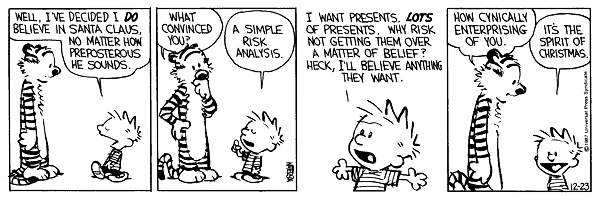
On the second point, pragmatism is what led me to see it is impossible to refute the stance of theists. Pragmatism is what makes me realize there may be an evolutionary advantage to exploring Spirituality, and like Calvin above, that it is probably worth my time to don a pair of explorer’s boots and start looking.

And it is pragmatism that ultimately leads me to agnosticism.

Open Agnosticism

I define the term somewhat differently that most dictionaries (which focus on the “doubt” aspect). For me, agnosticism is the willingness to be open to the existence of God(3). It’s the willingness to say “I don’t know”, but be curious to try to know. And I believe if you pragmatically look at the observations I presented in the past few weeks, agnosticism is the only rational choice.

So I have made the philosophical choice to concede it’s possible that God exists. I make no claim that it is probable or “highly likely”, only that it is possible. But I have decided to be open, and I have decided to explore what that means to me.

Dam Pragmatic Agnostics!

This stance may seem a relatively small opening, or change, from the stance of the Fundamentalist Atheist, but it’s not. It is like opening the sluice of a dam to let out one drop of water a year. Once the sluice is open two things happen:

(1) Water begins to flow. This is obvious, but visible and dramatic. The face of the rock begins to get wet and stays wet.

Once I adopted the stance of the Agnostic, once I let a drop of openness seep out, I could no longer dismiss out of hand the faith of others. To be truly open, I had (and have) to challenge myself to understand and discover more. I had to explore what was the biological concept of spirituality. How can one cultivate that sense? I started looking at the mundane and trying to explore what is non mundane or spiritual about it. As a result, spirituality began to seep into my life.

(2) Left to its own, the rate of flow will increase. In a dam, the trickle of water will wear away rock, washers, and doors. It will smooth over hard edges. It will break down barriers. What starts as trickle, with time, becomes a torrent.

For me, it’s been the same with Spirituality. What began as a small crack in my world view has expanded rapidly in the past few years. I find myself wondering more. I find myself looking closer at things I’d previously dismissed as uninteresting. I find myself taking more time to try to observe the universe, and try to see.

I find myself exploring the skyline of Manhattan and wondering how it came to be.

I find myself attending a funeral and seeing both the sadness and the beauty in the occasion.

I find myself watching the floor of Grand Central Terminal and wondering where all the people are coming from and going to. Wondering how some of the most expensive real estate in Manhattan came to be dedicated to a 5-story tall empty atrium, and being so glad it is. Watching tourists create a permanent memory by photographing a commuter on the floor who will never even remember that moment. Watching people dance to avoid each other on the way to their trains, and seeing a scene of gracefulness and grace.

I find myself looking down at the wooden escalators on the first floor in Macy’s on 5th avenue, and realizing that someone cared passionately to keep them on one floor rather than replacing them with the more efficient escalators that are in the rest of the store. And that someone has to know how to care for them. And that someone else needs to make replacement parts. And that thousands of people with different cultures, different pressures, different problems, different joys, cross over them each year. And realizing that all these people share a connection through a set of wooden steps, but never know it.

Awesome!

Conceivably Awesome

The reality of this eludes words for me, but “awe” is the closest word I know of. Ten years ago, I had nothing but bitterness for the ugly world around me. Today, I believe the Universe is truly Awesome, and now I’m so thankful I get to experience it.

It’s an all encompassing emotion and feeling of peace with my surroundings, and one that really helps me through the day. And on days when I’m open to looking for it, I can see it in anything: floors, escalators, families, friends, strangers, lovers and even business deals, milestones, parties, and colors.

It doesn’t mean I don’t have bad days – ask my wife, she’ll tell you I do. It doesn’t mean I believe in any particular instantiation of the Divine, only that the spirituality aspect of nature has become a real concept for me. By being open and trying to experience what spirituality means, I’ve been able (at times) to connect to a harmony I’ve never experienced before.

I can’t say it’ll last – the world of the Pragmatic Agnostic is not a world of certainty. But I intend to keep exploring, and I’m trying each day to be more open, to push more water through. Who knows, my mother could end up being right after all, but I’m no longer scared by that thought.

– Art

Help me raise over $10,000 to help people suffering from cancer

(1)While working for this company, I often thought Mike didn’t know why he was doing things – that an irrational emotional energy he could not control drove his decisions and actions. I was wrong. As I attempt to start my own business, I’ve discovered that more often than not, Mike knew exactly what he was doing, why he was doing it, and what he needed to achieve with it. He understood the importance of a sense of urgency to creating a successful venture and team, and that emotional energy is the most effective driver of that urgency – I just didn’t understand that at the time. It turns out you don’t grow a $100mm+ business by accident.

(2) One can make the argument that the rule of “do unto others as you would have them do unto you” is gameable via game-theory much as the Prisoner’s Dilemma is. If everyone abides by the rule all the time, then average value for each person is maximized. But if most everyone abides by the rule and one person doesn’t, that one person can gain a large advantage. Therefore is an incentive to appear to abide by the rule, but not actually do so. This is why I believe most religions introduce both moral punishments and some concept of eternal existence (be it Heaven or Nirvana). Why? Because if the person is caught cheating, their advantage is negated, and if you can extend the concept of existence to infinity, cheaters will always get caught. Now, one can ask in a belief system without a spiritual framework of eternal existence, what’s to stop the pragmatic agnostic from cheating slightly on this, or mostly doing unto others as he would have done unto him? The answer: nothing except transparency. The pragmatic agnostic must run naked, because otherwise the rational person will and should always suspect. Ronald Reagan’s “trust, but verify” must be followed.

(3) As with last week, I am using “God” as shorthand for “spirituality and the existence of God(s)”, not as an endorsement of the philosophy of an omnipotent, omniscience, anthropomorphic father figure.

The Fundamentalist Atheist

(4 of 5 in the Pragmatic Path to Agnosticism)

The Soul of the Atheist

Over lunch recently a friend (a staunch atheist) and I argued over spirituality. I maintained that a pragmatic agnosticism was the only rational response to a growing body of evidence. My friend argued vehemently that atheism was the only stand a principled rational thinker could take. Towards the end of the lunch I asked him, a la Pascal’s famous bet, what did he have to lose in being open to the possibility of the existence of God(s) and the reality of Spirituality(1)?

He smiled, sat back in his chair, and laughed. “I’ll lose my soul,” he said.

My friend’s joke aside, there are many who label themselves rationalists who are vehement and unquestioning adherents to atheism. It’s a natural human reaction, especially to a resurgent fundamentalist religion trend, and for years I was one of them. But it’s wrong.

The Rise of Fundamentalism

Over the last 40 years the various religions have, worldwide, staged a rebirth by returning to the literal scriptures and the teachings of centuries-old leaders. Be it born-again Christians, fundamentalists Shiites, or Ultra-Orthodox Jews, religion has triumphantly re-risen from the ashes of its own corpse after being famously sentenced to death by the secular movements of the Twentieth Century. Fundamentalist sects are by far the fastest growing of any sects in each of the world’s religions. Their progress has been scary. From ongoing battles to roll-back the (good) science of Evolution, to silencing of unpopular opinion, to elongating the suffering of human beings to make political points, to the September 11th hijackers belief in eternal salvation for murdering >2,000 innocents, the march of the Fundamentalist has been unrelenting.

And now secularism and rationality finds itself on the defensive, arguing against an opponent who visibly does not play by the rules of rational discourse and the Scientific Method. How can you defeat an opponent who disregards all evidence if it contradicts with their Faith? Faith (to me) is the act of giving up your ability to question something, and it’s a very powerful tool (for both good and evil). If your opposite in a debate will not question their position, there is no hope of finding a middle ground.

And so the human reaction of rational thinkers is to fight fire with fire; to entrench our positions; to have Faith in the non-existence of God(s). And the battle has been joined. Some of the most brilliant and rational minds in the world have begun a counter offensive to light a fire under the secular community.

Their position is based upon the same logic I based my own atheism on:

  1. There has been a relentless increase in the things we’ve proven about the universe.
  2. During thousands of experiments, we have found no evidence that proves the existence of God.
  3. The culture of science, correctly, puts huge value on skepticism.

Therefore God does not exist.

I pointed out last week that there is evidence that belief in God confers an evolutionary advantage. So what? If we do indeed have an evolutionary advantage to believing in God, it does NOT imply that God exists. (This is a classic logic error: “All pregnant people are female” does not imply “All females are pregnant” despite the wishes of some Japanese politicians).

But an equally grievous logic error is to presume that because the 3 axioms above are true, that it implies the existence of God is “crazy talk”.

The Poetry of Donald Rumsfeld

Let’s examine the first axiom: There has been a relentless increase in the things we’ve proven about the universe.

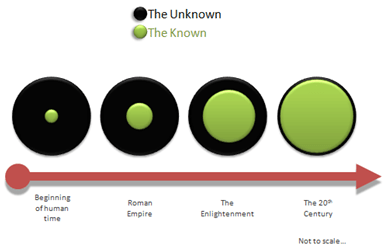
This is undeniably true. However, the view that I presented in The Shiny Ball of Atheism is misleading. To refresh your memory:

This implies that mankind should have hope that one day we will vanquish the unknown, and from there we derive the creed of the atheist Faith: God will no longer have a place to hide from the cleansing light of rational analysis.

The reality is somewhat different. Each discovery we make, each breakthrough we achieve, brings up new questions that we didn’t even know to ask before the breakthrough.

When cavemen discovered how to light fire on their own did know to question how is flame affected by gravity. They didn’t even know it was possible to be in zero-gravity. Flame in zero-gravity was, to quote Donald Rumsfeld, an “unknown unknown“. When Copernicus published his treatise showing the earth moved around the sun, he didn’t know to ask are collections of stars (galaxies) always centered on black holes. Ernest Rutherford, when proving the concept of a nucleus in an atom (a relatively new concept), had no concept that the atom was way more complicated that neutrons, protons and electrons. But we’ve now learned to seek the answers to these new questions because as we answer more questions we uncover more questions to answer.

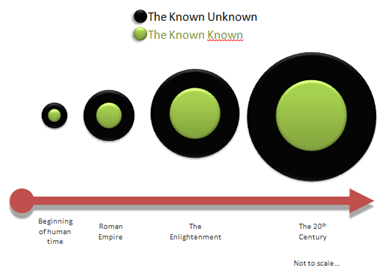
A better view of the “relentless increase in the things we’ve proven about the universe” is:

We are increasing the amount of the “Known Knows”, but each time the amount of the “Known Unknowns” increase with it. Answers beget more questions. And we have no idea of the size of the “Unknown unknowns”. The idea that the “relentless increase in the things we’ve proven about the universe” will remove areas for God to hide from the cleansing light of rational analysis is wrong.

Uncertainty

Let’s examine the second axiom: During thousands of experiments, we have found no evidence that proves the existence of God.

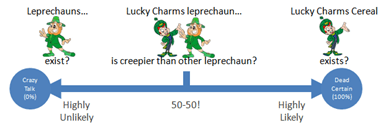
This is true. Now, let’s refresh our understanding of probability from The Shiny Ball of Atheism:

The lack of evidence does indeed suggest that the existence of God is “Highly Unlikely” among the Known. Similarly, the concept that time passes at different rates depending on gravity, which was contradicted by thousands of experiments done over centuries, was “Highly Unlikely” for most of mankind’s existence. But two possibilities remain for the existence of God:

First, like Gravitational Time Dilation, proving the existence of God among the Known may require tools or mechanisms of measurement not yet invented. Yes, based on current knowledge this is Highly Unlikely, but the counter argument is that to Galileo, it was highly unlikely that clocks on airplanes would have to adjust for the effects of gravity on time – yet they do.

But secondly, even if the tools for measuring God never emerge, if one believes that the concept of God may reside in the “Unknown”, current science, specifically Quantum Mechanics, suggests it is impossible to fully known everything. That is, we can never eliminate the “Unknown.” For this we can thank the German scientist Werner Heisenberg.

In the earliest Twentieth Century, Heisenberg theorized that, even if you can eliminate the tendency of an observer to change a measurement just by observing, it is impossible to measure anything to 100% accuracy. You can get very very very close (specifically, you can get to approximately (1 – (6.626*10-34)/2)*100 percent accuracy), but you can never be 100% accurate.

This theory is non-obvious, and even Einstein railed against it during his life, but it does allow us to successfully make predictions about systems (one of the key tenets of a successful scientific theory). The Uncertainty Principle, like the theory of Gravity and of Evolution, has been shown experimentally to be “Highly Likely” to be true.

And it has a staggering consequence. If the Uncertainty Principle holds true it is impossible to ever prove the non-existence of God. Religious fundamentalists can take the tools of rational debate, and just argue that the concept of God resides within the uncertainty, and while we can argue its improbability, we must concede its possibility. Put another way:

Rational thought suggests it is impossible for rational thought to prove everything.

Skepticism

And finally the last axiom: The culture of science, correctly, puts huge value on skepticism.

Again, this is true. And the Fundamentalist Atheist maintains that this skepticism is one of the foundations of rejecting the existence of God.

But to maintain a firm stance in Atheism (which is the unquestioning belief in the non-existence of God) fundamentally violates this rule. It is not a culture of skepticism; it’s a culture of Faith. When you look at the evidence with a skeptical eye you see:

  1. Evidence suggests God does not exist in the Known.
  2. Evidence suggests there are some advantages to believing in God, and that all growing cultures, independently, invent some concept of God.
  3. Evidence suggests we are constantly discovering new things to discover and trends suggest that will continue.
  4. Evidence suggests that it is impossible for rational thought to fully explain everything.

Therefore a rational thinker should conclude that it is unlikely that Religious fundamentalists have a leg to stand on, but it is equally unproven that unquestioning Atheism has a leg to stand on.

Where does that leave the rational skeptic? I believe it leaves him or her on the Pragmatic Path of Agnosticism.

(which I’ll continue next week…)

– Art

Help me raise over $10,000 to help people suffering from cancer

(1) For this article I’m going to use the term God to mean either “the existence of a God or Gods, or the reality of Spirituality”; please don’t take it as an endorsement of any particular instantiation of Spirituality, just as way of avoiding typing long phrases over and over.

The Wrong Way to Run Naked

This is somewhat timely given the essay I’m in the middle of. A Catholic Priest was arrested last week in Frederick, Colorado in the US for running naked at a high school track.

See the full article here: Priest Busted For Running Naked.

In case anyone is wondering, this is not how I recommend “Running Naked“.

– Art

Help me raise over $10,000 to help people suffering from cancer