Category Archives: Processes

Staying Sane: Do Less More

(5c of 5 in The Rules of Naked Management)

Trying to stay sane as a manager? This is the second step in doing that.

Why Do I Write This Blog?

It’s Friday at 6:30pm now, and as I write this I’m asking myself why. It takes time for me to this, time that would be spent on Vlideshow, time that could be spent at the gym, or time that could be spent having fun. It’d be so much easier to just punt this, and “do it next week”.

Heck, would it really matter if I didn’t write this at all? I mean it’s important to me in the long term as part of my philosophy of running naked(1), but it’s not really urgent. I think I’ll skip it this week.

The Trap

The reality is I have more things to do each day than I can possibly do in the time allotted, and several of those are urgent things. Today for example I had a meeting I agreed to take with another entrepreneur, I had a meeting scheduled with a recruit, I had some Flash coding (yes… I’m writing code these days) for my upcoming Vlideshow user test, a call with a business mentor, a meeting for a board I’m on, and a bunch of other things. And I had to write this blog entry. I was totally overcommitted today, and I knew it as soon as I got up.

I’ve mentioned it’s a trap; and it applies to the Entrepreneur as much as it does the manager. As you progress as a manager and get more successful, you’ll be asked to do more and harder things, but because they are harder things you’ll actually be able to effectively do less and less. The traditional answer is to delegate (less of an option for me these days), and while that’s necessary, it’s not sufficient. You’ll find that even after you’ve delegated all the things you can away, you still have more to do than is possible. You need to do more than just that.

The Answer

The answer is simple: don’t try to do everything. Do less. And the trick to that consists of two parts:

  1. Learn the difference between important and urgent tasks and concentrate on the important.
  2. Recognize you’re not going to get everything done, and choose the right things to not do.

Let’s talk about the first one of those parts.

Urgently Important

Urgent tasks demand attention. Urgent tasks are the person from finance yelling for your quarterly sales projections; Urgent tasks are your boss demanding you to fix a programming bug that is crashing your company’s website; Urgent tasks are the instant-message window that just popped up from a friend asking where you want to go for dinner tonight. Urgent tasks are the e-mail from a development manager asking you to read a 12-page product presentation they have and give them feedback in 2-hours before their meeting with the CEO. They are the things that if you don’t respond in the moment, someone gets upset.

Important tasks are the things that if you don’t do will eventually result in you failing in your goal.

But, it’s worth noting that not all tasks are urgent, and not all tasks are important. Some tasks are urgent but not important (e.g. responding about dinner). Others are important but not urgent (e.g. for me, writing this blog entry). Broadly you can categorize any tasks you have based on how important and how urgent they are and figure out which of the following categorizes it belongs in:
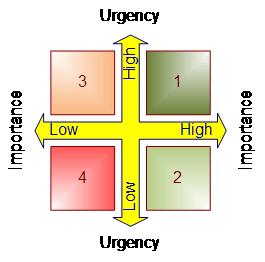
The trick do “Doing Less More” is simple. Each day:

  • Do all the tasks in box 1 that must be done;
  • Do at least one task in box 2;
  • Try to avoid tasks in box 3, but recognize you’ll have to do some of them;
  • Don’t do any tasks in box 4 until they “graduate” to box 3.

Doing Less More

As usual with me, this isn’t something that I invented. Lots of folks have recognized the difference between “important” and “urgent” (sometimes called “tactical” and “strategic”). For example, see Getting Things Done. But here’s how I do it.

  • I maintain a list of “strategic” things I need to do (with corresponding due days), and a list of “tactical bullshit” I need to do (with corresponding due days).
  • Every night, I create my to-do list for the next day. I used to do it on paper (in a black book I would carry) but these days I just do it in Microsoft Word. I always leave the top entry on my to-do list empty to start.
  • I fill in the remaining entries with first any urgent and strategic things that must be done (box 1 above).
  • I then start listing any items from box 3 that must be done tomorrow.
  • And then, I look at box 2. I take one item from box 2, and I fill in the blank top entry on my to-do list. That becomes my top priority for the next day.
  • In the unlikely event that my to-do list has less than 5-7 entries, then I add other things from box 2 to the bottom of the list.
  • If my entry has more than 7 entries, I look at every entry below 7 and find some way to punt it (e.g. delegate, or just don’t do it). Seriously – I kill those puppies. I don’t do it. It sometimes means I piss people off, but that’s the nature of killing puppies.
  • Then, the next day at work, I start working off my list and I DON’T STOP WORK UNTIL THE TOP TASK ON THE LIST IS DONE.

There are two odd things about how I do this (different that things like GTD recommend):

  1. I prioritize one non-urgent but important task (box-2) above all the other urgent-and-important tasks (box-1). Why? In the short term (when I started doing this) it meant I had to work hard to get through all my box-1 tasks and get the box-2 tasks done, but after a while the investment I made in “farming” box 2 started paying off, and my box-1 tasks decreased (because I wasn’t procrastinating as much).
  2. I choose 5-7 tasks because as a manager I found most tasks took me about 10 to 30 minutes, so doing 5-7 filled up about 50% of my day, leaving time for other interrupts. If a task takes longer than 30 minutes, then I schedule fewer things for that day. You need to recognize as a manager that at best 50% of your time will be under your control.

It sounds like a lot, but with practice you can get very fast at it. At this stage, it takes me 60 seconds to do this exercise every night. Most folks I know who have similar systems also spend no more than 1-2 minutes each day maintaining it. And during the day, as things get out of plan, I just start jettisoning things lower on the list. For example today, I punted on my flash code so I can write this blog (which since it’s not on my software critical path right now, is the right decision to make).

What Happens When You Do Less

A strange thing happens when you do less. I’ve found that once I started doing this, I pissed off some people in the short-term, but usually (sorry) they were people who cared about non-important tasks, and there was little long term damage to me. But I also found I developed a reputation for getting “important things” done, and people started giving me more important things to do.

Why is that? Well, come review time it becomes obvious: people care that you got the important things done, not that you reacted quickly to some urgent tasks 4 months ago.

What Happens When You Don’t Do Something

Still, just deciding to “not do something” may seem hard. And it is. But fortunately, there are ways to make that easier too, and that’s what killing puppies is all about. Which I’ll continue next week.

– Art

(1) In the short term it absolutely wouldn’t matter. I know that. But in the long term, if punting became the pattern, I’d lose sight of my goal of Running Naked. I pledged to write long pieces about once every week exploring different topics that are important to me, and if I can keep a track record of doing it, I believe the discipline will help me think through a lot of my approaches to life, and ultimately help make me a better person.

 

Staying Sane: Love Thyself

(5b of 5 in The Rules of Naked Management)

Trying to stay sane as a manager? This is the first step in doing that.

My Wife Is Flawed

I love my wife deeply; those of you who know me closely know how true that is. We started dating almost fourteen years ago, got married six and a half years ago, and I am more in love with her today than I have ever been.

But allow me to bitch for a moment: my wife isn’t perfect! Were she a diamond in a jeweler’s hand, he’d spot all sorts of inconsistencies, imperfections, and flaws(1).

I know: woe is me!

Aw Shucks…

Yet, I love those inconsistencies, and I love those imperfections. I accept and would not want to change any of those flaws, even though I’ll admit I don’t understand some of them. To me that’s the nature of love: truly accept what you cannot change.

My wife may not be perfect, but I still wouldn’t change a thing: she’s perfect for me.

Filling The Gaps

OK, hopefully you’ve finished throwing up now. Although I do mean what I wrote above, this article is still about Naked Management so let’s get back to the topic.

Let’s talk about personal growth and how most of us approach it.

Early in my career I took a look at myself, set a vision, and asked what I needed to achieve to get there. I then identified gaps to fill, imperfections in myself, and started filling them in.

  • I felt I needed sales experience? Check, I joined a sales team.
  • I felt I didn’t know how to effectively influence executives? Check, I designed a modification of my boss’s organization in my head and then influenced a reorganization.

This was the path I followed for several years until 2004: find the next flaw, the next weakness, and fix it.

Falling Into The Gap

At first I got huge returns on my investments, but gradually “filling the gaps” became harder. For example, in 2002 I got it into my head that I needed to learn more about design and pick up some skills in that area (I picked voice design because that was what was done at my employer). I started (as a sales-engineer) suggesting designs for automated phone system interactions.

Today I’ll happily admit any of my attempts (which took hours of work on my part) were easily bettered by 5-minutes of effort on the part of one of Tellme’s talented designers. Worse, my meddling efforts pissed off several designers, so not only did I fail to pick up this skill, but I did myself measurable political damage.

Talentless Hack

In retrospect the reason I never got good at design is because inherently it’s not a skill; it’s a talent. Some things are inherent talents; you either have it or you don’t. You can improve upon the talent by learning new skills(2) and someday you can become great! But if you don’t have a talent for something, you can work hard, learn all the skills you can, and at best (with a lot of work) you’ll be merely good. Only with an innate talent will you achieve greatness.

And when it comes to interface design, I have anti-talent.

Now the difference between talents and skills is well recognized, and the advice given by many people on it is quite good. I’ll summarize. To become great in your career:

  1. Invest heavily in skills that hone your core-talents; under-invest in skills that attempt to hone talents you don’t have.
  2. Avoid positions and circumstances that require talents you don’t possess; instead try to change the circumstances to rely on talents you possess.

Official management doctrine does not suggest you ignore areas you don’t have talent in; only that you invest up to the point where it is no longer a show-stopper for your career, but no further. Better yet is to avoid (or delegate away) the responsibilities that require a given talent.

But there is one thing extra you must do that I didn’t realize until 2004, and it relates back to the fact that I love my wife.

Anti-Talents

I believe I have a talent (which is not say I’m great at it, only that I have an innate passion and ability for it) that separates me from most people: I love and thrive in times of change and chaos. My adrenaline fires up when things are going wrong and I work hard to bring about change to fix a problem. But this talent(3) comes with two flaws, one of which I always realized, and one of which took me until 2004 to realize.

The first anti-talent, the one I’ve known for years, is that when things are not in chaos or the chaos is something I’ve seen and know how to solve, I get very unhappy. Once a problem is fixed, I get bored. Once the chaos is in order, I’d rather gag myself with a spoon all day than go to work. I’ve learned to work around this by hiring people who love and excel managing during good times, and then getting out of their way.

But I only realized the second flaw in 2004. I (like most people) have a large ego. OK, I have a super large ego. Sue me. And I believe given a little time and some resources, I can solve any new problem. I still believe that today.

But the flaw was I believed I could change anything about myself: I inherently believed every flaw I have was fixable. Every imperfection was smoothable. And as I continued on my path of career growth, and my ability to change some things about myself started to wane, I grew more and more frustrated and threw myself more and more into trying to fix the unfixable. It ate me up alive.

While my burn-out occurred on a spectacularly fucked-up and mismanaged project, the reality is I was headed in that direction anyway by following the personal growth path of fix all flaws.

In short, I did not love myself.

Sanity and Love

And that’s the first trick to staying sane: Accept and love yourself.

I started out this essay by pointing out that I love my wife. That means I love both her good attributes and her imperfections. And I accept those imperfections and don’t try to change them (well, except for her penchant to remind me I’m too wordy in my writing; she’s got to stop that!).

In 2004 I realized I needed to do the same for myself. I needed to accept that although there were things I didn’t like about myself, some of them were unchangeable and I had to accept them. I will never be a great designer. I will always get bored with day-to-day operational tasks.

And my fatal flaw? The one that ultimately felled me in 2004? I will always be compulsively obsessed and addicted to something. In 2004, it was my job. I had no sense of balance and was putting my job before everything else in my life: my wife, my family, and my health.

For me it took of a crisis to jar me to life, but I’ve come to accept this flaw in myself, and now I try to use it as a talent. I’ve been trying to apply my compulsiveness to building a balance of body, mind, spirit and soul, as opposed to just succeeding at a job. And since doing that, I’ve also learned how to be more effective at my jobs, and much more content at my place in the Universe.

For each of us the flaws are different, but the key step in keeping your sanity is the same:

  1. Know your talents
  2. Know your flaws
  3. And while you should always try to improve, accept that you are who you are.

If you can do that, the other steps in keeping your sanity are just details. Really.

– Art

(1) Now, I’m not the world’s smartest man but I’m also not the world’s stupidest man, so I’m not about to detail those flaws here. Suffice it to say she has flaws.

(2) As usual, I’m not the first person to realize the distinction between skills and talents. Here’s another framework recommended to me by my friends Naomi and Rich for understanding the difference, and a tool that helps some people discover their talents versus their skills.

(3) I believe all talents come at a cost, and everyone who is insanely talented in one key area is also fatally flawed in another. And nothing they can do will ever remove the fatal flaw; they just need to manage around it. It’s almost like we were given $100 to spend on talents when we were created, and some of us choose not to spend it evenly on all talents. I imagine Jimi Hendrix choosing to spend $99 of it on musical talent, leaving self-control underinvested in. But on the flip side, if we didn’t do that, how much more boring and ugly would this world be?

The Rules For Keeping Your Sanity

(5a of 5 in The Rules of Naked Management)

In prior entries I talked about the keys to running naked teams: Figure out the most important thing, run a naked team, grow your naked team, and grow the individuals on your team. With all that stuff to follow, how can the Naked Manager stay sane? That’s what this last article focuses on.

The Management Paradox

A trap awaits the successful Naked Manager. It consists of two truisms:

  1. You will be asked to do more and harder things with each success
  2. You will be able to do less and less with each success

The first truism happens because other managers always give their stars more and more to do – track-records are valued more than anything else. The second truism occurs because the problems get harder, require more time, and require more thought, and despite efforts by scientists to solve the problem, there remains only 24 hours in each day.

Left alone most managers at some point (myself included) fall into the trap of taking on more and more and relying on brute-force, intellect and ego to keep up the track record. Some managers (myself included) eventually cave under the pressure.

It happened to me in 2004. I feel into the trap of working 80+ hour weeks for three months in a row and I spectacularly burned out in my job and had to take 3 months off to recover. It was the second biggest failure of my life(1), but…

Breaking the Paradox

…I had the luxury at the time of working for a company that welcomed me back (which I’ll be forever grateful for) and the time off gave me some time to create a new framework to approach my job (and my life) with, which I applied and tweaked in my next go-round of the management merry-go-round. In reality what happened was one of the best things to ever happen to me.

This series of mini-articles will detail the approach I came up with to stay sane. These are the steps:

I’ll fill in the links as I post the details. I can’t guarantee it’ll work for everyone, but I’ve had some other friends and co-workers adopt the framework and reviews are very positive. Stay tuned for the details…

– Art

(1) I may write one day about the first. However, in both cases, the lessons I learned from the failures far outweighed the pain of the failure. I’m become a real believer that failures are the key to growth in all aspects of life. In the first failure I learned what it means to really love another person (my now wife). In the second failure I learned what it really means to love myself (and no, that’s not a masturbation reference 🙂 ).

Growing Individuals: Fire Your Stars

(4f of 5 in The Rules of Naked Management)

You’re Fired!

In the intro to this section, I laid out my argument for why you should “fire your stars”, but to recap:

“Fire your Stars” means tangibly change the responsibilities of the best performer on your team (and optionally change their title and compensation), even if it means transferring them to another group in the company.

This goes counter to most management advice which says retain your stars at all costs, but I say “Fire your Stars” because:

  1. Without action on your part, your stars will leave anyway.
  2. By “Firing Your Stars”, you can control the timing and circumstances.
  3. Your team becomes more resilient.
  4. Your team’s morale increases.
  5. Your team’s performance reaches a higher level than before.
  6. And damn it, it’s the right thing to do for your Stars anyway.

See the intro if you want the background for why these things happen.

Your Goal

This part of Growing Individuals is deceptively simple. You’ve already identified the top performer on your team (you did it as part of Putting Your Money Where Your Mouth Is). Now, you need to set the following goal for yourself:

Within 12 months since your last top performer changed responsibilities, you will change the responsibilities of your current top performer.

That’s it. Once every 12 months should give you a maintainable rate of change. You can “Fire more Stars” if you think your organization can handle it, but the minimum is one.

Now hitting this isn’t easy, you have to do lots of things:

  1. Understand and anticipate potential opportunities for your Star within your organization or other organizations.
  2. Pre-sell potential stake holders on the change.
  3. Aggressively make your Star fill any gaps that would preclude success in the new role.
  4. Balance the reality of your organization (probably slow moving) with the expectations of your employee (wants fast change).
  5. Handle unexpected realities, such as another person quitting unexpectedly.

Worse, there is no cookbook to follow for this one either, because each individual is unique, each circumstance is unique, and each set of opportunities is unique. In other words, it’s hard.

But it’s the right place to spend your time growing individuals. It means in reality of the time you spend on “growing individuals”, you spend most time on just your top performer. But that’s ok, because by following the other rules you’ve outsourced most of the rest of the work to the other individuals on your team and as a result they are growing nicely on their own.

For The Unbelievers

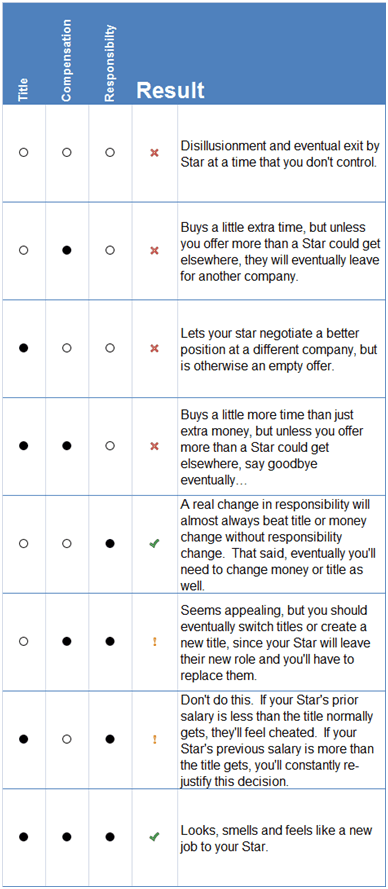
Some people will try desperately hard to retain their stars through other means. Usually they resort to compensation or title changes without actual changes in responsibility. I know I have before I figured out to Fire them. I can say with certainty, having tried all combinations of ways to keep stars that “Firing Your Stars” actually leads to the best retention for your company (if not your team). Here’s a quick summary of what I’ve experienced when I had a star who wanted to grow and changed some combination of title, compensation or responsibility.

A black circle represents something changed (for example, on the first entry, I changed nothing, resulting in the Star deciding to leave the company on their own):

One Last Caveat

The key thing about “Firing Your Stars” is making sure your Star has new responsibilities. But it only works if your Star feels that they are genuinely new responsibilities, and that some of her old responsibilities no longer need to be done directly by her.

I’ve tried, and seen many managers try, to spin an increase in responsibilities as a “new job” to an employee and they see through that bullshit immediately.

Here’s the key rule of thumb: if your Star does not perceive the change in responsibilities as a real step forward in their career, then you have not “Fired Your Star”, you’ve pissed them off. Very different.

Managing The Naked Team

Still, I believe if you run a naked team, grow a naked team, and grow individuals, you’ll end up with the strongest of teams you could possibly have. But, as GNP pointed out, it’s a lot of steps to follow. How the hell do you do all this without going crazy? That’s the next topic.

– Art

Growing Individuals: Crack the Whip

(4e of 5 in The Rules of Naked Management)

A Coach or a Friend?

I started taking swimming lessons a few weeks ago. I’d started training for my first triathlon and I didn’t know how to swim.

My coach, Gus, is also a friend and I’ve spent a lot of time hanging out with him and his family. We’ve been to soccer games together (“Football” for the more worldly readers). I’ve babysat his kids. I’ve ridden hundreds of miles with him at my side. He’s a very good friend.

This morning I had a typical coaching experience with Gus. I had just finished a 50-yard dash in the pool, my breathing was heavy, and my legs were burning. I wanted nothing more than to rest and catch my breath. I looked up at my friend Gus and said “give me a second”.

But my friend wasn’t there. Instead my coach was, and he just said, “No. Do it again.” And I was off. Dear God, sometimes I hate my coach.

Now here’s the interesting thing: I am a much stronger swimmer today than I was four weeks ago.

Of Carrots… and Sticks

The last two parts of this essay talked about what you need to do to get an employee growing their career:

That’s good, and in reality most of the work that must be done is borne by the employee. So far, as a manager, you haven’t had to sweat, and as I’ve always said, laziness is good.

But all that was carrot. For many people carrots aren’t enough – it’s always easy to “start tomorrow” or “wait until next week”. Sometimes you need a stick to get folks moving.

Coaching

Earlier I cautioned managers to get over themselves and realize there isn’t that much they can do to force someone to grow their career.

Now I’ll modify that slightly: assuming you’ve done the stuff mentioned above, there is one thing you can do: you can be the source of honest feedback on whether progress is being made, and you can reward and punish if progress is made or not made.

To do that, you need to remember you’re not a friend, you’re a coach. And sometimes Coaches need to ‘crack the whip’, or ‘be harsh’ or ‘be demanding’ in order to get the most of their charges(1).

That’s what Gus was doing this morning, and that’s what you need to do too.

The Whip

Now I’m not recommending you keep a whip by your desk (although I’ve known someone who did that). Instead, be serious about managing your employee to complete their small steps, rewarding them when they do, and punishing them when they don’t. Small steps are measurable and are black-and-white: Your employee either scheduled the mentoring lunch or they didn’t. They either signed up for the PMI course or they didn’t. Don’t worry about the larger goal – the employee will track that. Instead, just remember what small thing they said they would do, and hold them to it.

As usual, everyone has a different style with this, but here’s what I like to do. I track the one small step each employee told me they would complete, and when they would complete it by. And then every time I meet them, I ask them for status. EVERY DAMN TIME (Several folks who’ve worked for me will tell you how annoying I am about that(2)).

I make it their #1 goal on their goal list for the quarter. When they miss the step, I tell them I’m disappointed but make them set and tell me another one. And if they consistently miss their small step goals, then I start trying to move them into some other position (or “manage them out”). I reward in reviews those who made their steps; I don’t reward those who missed them – even if the rest of their work was stellar.

In reality, I’ve had a few employees miss their first and second steps, but never more than that. My experience is that your employees get really serious about following through on their career growth goals (or they leave) when you start tracking their small steps closely.

Self-Flagellation

Sometimes you’ll have an employee tell you they think their next small step is to “have my manager talk to Bob in Operations about a transfer to his department.” Yikes! This goes against my principle of laziness: your employee is trying to get you to do something, and if you don’t do it they can claim that you caused them to miss a goal, and if you do it, you could lose them! They’re trying to get you to crack the whip on yourself.

OK, don’t panic!

First, do you think that’s the right next step for them to take? If it isn’t, you’re their manager, and can tell them to pick another step. If this person isn’t a star on your team, you have a duty not to pass him or her on to Bob (and they should NOT be surprised to find this out). You should make your employee aware of where the gaps are and encourage him or her to start fixing them.

But what if you person is a star… well, that’s fine too, because if you’ve been tracking closely, you’re now about to fire your stars…

(which I’ll discuss next week, unless I’m too stuffed from Holiday feasting).

– Art

(1) I do believe coaching is about 50% teaching, 40% motivating and only 10% cracking the whip, but all the earlier stuff I’ve talked about covers the first 90%.

(2) No comment on other things I’m annoying about.