Category Archives: Organizations

The Rules of Naked Management

Pop Quiz

What’s the most important thing a manager does?

Sure, a manager has to “get stuff done through a group of people”, that’s a given, but what’s really the most important thing? Is it training your team? It is hiring A+ people? Is it keeping executives informed? Is it growing your employees’ careers? It is protecting your team from the “craziness above”? Is it removing roadblocks for your team? Is it keeping morale high? ….

The First Time Manager

The first time I became a manager I asked a lot of folks that question, and read a lot of books and articles. And I got all sorts of answers back. Every one of the items above was “the most important thing” I needed to do according to some sources.

I tried to follow a lot of the advice the first time out, without really understanding WHY I should follow it, and I’ll bluntly say I wasn’t successful at it.

Sure, the individuals who reported to me got all the stuff done my managers wanted done, but my victims employees had to put up with a lot of mistakes as I learned what being a manager was actually about. Certainly at no point did we have a team working to achieve the same goals. In reality I was just an individual contributor checking in on other individual contributors, playing at being a manager, and usually just getting in the way (see pigeon management). Two of my employees ended up quitting, and another (high performer) transferred to another group to avoid me.

In retrospect I realized it was because I didn’t have my own answer to what’s the most important thing a manager needs to do. So for my second big outing as a direct manager, I tried a different approach: I figured out what’s the most important thing I needed to do as a manager, and then I did that. I didn’t worry about any of the other crap unless it directly helped the most important thing.

And I got more successful.

So, what is that “most important thing”?

The Rules of Naked Management

Well, that’s what the next series of articles is about. Some folks have asked me to write a little more about the concept of naked teams, and how to be a first time manager, so here goes. In this series, I will talk about:

  1. The Most Important Thing A Manager Does;
  2. The Rules for Running Naked Teams;
  3. The Rules for Growing Naked Teams;
  4. The Rules for Growing Individuals;
  5. and The Rules for Keeping Your Sanity

My apologies to anyone who has been through this before, as this series of posts is based on some training programs I developed for first time managers. But if you’re a first time manager, think you want to manage people, or have been managed by someone and you wish would be a “naked manager”, then hopefully this series will be useful.

As usual, there’ll be at least one update per week.

The Rules for Rules

This series will be laid out in a series of rules, with reasons why the rules are the way they are. You’ll see there are quite a few rules to follow. To help guide you in how to follow the rules here’s the two most important rules.

If you take NOTHING else from this series of articles, just remember these two rules and you’ll be well served:

#1) Rules should be followed

I’m not claiming I came up with these rules myself. They are based on my experience (yes) which I’ve now reapplied successfully many times. But they are also based on studying at a lot of effective managers at companies I’ve worked at, and at effective people in other companies. They’ve been tested on thousands of employees. And in general they just work. If you see a rule, and you’re doing the opposite, you owe it to yourself to ask, “why am I not following this rule?” Usually you’ll find you become a better manager by following the rule.

Still think you shouldn’t be following the rules? Swallow your pride. Put your ego aside. Shut up and realize you’re no different than anyone else. Seriously! That “special circumstances” bullshit doesn’t fly here. You’re not really different. Follow the goddamn rules!

Still think you shouldn’t be following the rules, and you have “good reasons” why you shouldn’t? Well, enter rule #2:

#2) Rules must be broken

Management is an art, not a science. If we could break it down into a series of rules that are followed 100% of the time, then some smart person would write a computer program to be a manager and I for one would welcome our new management overlords.

But management is an art, and as with all art, requires judgment to be effective. If you’ve tried to follow rule #1 above, really put your ego aside, and still think you should not follow one of the rules, then break the rule. Truly great managers, like truly great artists, don’t follow the rules. However, like truly great artists, they KNOW the rules (e.g. Picasso learned classical painting first), KNOW when they break the rules, and KNOW how they break the rules.

Trust Yourself

Put another way, rules are no substitute for judgment, and over time you’ll find your own way through this mess. So please read and learn these rules, but ultimately you’re going to have to learn to trust your own judgment and discard the crap (mine included) that folks tell you about management if it doesn’t work for you.

I’m just sorry I had to experiment on Jim, Nolan, Craig, David, Aileen and Scott to figure that one out (sorry guys).

– Art

Help me raise money for people suffering from cancer

Starting a Company with Boxes and M&Ms

This article talks about the importance of projecting confidence while innovating, but that your confidence needs to be firmly based on principles, and regularly subjected to transparent review. It also has a short teaser about my new company and a commitment about that company.

The Law of the Box

Think back to high school. You’re wandering through the hallways skipping your class and a teacher sees you – It’s an instant recipe for detention.

Now, imagine the same scenario, except this time you’re confidently carrying a box on your shoulder when the teacher sees you. Suddenly the teacher assumes you’re doing something for another teacher, and lets you pass.

By looking and acting like you know what you’re doing, you can directly influence the behavior of others, even when there is no way you could actually know what you’re doing – This is the Law of the Box.

I first discovered the Law of the Box while carrying a box of text books for my English teacher in 9th grade: Three different teachers let me pass without even blinking.

Once I recognized the phenomenon I kept a collapsed cardboard box in my locker. I would skip class, run to my locker, reassemble the box, and walk off campus to get bagels, confident that I would not be stopped by any teacher for any reason. (I was a nerd in high school, but I was a sneaky nerd.)

Evil and the Law of the Box

The Law of the Box is a very powerful tool in the hands of fourteen year old kid. In the hands of an adult, the ability to project confidence in the face of the unknown can be even more powerful, and like Faith can be used for both good and evil.

It’s the evil examples we remember most. By looking like you know what you’re doing, by following the Law of the Box, you can do horrible things (even if you think your principles are sound). For example:

  • You can convince employees to invest and lose their retirement savings in your company;
  • You can convince 38 people to commit suicide simultaneously; or
  • You can convince a country to invade another country to rid a dictator of weapons of mass destruction.

As I start my own company(1), I’ve given a lot of thought to the Law of the Box. To some the Law may seem Machiavellian, or manipulative, and just plain wrong. And it can be.

But the truth is all successful people follow the Law of the Box at times. And in order to accomplish anything truly innovative with a team of people, you absolutely must follow the Law.

It cannot be avoided.

So if following the Law is necessary to do something innovative, and I will be forced to use it as I get my company off the ground, how do I ensure I use the Law of the Box for good?

I believe the way to do it is state clear principles that we’ll operate by (with Mr. Bush did do), but be transparent in my decision making (which Mr. Bush did not do). In other words, I must Run Naked.

Read on for why.

A Confidence Game
I made the claim that “all successful people follow the Law at times”. Does that mean that all successful people claim confidence in an area they really can’t be confident in? Yes, it does. Does that make them conmen? Not at all!

Take the world of medicine again… Doctors are constantly treating people with unknown illnesses. (In fact during the diagnosis stage, all patients have “unknown” illnesses by definition.) But good doctors are trained to always present themselves with confidence even if they don’t know the actual problem, and while they try not to lie, they do present their thoughts in a way that attempts to maintain the confidence of the patient.

For example, my mother tells me that she has “primary idiopathic hypertension” and that her doctors are on top of it and treating it well. “Primary idiopathic hypertension” is the official name of her illness, and I believe her doctors are, in fact, treating it extremely well.

But my mother has no idea that “primary idiopathic” just means “the most common form of blood pressure, but we have no idea what’s causing it”. Her doctors present the term to her in way that disguises the uncertainty, my mother feels more confident, she takes her medicine, and hence feels better. (If you like “idiopathic”, also check out “iatrogenic,” another term often thrown around by doctors.)

Physicians are not doing it to be malicious – they are doing it because they know that if a patient loses confidence their chances of a successful recovery decline. In other words, it is in the best interest of the patient for the doctor to act with confidence.

I’m not harshing on doctors – I have immense respect for anyone who goes into that field. My point is in order to effectively do their jobs in an inherently uncertain environment, they must always look like they know what they are doing, or patients will lose confidence and get sicker.

Doctors follow the Law of the Box. So does any person who needs to change, inspire, comfort, lead or manage other people in an environment of uncertainty.

Innovation, Faith & Confidence

This is why innovators and entrepreneurs must follow the Law of the Box all the time. By definition, if you’re accomplishing something new and innovative, you’re doing something that has never been done before. It’s therefore completely impossible for you to actually know completely what you’re doing.

Like with doctors, lack of confidence is contagious; if you don’t project confidence, your team will not weather the squalls of uncertainty that you’ll encounter on your voyage.

Could Columbus have manned a fleet of 3 ships to find a “passage to India” if he had not projected confidence in his ability to navigate (which he clearly overestimated)? Unlikely.

Could the US government have maintained the support of the nation to put a man on the moon of they had not projected complete confidence in their ability to safely do it? Unlikely, and yet if you look inside the Apollo program you see countless examples of uncertainty, and even cases of death on the way to the goal.

To innovate, you must (1) have Faith in your mission and (2) you must project a confidence in excess of the facts on the grounds (the Known) in order to keep your ship sailing. You must follow the Law of the Box.

Hippocrates liked M&Ms

So, the Law of the Box is pervasive, must be followed by all entrepreneurs, and can be used for both good and evil. How does one ensure it is used for good?

Again, let’s return to the medical world. Doctors, a group of the world’s best confidence-men and women, manage to use the Law of the Box for good. They do so by clearly stating the principles they operate by, and by having a method to ensure transparency.

The principle is Hippocrates’ oath: Do no (unnecessary) harm. Most every non-doctor has heard of this. And ask any physician and you’ll find they take the oath quite seriously.

But most lay people (non-doctors) have not heard of the medical culture and concept of M&Ms, and it is just as important as Hippocrates’ oath. M&Ms for doctors are not tasty chocolate candies – they are “Morbidity and Mortality” conferences. All major hospitals hold them regularly.

In an M&M conference, physicians present their own cases where their patient had a poor outcome and review their mistakes openly in front of their peers. They face critique. They get advice from other doctors on how do better in the future. They force themselves to get honest assessments for how well they live by the Hippocrates oath.

And in this way, they have a check and balance on their projections of confidence. Unlike Mr. Bush as he went to war in Iraq, Doctor’s regularly check themselves and hold themselves accountable to their principles.

In other words, doctors run naked.

How Naked is “Naked”?

But just as important as what happens in an M&M conference is what doesn’t happen in an M&M conference. M&Ms do not criminalize mistakes – doctors are human and recognize that mistakes will happen. They view the mistakes as a way to learn.

And doctors don’t open the M&Ms to the general public.

Wait, isn’t that a violation of Running Naked? Shouldn’t you Run Naked completely openly?

No.

The point of Running Naked is to make sure you allow some independent people to review how you adhere to your principles, but Running Naked does not require everyone to see everything.

In fact, you can often expose yourself, your organization and the world to unhealthy harm by being too naked.

It’s a balancing act of independence of your reviewers versus their familiarity with the problem space, and while I do believe you should lean heavily towards independence over familiarity, sometimes you must choose familiarity.

Consider this case of life and death. A non medical person may find it appalling that a doctor could deliver a fatal dose of a drug to a five year old child by misreading a syringe, and will often look to punish the doctor (for proof of this, just look at the medical ‘malpractice’ industry). But this is likely not going to help the emotional wellbeing of the patient’s family, the doctor in question, or the world at large, and certainty will not bring the child back to life. (It will often however help the legal malpractice attorney’s, and the patient’s family, financial wellbeing.)

An independent, but not public, M&M conference will look at the surrounding circumstances where the patient was in the emergency room, chaos was everywhere, and a split second decision needed to be made. The doctor being reviewed is a lot more likely to share unflattering details about his or her performance. The committee may see the doctor got distracted half way through filling the syringe when the patient’s heart beat stopping. They will see that the doctor tried to live by the Hippocrates motto, but made a mistake that any human could make, and will concentrate the remediation on fixing the system (as a result, some dangerous medicines now come in pre-packaged syringes that guarantee the correct dose).

In reality, they make the system stronger by not being 100% naked.

Want other examples of organizations that project confidence in a world of intense uncertainty, but still ensure they use the Law of the Box for good without being 100% naked? Take a look at how the FAA consistently projects confidence in the safety of the air travel industry, and how they use post-accident review processes to hold themselves and their industry accountable to their principles (note: these are mostly public, but not completely).

Starting a Company

So what does this have to do with my new company? I’m not posting exactly what the company is doing here because that’s not yet in the best interest of my (future) customers, team and investors. (I will tell you the company’s working-name is Vlideshow).

Instead, let me talk about confidence. To get this company off the ground, I’m going to have to deal with a lot of uncertainty. I am 100% confident there is an opportunity here, and a customer base with a need that we can serve better than everyone else. I am 100% confident that Vlideshow will meet that need with aplomb. But my confidence has many unknowns and assumptions underlying it. How can I be sure that my confidence guides me in a direction that will actually be good for my customers, team and investors?

To solve this problem, I plan to do two things. First, I will publish (openly) a set of Operating Principles that Vlideshow will live by. And secondly, I will set up a group of independent reviewers where I present the mistakes I make while trying to adhere to those principles for review and learning. This will not be a public review committee – as some of the things we learn would help our competition in ways that is not good for our investors or team – but the committee will have real teeth and I will follow its advice.

Now’s I recognize it’s lame of me to claim this post is about starting my company and not tell you what the Vlideshow product is, so if you’re curious as to what I’m up to, feel free to give me a buzz and I’ll happily chat with you about it.

I’m especially interested in hearing from you if you’re an engineer:

  • experienced in streaming media and/or web-applications;
  • always have an eye for scaling architecture but absolutely believe in “ship first, ask questions later”;
  • have a burning yen to change the world with the most fun product you’ve ever worked on; and
  • you’re up for some excitement (and some risk) in co-founding a company (I’d prefer if you’re based in the Bay Area or New York City).

If you’re that person, I want you to help decide the Operating Principles with me.

415-378-4554 is my cell, or e-mail me at “aclarke(at)vlideshow.com” (replace the (at) with @).

Thanks,

– Art

Help me raise money for people suffering from cancer

(1) For those who don’t know, I left Stolen Bases about a month ago to pursue my own company. It was a hard decision, and while I continue to believe in the Stolen Bases mission and assist the Stolen Bases folks (and they advise me on my new company), I was at a good transition point and I’m so excited about the opportunity my new company is pursuing I found I couldn’t stop thinking about it. So here I am.
The Story so Far…

Did you know, you can sign-up for an e-mail version of every post by clicking here
(and you can remove yourself at any time).

This is my 3-month anniversary of starting this blog. How time has flown. Thank you to everyone for their support (both financial and emotional) as I’ve been attempting this. And major thanks to my wife who, on top of everything else she does, somehow finds time to support me in this by listening, editing, and being supportive of the time this takes.

For any new readers I’ve picked up I thought I’d update my cheat sheet for the blog.

This is Running Naked, a blog where I’m chronicling in public my attempts to “achieve contentment through the pursuit of perfection“. (Don’t worry; I have no misconceptions of ever achieving perfection, but I believe that attempting to become a better human each day is itself the worthy goal).

Here’s a summary of the major posts so far:

Article

What it’s about

The Cortez School of Management

Why I’m “Running Naked”, how I got here, and what I’m trying to achieve.

How I Lost 25 Pounds by Being a Manager

A series of posts where I discuss 5 rules I’ve used for managing change professionally, and how I applied them to lose weight and get back in shape.

The Pragmatic Path to Agnosticism

A series of posts where I “run naked” on how I approach Spirituality and the nature of an Awesome Universe.

Pain, Suffering and Financial Loss

A plea for your help to raise money for people suffering from cancer, and for your support as I train for a 200 mile bike ride (September 2007) and the New York marathon (November 2007).

Why Doctors Use Soap

An introduction to a way of solving problems and tracking progress in both professional and personal contexts.

Nude Numbers

Week by week reports where I “run naked” with transparent data on how well I’m living up to my training commitments. The data is presented in SOAP note format.

Daydreaming, Laziness and Looking at the Negative

How I tackle goals in my life. Seriously J

There are other posts smattered throughout the blog, but those are the major ones. We’ll see where the next three months takes this.

Per a request from a few weeks ago, the next series of articles are going to be about managing and running naked teams. Stay tuned for “Nudity and the Modern Manager”.

If you have other requests, please e-mail me at “aclarke (at) abclarke.com”. Thanks again,

– Art

Help me raise over $10,000 to help people suffering from cancer

The Shiny Ball of Atheism

(2 of 5 in the Pragmatic Path to Agnosticism)

Imagine a Faith that has delivered miracles you’ve actually seen in your lifetime, other miracles that can be conclusively documented in prior lives, and that promises, based on an unparalleled track record, continued miracles in the future.

Imagine you have just been admitted into the leading seminary of that Faith, where you, surrounded by true believers and acolytes, are promised a position in the clergy and a chance (however small) to brush arms with the saints of the Faith, and someday perhaps be a saint yourself.

Imagine all that is asked of you to be part of this world is hard work, and strict adherence to doctrine. Officially, you can even worship another God if you’d like. What’s not to like?

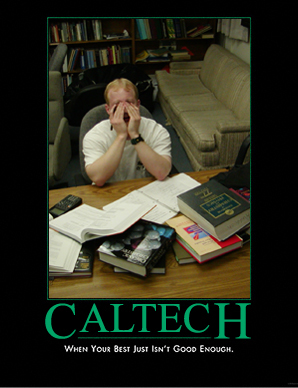
Do all this, and you’ve conceived of Caltech. I was admitted in 1992, joined a fraternity-like dorm, and found a new way of viewing life that would shape my outlook on the world.

It was here, after having rejected Catholicism in high-school, through using several of the new shiny tools and toys I was given during my education that I came to be a devout atheist.

The Scientific Method

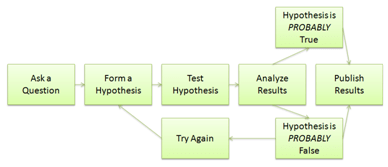
Science is founded on many principles, but few are more important than the Scientific Method. It’s a series of steps that are drilled into every budding scientist, and that you (should) follow throughout your career. You start by having a question you want to answer, such as “what does matter consist of” and then you go from there:

One of the key points in the method is how it determines truth or falsity. The method does not have to completely prove something – only show a hypothesis is consistent based on known data, is probably true, and can make some (falsifiable) prediction about the future.
If you can meet these three definitions, then your hypothesis achieves the coveted title of “accepted scientific theory.”

A Tangent on Probability

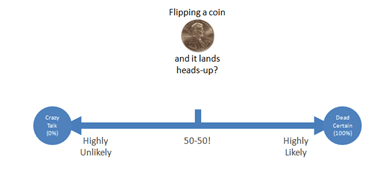
Many readers may be familiar with probability, but let’s go through a brief refresher. In science we talk of events occurring with a certain probability, and all we mean is, all things being equal, how LIKELY is the event to occur. Events can be very likely (i.e. more times than average, the event will occur) or very unlikely (i.e. more times than average, the event will not occur). Imagine placing an event along the following scale:

Now, this being science, folks like to apply numbers, and then usually assign probability a number between 0% and 100%. What does that mean? Well:    

0% is “it will NEVER happen” and 100% is “it will ALWAYS happen”. And 50% means “it might or might not happen”, or “50-50”, or “even odds.” Let’s consider the classic case of “flipping a coin”:

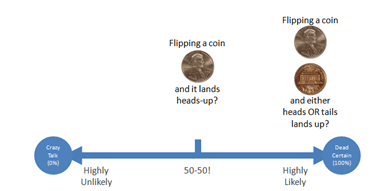
On average, you’ll get heads once out of every two coin flips. So, the probability of getting a heads (assuming an average coin) is 50%. What about the odds of getting EITHER a heads or a tails?

If you’re asked to bet $1 to potentially win $2 on this question, it’s probably a good idea to take the bet. You’ll win ALMOST all the time. But you might think the probability of getting EITHER heads or tails would be 100% or “Dead Certain”, but it’s not. Why is that? Well…

…it’s possible that the coin will land EXACTLY on its side. The probability of this occurring is very very small, but it’s not zero. So you can’t say the odds of getting EITHER heads or tails is 100%, just that it’s very close (say, 99.9999%).

That is an important part of the scientific method. It tells us what is PROBABLY true, but it is usually impossible to prove anything to 100% (one exception). Still, being PROBABLY true is usually enough, and is very valuable: you can use it to make extremely accurate predictions about the future! For example, I confidently predict the sun will rise tomorrow, but technically the probability of that occurring is not 100%.

And I’d guess most people can agree on the likelihood of the following events being true and make some accurate predictions about the future based on them (for example, will you find a pot of gold at the end of a rainbow tomorrow?):

Technically as an Irish citizen I’m require to believe it is possible leprechauns exist, but I know it’s extremely improbable. It’s also possible that Lucky Charms Cereal does not actually exist (e.g. we all live in a Matrix like world), and I really hope it doesn’t, but it is extremely probable that it does exist.

March of the Scientists

Seems boring (it often is) but this method, in various forms, has been followed since the ancient Greeks, and the results have been outstanding. Think of the miracles that science has brought us, and almost all can be attributed to consistent repeated application of the scientific method: the theory of gravity, plastics, flight, nuclear power, and computers to just name a few. Consistent application of forming hypothesis, doing tests, examining data and repeating: in this way, we have uncovered the world.

And coincident with the rise of this method, a culture has arisen among scientists, and Caltech is no exception among them. It is a culture of intense optimism in the belief the science can continue its rapid progress and illuminate more of the universe. And it is a culture of intense skepticism, questioning those who believe in things that science has proven to be false but also (usually) relentlessly questioning the things that science has already proven to be true (a good example is how Einstein questioned Newtonian gravity and as a result brought a deeper understanding of that theory). (Note: in its purported focus on self-questioning, science is differentiated from almost all other faiths, and certainly all mono-theistic faiths I know of).

What does this have to do with God? I had struggled with the concept of God, and my struggles intensified as I learned more about the world. Even before I went to college, I had formed a belief that the world was divided into things we knew (could prove) and things that were unknown (we hadn’t yet proved or disproved), and I was trying to rapidly expand the former. God and the concept of spirituality firmly lived in the world of the Unknown for me.

Caltech showed me was a way to rapidly expand what we knew, gave me a set of tools that could be used to achieve that goal, and imbued me in a faith that we will continue to make progress.

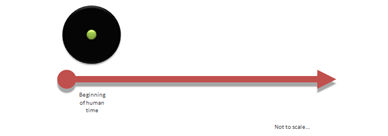
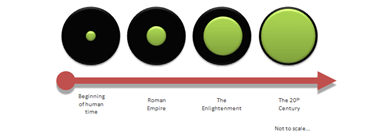
I viewed the world at the start of mankind as being mostly “The Unknown” with a small set of knowledge (e.g. how to make fire)…

…and that over time through the application of the scientific method we’ve rapidly expanded on the amount we know.

The more we looked for spirituality in the world of the known, the more we failed to find it, and we were rapidly running out of “unknown” areas where spirituality could hide. Evidence of the existence of God was scarce. In fact, the data and experiments done by mankind over the last 2,000 years, and especially since Darwin, have pointed towards the improbability of the existence of the God I grew up with (and certainly in the concept the world was built in 7 days 6,000 years ago).

I came to believe during my time in college that we were rapidly expanding on our knowledge and removing places for God and Spirituality to hide, and that we were likely to prove that concepts of God, spirituality, Plato’s unmoved mover, and others were nothing but the biochemical rantings and ravings of a fit species trying to survive:

Support Group for Atheists

And I wasn’t alone in this belief – in college a belief in the non-existence of God was the most popular view point among my compatriots (agnostics were tolerated, but theists were ostracized). I believe among hard-science intellectual communities today, it remains the dominant belief due to three arguments:

  1. There has been a relentless increase in the things we’ve proven about the universe.
  2. During thousands of experiments, we have found no evidence that proves the existence of God.
  3. The culture of science, correctly, puts huge value on skepticism.

Therefore, it is PROBABLE that God and spirituality are purely concepts, invented by man, and any instantiations of either concept can be wholly explained via (eventually) knowable physical phenomenon. And anyone who says anything different, well, that’s “crazy talk.”

And it’s fun. It leads to wonderfully amusing things like the God FAQ, cute summaries of traditional theist arguments for the existence of God, and countless fun spoofs of people of Faith including one of my favorite, What Would Jesus Drive?

I’m a sarcastic person, and the opportunity to use these tools and logic to eviscerate the concepts I’d had forced upon me as a young man was too good to give up. And I became an ardent hard-core atheist, mocking any who tried to advance an alternate view of existence.

(…by the way, hard-core atheists are not quite as amusing, as Unitarian Jihadists…)

What’s Your Problem?

So now I had a philosophy to replace my concepts of order in the universe. What was the problem? My friend Sarah put it to me much better than I ever could write, so I quote:

“There has been a philosophical gap there, maybe since Spinoza. I think atheists and agnostics need a spiritual outlook as much as anyone else, but they have more difficulty finding it. (By “spiritual” here, I am referring to a sense of wonder, awe, or inspiration, and obviously not a belief in supernatural agents.) I find people like Bertrand Russell inspirational in the sense that they lived good lives despite a lack of belief, but atheist philosophers have a tendency to recommend calm stoicism in the face of the universe, rather than inspiration or awe. Stoicism is nice and all, but it doesn’t get you through the day.”

I gradually realized that pure atheism without any sense of spirituality “didn’t get me through the day.”

And just as importantly, I realized that my logic in arriving at hard atheism, the 100% confident belief in the non existence of a spiritual element to the Universe, was (and is) horribly flawed.

Why? Strangely (and likely to the dismay of Creationists) Darwin and a German gentleman named Heisenberg point the way.

(which I’ll continue next week…)

– Art

Help me raise over $10,000 to help people suffering from cancer

Evolution, Not Revolution (3 of 5 Rules of Change)

(3 of 5 Rules)

As a reminder, my goal is to get to 10-12% body fat by November 2007 (starting from around 20-23% in August of 2006). This series of articles talks about the approach I’m taking by turning some business management techniques onto myself. In prior posts about changing body fat, I talked about how I “learned what I was changing” and how I had early some success by remembering “less is more“. Those two techniques help you successfully make an individual change. The next 2 articles will talk about how to choose specific changes. The last will talk about how to make a habit of it.

Che and the Art of Revolution Management

Stop me if you’ve heard this one before: A new executive gets hired into an existing company with a mandate to drastically change how the company does business. She’s awesome. She’s just had amazing success at FoodleWoodleBoodle.com where she grew revenue from nothing to a gazillion dollars. And, she has big dreams for how the company will change the world.

She’s smart: She knows it’s important to know what she changes, and that less is more. So she’s clearly defined goals for the team and is focused on only one first step! But it’s a big step: she’s going to introduce a brand new product built in a brand new way! She can’t wait to start and her team can’t wait to start…

Fast forward six months, and our intrepid new executive is at odds with all other folks on the executive team, her team is demoralized, no one knows how to get even the simplest stuff done, and all our heroine wants to do is skulk out the door before 4pm and hope no one notices.

What happened? Well, most likely our failed executive tried to implement her revolutionary ends with revolutionary means, and the thing she was trying to change rebelled (a counter-revolution). Like Che Guevara in Cuba in the 1960’s, she tried a change that frightened those who needed to change, and the establishment bucked her. And it’s a very common story…

You Say You Want A Revolution?

This is a blog about change, and it would be foolish of me to dismiss revolutionary means as a way to achieve revolutionary ends – so I won’t. Some truly spectacular things have been achieved with revolutionary means:

  • The American Revolution put in place the world’s most successful representative democracy;
  • Einstein’s sharp break with classical physics allowed us to enter the nuclear age;
  • And Alexander Fleming’s discovery of the antibiotic effects of penicillin changed medicine overnight.

Revolutionary means are exciting; they stir men’s soul; they inspire poetry; they are the means humans remember most in history; Revolutionary tactics are just plain sexy!

But there is a hard truth about revolutions that is rarely publicized:

Revolutionary ends through revolutionary means almost always fail.

Want examples? Well, how about: all the violent revolutions that ended up on the bin heap of history (I’m Irish and our story is littered with them); all the superior technologies that failed to get traction in the marketplace; all the products that have been labeled revolutionary initially that never caught on (Segway anyone?). And I’m not even going to bring up communism.

Why? As mentioned before, everything resists change. And the bigger the change, the bigger the resistance. Revolutionary goals involve change so large it was previously unimaginable. If you try to bring about these goals by making one or two really large changes (revolutionary means), every conscious and unconscious form of resistance will crop up, because (although we won’t admit it) we like the status quo.

For example, if you try to change how a group of people work or interact in some large new way, some people will openly and actively resist your revolutionary change – and these are the easy folks. Worse, others will give lip-service to believing in your change, but continue doing things the old way intentionally. Worst of all, some people will actually believe in your change, but continue doing things the old way anyway because they’re scared. Without near infinite energy and drive to keep pushing against the passive resisters, the revolutionary means will falter. And the revolutionary ends will fail.

It’s not that resisters are bad or evil people; they’re just human. While people can accept and even thrive with small changes, we all get insecure and frightened when the rug is pulled out from under us. Intellectually we may think the change is a good idea, but emotionally we feel threatened.

I want to achieve revolutionary ends, but I don’t have limitless energy or drive and I prefer my attempts at change to have higher odds of success. Fortunately there is another way to succeed…

Vive Le Evolution!

You may not know this, but Malcom McLean has had a big impact on your life. McLean initiated one of the most revolutionary changes of the 20th century – a change that enabled a scale of globalization that was hereto unimaginable. This change has allowed us to get access to goods from far away countries and prices that would shock and astound our grandparents. And what did McLean do? He built a ship that took trailers directly from trucks and stored them directly in its cargo area without requiring the trailer to be opened and repacked.

This one change has directly led to the cost of shipping via the ocean to drop from over $5/ton in the 1950’s to less than $0.20/ton today.

McLean dreamt big and always meant to revolutionize the shipping industry. He first had his big idea of loading ships directly from trucks in 1937, but at the time this idea would have required rail car infrastructure to change, truck beds to standardize, and mechanization to take hold in docks (a place where the Longshoremen ruled) – or put another way, achieving his revolutionary ends would have required truly revolutionary means. He didn’t even attempt it. But over the next 20 years, thanks in large part to World War II, the rail industry developed box cars that loaded directly from trucks. Forms of truck-standardization begin to appear (large boxes). And dock owners were open to mechanization technology to recover margins that had been falling since the war ended. In 1956, the year McLean’s first container ship sailed, his revolutionary change required only one evolutionary idea: load the trailers directly, and therefore don’t require the truck containers to be opened.

McLean is a good example of revolutionary ends achieved through evolutionary means. But it’s not the only one. Property law evolved slowly over centuries in Anglo-Saxon law, but has revolutionized how humans live. The Internet revolution has been achieved through thousands of small evolutions including networking protocols (TCP/IP), cabling innovations (Ethernet), and programs that parse simple text protocols (web browsers).

In fact, look closer at the examples I gave of “revolutionary ends achieved through revolution means” and you’ll see something interesting. While we’re taught the sexy story that they happened overnight, in fact they did not – they evolved:

  • The creation of the US representative democracy experiment started well before the start of the Revolutionary War (you can see it stirring in writings well before 1776), and continues to evolve to this day;
  • Einstein’s big breakthrough of special relativity built heavily on papers published just before Einstein’s (as Newton before him, Einstein saw far because he stood on the shoulders of giants);
  • And Fleming’s “overnight success” with penicillin actually took over 20 years and an entire team of talented scientists making small evolutionary changes.

In all the cases cited above, the drivers of the change had revolutionary ends in mind… they just used a series of smaller evolutionary steps to get there.

Put another way, Evolution, not Revolution.

Fight the Revolution; Accept the Evolution

We’re odd creatures. We’re inspired by revolutionary ends and ideals (the stuff of dreams) but actively resist and fight revolutionary means.

So what’s the key so succeeding at bring about big change? Well, first, it’s always good to have a revolutionary end in mind — the dream is powerful, absolutely required and must be shared by everyone involved in the change.

But in the early stages of change, when you’re trying to get a team to see the goal can be achieved, try to start by evolving from existing systems, people or processes.

People (even good people) will fight a revolutionary step that forces them to move too far out of their comfort zone, but most people (even bad people) will acquiesce to an evolutionary step that moves closer to a revolutionary goal. And after several successful evolutionary steps, while your team may think the next step is yet another evolutionary step, to the outside world you’re a team of revolutionary guerillas successfully installing a new regime (think of this as Einstein’s Special Theory of Relativity for Guerillas).

In a more real world example, it’s easy for someone to resist a totally new system, but hard for someone to resist a 20% improvement in an existing system. And once that’s successful, how hard is it to improve another 20% on top of that, especially when your team has seen they could do it once? Before you know it, by making steps that are no more than a 20% change, you’ve made revolutionary change (think of compound interest: 20% growth over 10 years will turn $100 into $620).

Lastly, I’ll admit there are some times where evolution is not the way to go, and you’ve got to make big change (I can’t recommend evolving the Bush cabinet, but that’s OK, because I know George Bush doesn’t believe in evolution either). But these circumstances are rarer than you think they are – we often think it’s the only option because we’re attracted to the concept of revolution. Beware that siren call — you take a big risk by not starting with evolution.

Person, Evolve Thyself!

So back to the goal here, getting to 10-12% body fat by November 2007. It turns out when changing something personal the same principle of Evolution, not Revolution applies.

If you have a revolutionary goal (let’s say run a marathon when you haven’t run more than 1 mile in 10 years), and you use revolutionary means (no training, but take lots of painkillers), you’ll likely fail.

But consistently making small steps that evolve from what you did the week before, you can achieve some spectacular results. For another good example, go read GNP3.0 and watch the revolutionary change that starts in early 2006 by taking small steps.

On my weight loss goals I decided to try to evolve. There are lots of revolutionary means out there; Atkins all-protein-all-the-time diet, Gastric Bypass, or my personal favorite, the Alli Fat pill (which apparently sells quite swell despite the following disclaimer: The treatment effects may include gas with oily spotting, loose stools, and more frequent stools that may be hard to control). All of them are effective in the short term, but people tend to gain the weight back pretty quickly. But for me, they would be huge changes in how I eat or live.

Last week I talked about how I made one small change – I measured what I ate. But with weight loss, your body adapts quickly, so you need to keep changing.

The next step I made was a small evolution on that: I set a target for how much I should eat, and then started eating 6 times a day (I’ll talk next week about why I picked that).

Eating 6 times a day was a very small change — I didn’t change what I ate, just when I ate it. All I had to do was eat half of what I normally ate at a meal (so I could still eat with others), and then eat the remaining bit 3 hours later.

The results: 1% of body fat lost (17.5% to 16.5%) between 4/24 and 5/15, which was right in line with my goals for rate of change. And I never struggled to make the change because it was so small.

Of course, sometimes it’s not obvious where to evolve to for that next 20% improvement. In that case, I’ll recommend — Rule #4: Round Wheels Work.

(which I’ll continue next week …)

– Art

Help me raise over $5,000 $10,000 to help people suffering from cancer