Category Archives: Management

Growing Individuals: Fire Your Stars

(4f of 5 in The Rules of Naked Management)

You’re Fired!

In the intro to this section, I laid out my argument for why you should “fire your stars”, but to recap:

“Fire your Stars” means tangibly change the responsibilities of the best performer on your team (and optionally change their title and compensation), even if it means transferring them to another group in the company.

This goes counter to most management advice which says retain your stars at all costs, but I say “Fire your Stars” because:

  1. Without action on your part, your stars will leave anyway.
  2. By “Firing Your Stars”, you can control the timing and circumstances.
  3. Your team becomes more resilient.
  4. Your team’s morale increases.
  5. Your team’s performance reaches a higher level than before.
  6. And damn it, it’s the right thing to do for your Stars anyway.

See the intro if you want the background for why these things happen.

Your Goal

This part of Growing Individuals is deceptively simple. You’ve already identified the top performer on your team (you did it as part of Putting Your Money Where Your Mouth Is). Now, you need to set the following goal for yourself:

Within 12 months since your last top performer changed responsibilities, you will change the responsibilities of your current top performer.

That’s it. Once every 12 months should give you a maintainable rate of change. You can “Fire more Stars” if you think your organization can handle it, but the minimum is one.

Now hitting this isn’t easy, you have to do lots of things:

  1. Understand and anticipate potential opportunities for your Star within your organization or other organizations.
  2. Pre-sell potential stake holders on the change.
  3. Aggressively make your Star fill any gaps that would preclude success in the new role.
  4. Balance the reality of your organization (probably slow moving) with the expectations of your employee (wants fast change).
  5. Handle unexpected realities, such as another person quitting unexpectedly.

Worse, there is no cookbook to follow for this one either, because each individual is unique, each circumstance is unique, and each set of opportunities is unique. In other words, it’s hard.

But it’s the right place to spend your time growing individuals. It means in reality of the time you spend on “growing individuals”, you spend most time on just your top performer. But that’s ok, because by following the other rules you’ve outsourced most of the rest of the work to the other individuals on your team and as a result they are growing nicely on their own.

For The Unbelievers

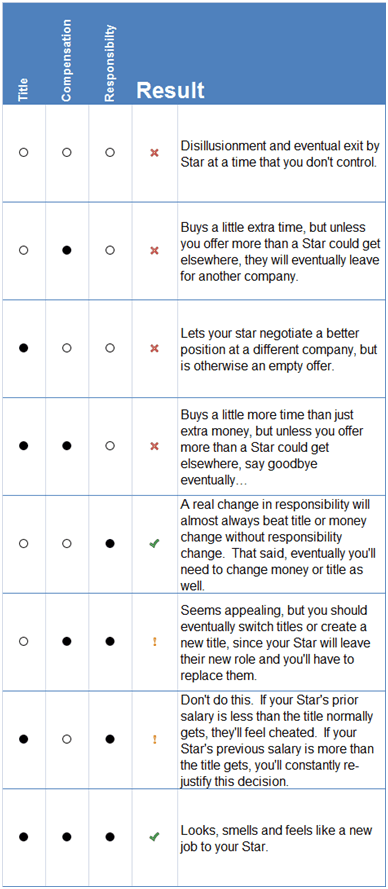
Some people will try desperately hard to retain their stars through other means. Usually they resort to compensation or title changes without actual changes in responsibility. I know I have before I figured out to Fire them. I can say with certainty, having tried all combinations of ways to keep stars that “Firing Your Stars” actually leads to the best retention for your company (if not your team). Here’s a quick summary of what I’ve experienced when I had a star who wanted to grow and changed some combination of title, compensation or responsibility.

A black circle represents something changed (for example, on the first entry, I changed nothing, resulting in the Star deciding to leave the company on their own):
One Last Caveat

The key thing about “Firing Your Stars” is making sure your Star has new responsibilities. But it only works if your Star feels that they are genuinely new responsibilities, and that some of her old responsibilities no longer need to be done directly by her.

I’ve tried, and seen many managers try, to spin an increase in responsibilities as a “new job” to an employee and they see through that bullshit immediately.

Here’s the key rule of thumb: if your Star does not perceive the change in responsibilities as a real step forward in their career, then you have not “Fired Your Star”, you’ve pissed them off. Very different.

Managing The Naked Team

Still, I believe if you run a naked team, grow a naked team, and grow individuals, you’ll end up with the strongest of teams you could possibly have. But, as GNP pointed out, it’s a lot of steps to follow. How the hell do you do all this without going crazy? That’s the next topic.

– Art

Growing Individuals: Crack the Whip

(4e of 5 in The Rules of Naked Management)

A Coach or a Friend?

I started taking swimming lessons a few weeks ago. I’d started training for my first triathlon and I didn’t know how to swim.

My coach, Gus, is also a friend and I’ve spent a lot of time hanging out with him and his family. We’ve been to soccer games together (“Football” for the more worldly readers). I’ve babysat his kids. I’ve ridden hundreds of miles with him at my side. He’s a very good friend.

This morning I had a typical coaching experience with Gus. I had just finished a 50-yard dash in the pool, my breathing was heavy, and my legs were burning. I wanted nothing more than to rest and catch my breath. I looked up at my friend Gus and said “give me a second”.

But my friend wasn’t there. Instead my coach was, and he just said, “No. Do it again.” And I was off. Dear God, sometimes I hate my coach.

Now here’s the interesting thing: I am a much stronger swimmer today than I was four weeks ago.

Of Carrots… and Sticks

The last two parts of this essay talked about what you need to do to get an employee growing their career:

That’s good, and in reality most of the work that must be done is borne by the employee. So far, as a manager, you haven’t had to sweat, and as I’ve always said, laziness is good.

But all that was carrot. For many people carrots aren’t enough – it’s always easy to “start tomorrow” or “wait until next week”. Sometimes you need a stick to get folks moving.

Coaching

Earlier I cautioned managers to get over themselves and realize there isn’t that much they can do to force someone to grow their career.

Now I’ll modify that slightly: assuming you’ve done the stuff mentioned above, there is one thing you can do: you can be the source of honest feedback on whether progress is being made, and you can reward and punish if progress is made or not made.

To do that, you need to remember you’re not a friend, you’re a coach. And sometimes Coaches need to ‘crack the whip’, or ‘be harsh’ or ‘be demanding’ in order to get the most of their charges(1).

That’s what Gus was doing this morning, and that’s what you need to do too.

The Whip

Now I’m not recommending you keep a whip by your desk (although I’ve known someone who did that). Instead, be serious about managing your employee to complete their small steps, rewarding them when they do, and punishing them when they don’t. Small steps are measurable and are black-and-white: Your employee either scheduled the mentoring lunch or they didn’t. They either signed up for the PMI course or they didn’t. Don’t worry about the larger goal – the employee will track that. Instead, just remember what small thing they said they would do, and hold them to it.

As usual, everyone has a different style with this, but here’s what I like to do. I track the one small step each employee told me they would complete, and when they would complete it by. And then every time I meet them, I ask them for status. EVERY DAMN TIME (Several folks who’ve worked for me will tell you how annoying I am about that(2)).

I make it their #1 goal on their goal list for the quarter. When they miss the step, I tell them I’m disappointed but make them set and tell me another one. And if they consistently miss their small step goals, then I start trying to move them into some other position (or “manage them out”). I reward in reviews those who made their steps; I don’t reward those who missed them – even if the rest of their work was stellar.

In reality, I’ve had a few employees miss their first and second steps, but never more than that. My experience is that your employees get really serious about following through on their career growth goals (or they leave) when you start tracking their small steps closely.

Self-Flagellation

Sometimes you’ll have an employee tell you they think their next small step is to “have my manager talk to Bob in Operations about a transfer to his department.” Yikes! This goes against my principle of laziness: your employee is trying to get you to do something, and if you don’t do it they can claim that you caused them to miss a goal, and if you do it, you could lose them! They’re trying to get you to crack the whip on yourself.

OK, don’t panic!

First, do you think that’s the right next step for them to take? If it isn’t, you’re their manager, and can tell them to pick another step. If this person isn’t a star on your team, you have a duty not to pass him or her on to Bob (and they should NOT be surprised to find this out). You should make your employee aware of where the gaps are and encourage him or her to start fixing them.

But what if you person is a star… well, that’s fine too, because if you’ve been tracking closely, you’re now about to fire your stars…

(which I’ll discuss next week, unless I’m too stuffed from Holiday feasting).

– Art

(1) I do believe coaching is about 50% teaching, 40% motivating and only 10% cracking the whip, but all the earlier stuff I’ve talked about covers the first 90%.

(2) No comment on other things I’m annoying about.

Growing Individuals: Remember Michael Jordan

(4d of 5 in The Rules of Naked Management)

Who?

In the mid-Nineties, the Chicago Bulls’ star player, Michael Jordan, decided to retire even though he had plenty of playable years left in him. Even more surprising, he decided he’d go play professional baseball.

Not surprisingly, Mr. Jordan didn’t achieve the same level of success between the bases as he did between the baselines. Within two years, he admitted that baseball was not for him.

But when he attempted to return to basketball, no one would have him. Team after team passed on him. They wouldn’t even consider him for a coaching position. Eventually Michael ended up having to take a low paying job in retail to support his family.

At best, Michael Jordan is but a sad footnote in the history of basketball, and a sad but common parable of the human race: a man following a dream, only to have his life destroyed in the end.

Bare with me… I’ll get back to that (obviously false) story in a bit.

Why Assume It’s True?

A few weeks ago (I’m behind…) I wrote about the importance of encouraging your employees to dream. Without a dream to move towards, they won’t push themselves. Once they have a dream, it’s usually fairly easy for them to envision a few small steps they can take that will move them closer (for example: go ask a potential mentor to lunch).

And yet, often there is a hesitation to take even the small step; a worry that if they fail in achieving their dream, their professional lives will be over. Often this hesitation is strongest in your stars as they think they have the most to lose. And as a result, too often, your employee never takes the first step.

That’s where the concept of “Looking at the Negative” comes in.

The Power of Negative Thinking

Let’s revisit the process again for getting something done:

  1. Daydream: Form a vision of what you want do.
  2. Be Lazy: Come up with one small step that moves you closer.
  3. Look at the Negative: Look at the opportunity cost of that step, and if it’s too large, go back to step 2.

Then, TAKE THE STEP!

We’ve covered the dreaming and being lazy in the last article, but “Looking at the Negative” is the key to dealing with hesitation. As a manager, your job is to force your hesitating employee to look at the negative. Yes, I mean force: Make them uncomfortable; Make them list all the things that could go wrong and the consequences; Make them squirm as they try to justify why such trivial things are stopping them.

Do this, and all sorts of obstacles will vanish under the scrutiny of examination. For example, your employee may worry if they ask a mentor to lunch that they’ll be rejected, but when they think about it out loud they’ll see the only real worry is schedule availability, not personal rejection. They may worry that they’ll be laughed at if they do an architecture talk in front of the entire Engineering division, but will quickly realize that the worst result is someone offering free help in presentation skills afterwards (really…).

In addition, if an employee verbalizes the negative before he takes his step, and decides to take the step anyway (for example, realizing that some assholes will laugh at you if you give a sucky presentation, but trying anyway), it makes it much easier to get through the bad when it happens.

In general you’ll be amazed how successful a technique it is to get your employees to verbalize their fears out loud.

But occasionally one “negative” or “opportunity” cost may not be easily dismissible: Your employee, particularly your stars, may worry that they’ll lose their job and destroy their careers if they fail in their next career endeavor.

That’s where Michael Jordan comes in.

The Consequences of Failure

Here’s the truth about career development: if you are a star today, but fail in something different tomorrow, you will always be welcomed back in your old role (although not always at the same company).

If you were an excellent engineer, and then fail in marketing, someone will always take you back as an engineer.

If you were an amazing designer, and then fail as an account manager, someone will always take you back as a designer.

And, as if you believed the bullshit I wrote at the top of this article, if you were a great basketball player, and then fail in Major League Baseball, basketball will welcome you back as you decimate all opponents again and win another three championships.

I’m not suggesting that people plan for failure – quite the opposite, you should expect and envision success.

But realize that if you don’t succeed, it’s not that big a deal. That’s what Michael Jordan teaches us. Even if (in the unlikely event) your employee fails in a new position, they can always fall back.

Oh, there will be some short term embarrassment (Jordan definitely got shit in the media), they may need to find a new company because their old job is filled, but once they go back to being a star again in their old role, naysayers shut up really really quickly.

As a manager, when you see someone hesitate because of fear of failure, coach them to think through what the real consequences are, and most will see the light: in career development, risks are rarely as dangerous as they appear.

Cracking the Whip

Now, if you’ve done the steps I’ve been writing about, and with a bit of luck, you’ve now gotten your employee to actually take one small step towards a brighter career future.

How do you (again remembering how little you matter in this process) get them to take the second step?

Simple… be a manager and crack the whip… which I’ll talk about next.

– Art

Growing Individuals: Be the Sandman

(4c of 5 in The Rules of Naked Management)

Two weeks ago I talked about the first rule of growing people on your team: get over yourself! Assuming you’ve done that, the next step is to Be the Sandman…

Cathedrals of the Mind

So your employee holds the key to growing their own career. If so, why the hell do we need managers involved?

Well, let’s revisit the process involved in getting something done:

  1. Daydream: Form a vision of what you want do.
  2. Be Lazy: Come up with one small step that moves you closer.
  3. Look at the Negative: Look at the opportunity cost of that step, and if it’s too large, go back to step 2.

Then, TAKE THE STEP!

In career growth therefore, the first thing you need to do is form a vision, a dream if you would, of where you eventually want to get to. It can be grandiose (“I will be the CEO of a fortune 500 company”). It can be noble (“I will create and run a charity that serves the needs of the homeless in Seattle”). It can be very specific (“I will be the Director of Strategic Projects within 2 years”). It can even by very vague (“I want to build something that is larger than just myself”), but it’ll need to get more specific over time. The most important thing though is to have that dream and to believe you’re going to achieve it. Every great achievement of mankind started as a dream, and so everyone who wants to be great needs a dream:

“A rock pile ceases to be a rock pile the moment a single man contemplates it, bearing within him the image of a cathedral.” -Antoine de Saint-Exupéry, Flight to Arras, 1942

If your employee doesn’t have a dream of where they want to get to, then all the training, all the mentoring, and all the experience in the world is for naught; it’s just passing time.

Enter the Sandman

Now, why are managers needed? Because left to their own devices most people will never follow the process above. Sure, they know they need to follow it. But they also know they need to rebalance their portfolios, get that annual physical, and have their teeth cleaned.

Most people are incredibly frightened by the concept of looking internally, finding a dream, and then communicating it to the world. So they procrastinate.

But as a manager you have one power that applies here; you can force someone to do something, and fire them if they fail to do it (harsh I know, but ultimately that’s the only hard-power managers have). And in growing careers, that’s what you need to do.

Your job is to force your employees to think hard and articulate where they want to take their careers; in other words, you must be the Sandman and force them to dream.

Becoming Morpheus

The concrete step here is simple: make sure every one of your employees has clearly articulated to you their dream for where they want their career to be in five to ten years. Write it down if that helps you, but the key is that the employee (not you) articulated it, and he or she can recall it at a moment without referring to some bullshit document (so don’t just follow the HR plan).

This will be easy with some employees – they will have firm dreams already ensconced in their minds that you just need to extract from them. For others though, you’re going to have to force them to do a lot of work. The good news is pretty much everyone has a dream; you just have to get it out of them.

People have lots of different ways of doing it, but here are some of the techniques that have worked for me.

  1. Listen, don’t direct. This goes back to “get over yourself”, but when you have conversations with your employees about where they want to grow their careers, make sure you spend most of the time listening. Don’t be afraid of silences – make them break the silence.
  2. Ask open-ended questions. Don’t ask “do you want to be a CEO?” But also don’t ask “what job do you want to have in ten years?”: I have no idea what my job will be ten years from now; how can I expect my employees to know? Instead ask “what are the qualities you want to have in your job ten years from now” (I do know the qualities I want in my job 10 years from now)? Or “what types of things do you want to do in your job ten years from now? (I know the answer to that too; I’ll bet you know your answers as well).”
  3. Encourage made-up titles. I’ve found this one to be very useful. Once I’ve asked a bunch of open ended questions about the qualities they want in a job, I ask the employee to make up a title for that job. Sometimes they pick “CEO” or “CTO”, but more often than not they pick something way more personal to them. I once had someone pick “Director of Special Projects”, and another person pick “Judge.” I’ve found that when someone picks a name for their set of job qualities, it makes it more real for them and more memorable!
  4. Ask them what are the differences between themselves today, and the person who holds the title they made up. This is useful to find the gaps and also to give some ideas of the types of steps they should take to get to their goal. For the person who told me “Judge”, he rightly pointed out he didn’t have a law degree (any guesses what his next step was)? For the person who told me “Director of Special Projects” he told me he hadn’t really worked on a special project to date, so the goal became getting him assigned to a more important project with trickier technology.
  5. Be persistent. Every time you meet with an employee who is uncertain of their dream, ask them how it is coming. When they have made no progress, be harsh. Give them deliverables if that works with them. But never give up on this – without a dream, they will not take their career anywhere!

Stop Dreaming

Once you have a dream that is articulated, with some gaps identified between the employee today and the employee of the future, it’s time to move onto the next two steps: being lazy, and looking at the negative.

Being lazy is usually quite easy once you have a dream: you ask the employee to come up with some ideas of steps they could take within your organization that moves them closer to their dream. This is a time where you can seed them with ideas, but try to make them come up with ideas first – you’ll be surprised by the results.

But “looking at the negative”, well that deserves its own topic which I’ll cover soon.

– Art

Growing Individuals: Get Over Yourself

(4b of 5 in The Rules of Naked Management)

Last week I talked about my general framework for why you need to make sure team members grow in their roles. This week I’ll go through some of the techniques I use.

Self-Importance

Before I talk about people on your team, let’s talk about you. Who has been the most important person in your career to-date? Who has had the most influence on what you’ve done and what jobs you’ve taken? Whose advice have you followed the most? Who’s been your best ally and who have you asked for the most input on career directions?

Without a doubt I’ve been the most influential person on my career (and not always in a good way). Sure I’ve had mentors who’ve suggested paths, but often I’ve ignored their advice – but I’ve never ignored myself.

Who’s the second most influential person? For me, that’s my wife. She’s listened to my cheers, my complaints, my dreams and my plans. She’s pushed me to take certain directions and (assuming I’ve agreed) I’ve favored her advice over anyone else’s.

Who’s the third most important? For me, it’s been my friends and peers. I’ve compared myself to where they’ve taken their careers. I’ve kvetched with them about my plans, my frustrations, and my dreams. I’ve done it at work, but also over dinner, out hiking, heck, anywhere my friends gather. We often talk about work and their stories about their careers definitely influences where I want to take mine.

In fact, you have to get pretty far down the list before one my mentors shows up. That’s not to say mentors aren’t important – they are critical and I’ve had some absolutely stellar mentors. But in reality I pay way more attention to me, my spouse, and my friends.

And I’m typical of most employees.

Get Over Yourself

First time managers often think they should take a very active role in growing their employees (or at least I did), and can find themselves devoting lots of time to it. It leads to things like career maps, ladder-levels, “mandatory training”, soul-searching on weekends about how you can improve individuals on your team, giving constant “constructive” feedback about ways to “grow”, and often leads to frustration on the part of both the manager on the employee. The manager thinks the employee is ignoring good advice. The employee thinks the manager is pushing some bullshit agenda on them that isn’t where they want to go. Eventually both manager and employee abdicate any responsibility for career growth, and instead talk (in bitter sarcastic terms) about following bullshit processes – and that’s the best outcome.

The manager is at fault here – the employee is following the advice of more important people, and the manager mistakenly thinks his advice should come first.

Given that, the first rule of growing individuals is: get over yourself. At best as a manager you are the 4th or 5th most important person advising your employee on their career (assuming most of your employees have at least 3-4 friends). Your advice, especially your unsolicited advice, is likely to be in competition with more important people and therefore not followed.

So stop giving it!

Instead focus your management powers on managing your employee’s relationship with their most important advisor – themselves. Make sure they are asking themselves where they want to go, make sure they are following the advice they lay out on their own, and only step in to help with the how when asked.

Once you do this, the amount of time you spend on “growing individuals” drops drastically, but the quality of the interaction increases drastically. You become the person an employee reports their career-growth progress to, not the person actually taking the steps to grow their career. The employee takes more ownership because it’s their own steps. You can put metrics around how they take their steps and hold them accountable. And you’ve delegated responsibility for growing the employee to the most qualified person imaginable – your employee.

The next few articles will talk about the 4 remaining steps I do to grow someone’s career, but the most important of them is the first: get over yourself. You’re not as important as you think you are, so spend the amount of time commensurate with your importance.

I’ll continue the rest the week after next

– Art