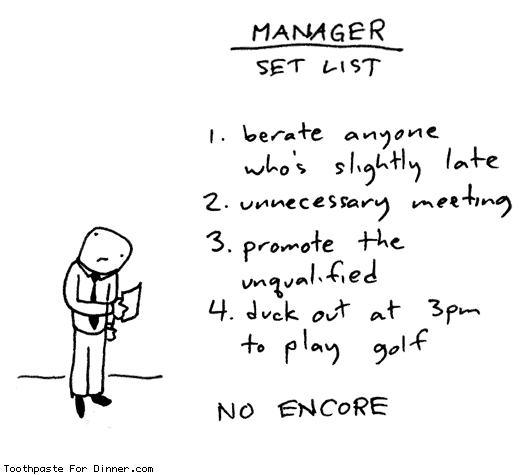
The Rules of Naked Management

Pop Quiz

What’s the most important thing a manager does?

Sure, a manager has to “get stuff done through a group of people”, that’s a given, but what’s really the most important thing? Is it training your team? It is hiring A+ people? Is it keeping executives informed? Is it growing your employees’ careers? It is protecting your team from the “craziness above”? Is it removing roadblocks for your team? Is it keeping morale high? ….

The First Time Manager

The first time I became a manager I asked a lot of folks that question, and read a lot of books and articles. And I got all sorts of answers back. Every one of the items above was “the most important thing” I needed to do according to some sources.

I tried to follow a lot of the advice the first time out, without really understanding WHY I should follow it, and I’ll bluntly say I wasn’t successful at it.

Sure, the individuals who reported to me got all the stuff done my managers wanted done, but my victims employees had to put up with a lot of mistakes as I learned what being a manager was actually about. Certainly at no point did we have a team working to achieve the same goals. In reality I was just an individual contributor checking in on other individual contributors, playing at being a manager, and usually just getting in the way (see pigeon management). Two of my employees ended up quitting, and another (high performer) transferred to another group to avoid me.

In retrospect I realized it was because I didn’t have my own answer to what’s the most important thing a manager needs to do. So for my second big outing as a direct manager, I tried a different approach: I figured out what’s the most important thing I needed to do as a manager, and then I did that. I didn’t worry about any of the other crap unless it directly helped the most important thing.

And I got more successful.

So, what is that “most important thing”?

The Rules of Naked Management

Well, that’s what the next series of articles is about. Some folks have asked me to write a little more about the concept of naked teams, and how to be a first time manager, so here goes. In this series, I will talk about:

  1. The Most Important Thing A Manager Does;
  2. The Rules for Running Naked Teams;
  3. The Rules for Growing Naked Teams;
  4. The Rules for Growing Individuals;
  5. and The Rules for Keeping Your Sanity

My apologies to anyone who has been through this before, as this series of posts is based on some training programs I developed for first time managers. But if you’re a first time manager, think you want to manage people, or have been managed by someone and you wish would be a “naked manager”, then hopefully this series will be useful.

As usual, there’ll be at least one update per week.

The Rules for Rules

This series will be laid out in a series of rules, with reasons why the rules are the way they are. You’ll see there are quite a few rules to follow. To help guide you in how to follow the rules here’s the two most important rules.

If you take NOTHING else from this series of articles, just remember these two rules and you’ll be well served:

#1) Rules should be followed

I’m not claiming I came up with these rules myself. They are based on my experience (yes) which I’ve now reapplied successfully many times. But they are also based on studying at a lot of effective managers at companies I’ve worked at, and at effective people in other companies. They’ve been tested on thousands of employees. And in general they just work. If you see a rule, and you’re doing the opposite, you owe it to yourself to ask, “why am I not following this rule?” Usually you’ll find you become a better manager by following the rule.

Still think you shouldn’t be following the rules? Swallow your pride. Put your ego aside. Shut up and realize you’re no different than anyone else. Seriously! That “special circumstances” bullshit doesn’t fly here. You’re not really different. Follow the goddamn rules!

Still think you shouldn’t be following the rules, and you have “good reasons” why you shouldn’t? Well, enter rule #2:

#2) Rules must be broken

Management is an art, not a science. If we could break it down into a series of rules that are followed 100% of the time, then some smart person would write a computer program to be a manager and I for one would welcome our new management overlords.

But management is an art, and as with all art, requires judgment to be effective. If you’ve tried to follow rule #1 above, really put your ego aside, and still think you should not follow one of the rules, then break the rule. Truly great managers, like truly great artists, don’t follow the rules. However, like truly great artists, they KNOW the rules (e.g. Picasso learned classical painting first), KNOW when they break the rules, and KNOW how they break the rules.

Trust Yourself

Put another way, rules are no substitute for judgment, and over time you’ll find your own way through this mess. So please read and learn these rules, but ultimately you’re going to have to learn to trust your own judgment and discard the crap (mine included) that folks tell you about management if it doesn’t work for you.

I’m just sorry I had to experiment on Jim, Nolan, Craig, David, Aileen and Scott to figure that one out (sorry guys).

– Art
Help me raise money for people suffering from cancer

Nude Numbers (#14)

For reference, here’s last week’s data. Curious what this post is about? I’m tracking my training progress for the New York Marathon. Click here.

Summary

This was a bad week for my training as my right foot developed a sharp pain immediately upon returning to running. I let the depressing thought of not running the marathon weigh me down all week.

Thankfully part of the reason for “Running Naked” is to force myself to admit to folks when I stumble, and I woke up this morning more determined as a result (thanks everyone, even if you don’t believe you actually did anything!). I got an x-ray done this afternoon (no obvious breaks in foot), scheduled a few more specialist visits this week, got back into the weight room and I may have found a way to run at least short distances that keeps the pain away (I ran across the Queensboro bridge).

This week is all about figuring out what is wrong without getting annoying or depressed at the hand of cards I’m playing with.

Subjective Data

I rested on Monday after the ride, and then tried to run on Tuesday. Even though I had absolutely no foot pain during the ride, I got a half-mile into my Tuesday run and the same pain I had two weeks ago in the top of the foot returned. It’s was a very sharp pain, and not runnable-through.

The next day my scale broke.

And in general, I let myself feel a little depressed and annoyed at my body, and the things around me, breaking down. This led to me being very (relatively) inactive this week. I stopped going to the weight room. By Friday I convinced myself to try a short run (still painful) and did a low-key bike-ride supporting a long training run on Saturday. On Sunday I just hung out with friends.

But all week, I was annoyed at myself for being annoyed at myself. Sigh.

Objective Data

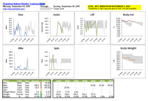
Click here for a PDF version of my dashboard.

Assessment

I went from a high to a real low when I couldn’t even run a half-mile without collapsing in pain. And I let the disappointment at that take me completely off my training track. Last week sucked, but in retrospect (as I write this) I know I’m going to have those weeks. For some reason the thought of publishing my “laziness” last week spurred me on today to resume my training, so thanks in advance to everyone for at least viewing this blog and giving me encouragement.

That said, I’m still shooting to win The Six Pack Charity Challenge, and finish the NYC Marathon. So I’m going to focus everything on the Marathon until told otherwise (by my body or a doctor).

As usual, if you have suggestions, leave a comment, or reach me at “art (at) abclarke.com”.

Plan

The big thing is remember to keep smiling, and that I’m doing this for charity. I’m going to slowly ramp up mileage as I test out the foot and try to find a way to run without pain, but where the marathon was “at risk” before, it’s now a long shot. But I’m also going to let everything else take a back seat to running and not worry if I don’t spend every spare moment at the gym. So:

  1. Short runs on Monday, Wednesday and Friday (no more than 6 miles on any run)
  2. Leg permitting, perhaps a long run (10+ miles) on Saturday.
  3. Swim if I feel like it, but don’t sweat it if I don’t.
  4. Keep the weight room work going, but again, only as I feel like it.
  5. Keep eating sensibly but continue gaining some weight.

Presentation Notes

No changes to data presentation this week. As with last week, data is presented in SOAP Note format.

– Art

Help me raise money for people suffering from cancer

A Plea for Purple Voters

Demographics, Democracy and the Blues

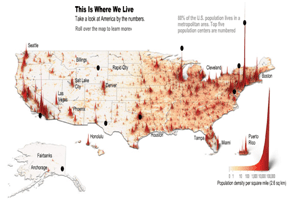
Here’s a map of the US with population density graphed in the z-axis (from Time magazine):

And here’s how people voted in the 2004 presidential election with number of winning votes by county graphed in the z-axis:

The more densely populated the area, the more likely they were to vote democratic in the 2004 election.

Another view can be seen below. In this one, the color scale changes between red and blue in each county. If a county voted 100% Democrat, it’s blue. If it voted 100% Republic, it’s red. If a county voted 50% Democrat and 50% Republican, it’s purple. Again, higher density areas tended to vote democratic in the 2004 election.

The Color Purple

I have two theories about why the pictures look the way they do.

The first theory is that living each day in close proximity to lots of people (with competing interests), where you can’t possibly get to know them each personally, forces people to compromise more on a daily basis than those who have the luxury of knowing all their neighbors. This tends to encourage social-liberalism (or social laissez-faire) where you agree to stay out of someone’s business with the expectation that they in turn stay out of your business. For example it’s very easy to be rapidly pro-gun (a position generally correlated with social conservatism in the US) if you personally know and trust each and every one of your neighbors. It’s much harder if you don’t know everyone you see every day. This causes most highly dense urban areas to vote Democratic (the large party in America more associated with social liberalism).

My second theory is that if you live in a highly dense area that is also highly culturally diverse, you are forced to interact with people with opposing points of view, and are likely to be more accepted if you have less extreme views. For example, it’s very easy to be rapidly pro-choice and believe that late-term abortions need to remain legal (to avoid “a slippery slope” where abortion eventually becomes illegal) if you live in Berkeley, CA (an extremely homogenous liberal enclave) where everyone takes pro-choice for granted. Try being rabidly pro-choice in a multi-ethnic neighborhood in the Bronx, NY, see the moral pain on a very religious Muslim’s or Christian’s face at the prospect of a late term abortion, and it’s much harder to maintain the extreme. This forces dense urban areas with heterogeneous populations to be more trend more bluish-purple than pure blue.

Perhaps the key to moving elections and candidates back to the middle in the 2008 election is to relocate all the people who live either in sparsely populated areas of the country or in culturally homogenous areas to a densely packed 100 square mile area of the country (I hear Billings, Montana has space). If we did that I suspect all the graphs above would get much more bluish-purple and we’d end up with candidates who are much more reasonable than the current set of Democratic and Republican candidates (who are all veering to the far left and far right).

Spending Purple Money

But we’re not likely to relocate everyone with extreme views to live next to each other (I am firmly against forced relocations of anyone, although I’d love to see Al Franken and Bill O’Reilly share an apartment). However, there is one thing I believe we can do to move American back to the middle ground.

If you are a Purple Voter, always vote in every primary election! Especially the small ones.

For example, New York has a (very unpublicized) local primary election on Tuesday. I’ll be voting in it. I consider myself (currently) a socially liberal, fiscally conservative, internationalist. In other words, I’m a bluish-purple voter, and I’ll vote for candidates as close to that as possible.

You might not think it matters, but the people we vote for in primaries are very influential. They choose the rosters of candidates that we’re presented with for many higher offices. They form the staff of national campaigns. They are listened to by the national parties when drafting policies, candidates and platforms.

Somehow in America many purple voters (like me) believe that if the candidate they voted for didn’t win then their vote didn’t count. And often in primary elections today, the middle ground (purple) candidate loses. But our votes do matter; politics, like business, runs on a market economy. Only in politics, votes are the currency. The mere fact that someone got our vote will cause other politicians to veer in our direction to try to woo us the next time we spend our vote (see how John Kerry veered left in 2004 to try to recapture the voters that went for Nader in 2000).

Purple voters have become convinced that our voting dollars are worthless, and therefore we don’t spend them in the elections where they are actually worth the most – small local primaries.

As a result, purple voters don’t vote in primaries, right and left extremists do. Then our low-level politicians run to the edge of the political spectrums and they nominate candidates for higher offices who also pander to the edges. And that’s how we get the crap national candidates and crap policies they spout (all but one Republican presidential candidate views the Theory of Evolution as suspect; all but one Democratic presidential candidate is firmly against the concept of free-trade). What do we expect? The politicians, like good businessmen, are responding to the market that spends money!

If middle-ground people are consistent about spending our purple money and voting in primaries, the local candidates will eventually notice us voting, and they will start having to pander more to the middle. This will lead to more purple candidates for higher offices. And as the map above shows, America is a lot more purple than red or blue, so if we consistently vote purple in all primaries, we will take back this country.

– Art

Help me raise money for people suffering from cancer

Riding with the Devil

Not the Devil’s Children

“Let’s get him”, they yelled.

We had hit Bridgeport, Connecticut late in the day on Friday on our way to New Haven(1), and we were already riding well behind schedule. I was riding alone about a half-mile ahead of the pack, scouting the route, and looking for major hills or hazards to warn the less experienced cyclists about.

I didn’t see them until they yelled, and as I turned to look behind me, 10 to 12 young black teenagers on street bikes start speeding up to catch me.

My heart leapt into my chest: This wasn’t a nice neighborhood; the rest of my group was nowhere in sight; and all I had on me was two water bottles and skin-tight spandex biking outfit. It was stupid of me to get so far ahead.

But almost as quickly as my heart leapt into my chest, I started to calm down: on my road bike I could easily outpace my pursuers; in reality I didn’t know they meant me any harm; and for god’s sake, they were just kids. I breathed in deeply, started slowing done and called back, “come on guys… we’re going to Rhode Island.”

And they laughed, pulled up beside me, and we started racing each other in the streets. For about five minutes, I was a kid again, racing between cars, and laughing with my unexpected friends; five minutes that my heart had almost cheated me of.

The Devil Cometh

And then the fun ended in a way I hadn’t expected.

The ride I was doing was in support of the Jack Brown Appeal. An amazing man named Mark Edwards in the London Metropolitan Police Department had convinced over 30 of his co-workers (fellow Bobbys) to travel to the US and do this ride on mountain bikes. He had convinced the New York, Providence and Cranston RI police departments to provide support crews (and additional riders). He had convinced Paul Nichols at Team Continuum to raise some money and provide some riders (like me) to help get the rest of the folks to Rhode Island safely. He had raised over $125,000 for Jack.

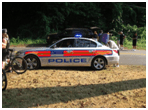
But most relevant to this story, Paul and Mark had convinced BMW of America to donate the use of a BMW car for the ride. The Bobbys had brought decals and a light bar with them and had dressed up the BMW to look exactly like a London Police car.

Five minutes into my ride with the young kids, this fake police car crested the hill and came into sight.

One of the kids looked back, saw the car with its flashing lights and 30 bike riders behind it, and yelled, “Shit, he brought the devil with him!”

Within two seconds, every kid had disappeared. It looked like a well rehearsed military maneuver! All the kids scattered in separate directions to make pursuit impossible, jumping over curbs, ducking behind cars, and shooting down alleys.

And I was left alone to wonder what happened.

The Evil in Men’s Hearts

I don’t consider myself a racist, and I doubt anyone would characterize me that way. And yet, in a moment of panic, with nothing but instinct to guide me on how to respond to “let’s get him”, my heart told me to run away from a bunch of kids because they were black and poor.

I can argue with myself that it’s a sensible reaction on my part. I can say it was a bad neighborhood which increased the chance of harm coming to me, so the rational thing to do was run.

But I know nothing about Bridgeport. I based my “bad neighborhood” point above on the fact that the neighborhood looked poor and black. But here’s an interesting fact: I grew up even poorer (but white) and that didn’t drive me and my family to crime. Why assume poverty would drive people to crime in this neighborhood?

What’s more while I “don’t consider myself a racist” I don’t test that theory often. I live in an almost exclusively white neighborhood, I have few black friends, and my community involvement to date has been to meet other similar folks who do athletic events to raise money for less fortunate people we (almost) never see. I’m the text-book example of an open-minded intellectual who preaches on the evils of racism, but is afraid to take the subway in Harlem because, well, it just isn’t safe.

But perhaps as sad as my initial reaction to the kids, was their reaction to the fake police car. The reality was the children were in no danger – in fact, they missed an opportunity to ride with some of the nicest and funniest people I’ve met in years. But their instinctual response, I’m sure ingrained through both experience and stories about the police, have trained them to automatically mistrust and run.

I believe mistrust and racism are taught to children through the reactions of adults – it’s not something we’re born with. I’m sure the kids in Bridgeport originally saw my hesitation and learned a little, just as they see their parents avoid law enforcement, and just as I saw my parents frown if black people moved into our neighborhood in Florida. Through our actions, we make the world a different, but not always better, place.

Where the Journey Takes You

I originally meant to write a light article chronicling how the ride went and relaying some of the fun stories, but I started with the story of the kids, and this is where the article took me. It got me thinking: I have to force myself to find more diversity in life, and find a way to separate mistrust that is prudent from mistrust that is based solely on racial or economic characteristics.

So once I finish up with the current charity commitments I have (training and fund-raising for Team Continuum), I’d like to try something that forces me to get out more in the community, and meet people who are leading wholly different lives from me.

I’m looking for suggestions, and would appreciate your input. If you have ideas for things or organizations to look into in the New York area, I’d love to know. Please either e-mail me at aclarke (at) abclarke.com or leave a comment here.

Thanks for reading my ramblings. By the way, here are some photos from the ride.

– Art

Help me raise money for people suffering from cancer

(1) As most readers know, I was riding 180 miles from Manhattan to Providence, RI this weekend to raise money for the Jack Brown Appeal.

Nude Numbers (#13)

For reference, here’s last week’s data. Curious what this post is about? Click here

Summary

I successfully completed the New York to Providence bike ride to raise money for the Jack Brown Appeal. And I met Jack, who was so cool! I’ll write about it in a separate post.

I am sore from 3 days in the saddle, but seem to have emerged injury free and ready to switch to running. I also gained 1-2 pounds without adding a lot of fat, which is cool. Now, 7 weeks to go until the marathon, and time to get back to running.

Subjective Data

  1. Completed the NYC-Providence 180+ mile bike ride without any injuries. And had a blast doing it.
  2. Weight lifting was good this week, but admittedly it was stupid to do heavy leg lifting two days before the ride started.
  3. I ate whatever I wanted this week, but after spending over 25 hours in a bike, I’m not too worried.

Objective Data

Click here for a PDF version of my dashboard.

Assessment

The ride was a blast, I rode very well (for me), and I’ll write about it separately. My leg injury didn’t even play in, even the foot bruise I got last Saturday, and although I am sore today, it’s the good kind of sore. That’s one of the two major events out of the way (just the November marathon remains), which is awesome.

I will post photos later (we’re still gathering them together).

On the sad side, it likely means my bike goes into storage for the winter season. I’ll miss it.

I cut back on the swimming this week because of time pressure, but my form was good when I did get time and my speed is improving. My weight control was on track. I gained 1-2 pounds without a major increase in body fat.

I’m still shooting to win The Six Pack Charity Challenge, and finish the NYC Marathon.

As usual, if you have suggestions, leave a comment, or reach me at “art (at) abclarke.com”.

Plan

Time to switch over to running. I’ll do a short 1.7 mile run on Tuesday, and then work with my trainers to come up with a short-time plan to ramp up for the marathon. More details next week. I’ll also keep lifting, do some swimming, and eat around 2,875-3,125 calories a day to gain some weight.

Presentation Notes

No changes to data presentation this week. As with last week, data is presented in SOAP Note format.

– Art

Help me raise money for people suffering from cancer