Category Archives: Personal

Nude Numbers (#20)

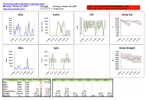
For reference, here’s last week’s data. Curious what this post is about? Click here to find out.
Summary

I did OK with my plan for the week, but I had a big decision to make. And I’ve made it. Read on for more (and do click the links… they’re fun J ).

Subjective Data

I did some (not much) weight lifting, tried some spinning, and went to see a physical therapist. Why? Because the pain from my run last Saturday did not subside as quickly as I would have liked. I also went back to my ortho-specialist to see what he thought and had an MRI. The result: nothing is broken, but I have a bad sprain and lots of bruising in my right foot.

My eating wasn’t great later in the week, and my numbers show it.

Objective Data

Click here for a PDF version of my dashboard.

Assessment

I had dinner on Thursday with my friends Jim and Sudipta (who by the way has a great new kids book on sale now… The Mine-O-Saur. Check it out). And during the conversation I asked them for their advice on whether to run or not. I thought Jim’s response is a good candidate for quote of the month:

You’re not Kenyan – the marathon is not a life defining event for you. If you injure yourself permanently during the run, it will become a life-defining event. Don’t make this a life defining event!

Well, facts are facts. I had a stress fracture, but now I have nerve pinching, swelling and bruising in my right foot. I get sharp piercing pain any time I stand up after sitting for 45 minutes or more. I could try to run the marathon on Sunday of next week, but odds are that (a) the pain would become unbearable late in the race and (b) I’ll permanently injure myself by re-breaking the stress-fracture or doing something else stupid as my body compensates over 26 miles to avoid the pain.

So, this morning I notified Team Continuum that I would not run, and have been guaranteed a spot in next year’s marathon. I’m going to take at least 6-8 weeks off running, and then work with a physical-therapist to slowly ramp up again. I’d like to target doing a marathon in the April or May timeframe of next year (and then maybe I do NY next year, maybe not…) – let me know if you have suggestions for one to do.

Also, thanks to everyone for their suggestions (public and private) on what to do. I really appreciate the feedback and support. In case folks are wondering on the breakdown of “live to fight another day” vs. “go for it!” the breakdown was:

Live to Fight Another Day

Go For It

20+ (I stopped counting…)

0

Telling, no?

Plan

I’d be lying if I said I wasn’t disappointed – I am. But when God gives you lemons, you find a new God. Whoops, I mean, you regroup and start again. So, the plan for this week is continue my new weight lifting routine, do some spinning, continue physical therapy, and then… get ready for Mexico. J and I are off to Mexico for 5 days next week (so, no updates next week). When I return, there will be a new format for tracking the metrics on my winter goals, which to remind you are:

  1. Be able to swim 1km without stopping by 3/1/08. This is really about form and balance for me.
  2. Gain 5-10 pounds from my 11/5/07 weight while keeping a 32 inch max waist by 3/1/08 (I’m expecting my 11/5 weight to be around 153-158).
  3. For weight lifting, increase my 1RM by 5% on average across the board by 3/1/08 from my 10/30 1RMs (1RM = 1-Rep-Maximum).

Presentation Notes

No changes to data presentation this week. As with last week, data is presented in SOAP Note format.

– Art

Help me raise money for people suffering from cancer

Nude Numbers (#19)

For reference, here’s last week’s data. Curious what this post is about? I’m tracking my training progress for the New York Marathon. Click here for why.

Summary

I did one “last chance” run to see if my leg could take the mileage on Saturday. Results: 17 mile run, but I’m in a lot of pain now and back in my restraining-boot. So, I need to make a hard call by end of this week: surrender and fight another day, or go for broke in two weeks? Send me your thoughts!

Subjective Data

This was a rest week which was good since I had a slight cold. I did two spinning classes, no weight lifting, but my bike ride on Saturday didn’t pan out. So, instead I decided to try my luck running again (stupid me, I know). The good news is I got 17 miles done in 3:03:00 (although I had to walk the last mile). The bad news is, like my run 2 weeks ago, I’m in a lot of pain.

That said, I’m in slightly less pain than 2 weeks ago even though I did over 2x the mileage… hmmm…

Eating was very on target all week, and the numbers show that.

Objective Data

Click here for a PDF version of my dashboard.

Assessment

The rest was good. The diet-control was good. On that front, not a lot to change.

On the run, I learned a bunch of things:

  1. Going at a super slow pace actually makes things worse, not better. I did the first 4 miles at a 12-minute-mile pace and it really sucked. I need to run at my natural pace, which means a 9-10 minute mile pace with breaks.
  2. Tighter laces earlier in the run actually seems to help.
  3. I need to stop every 1-2 miles and walk for at least 60 seconds to let the pain subside (that’s what kills my overall times). If I do the marathon, that’s what I’ll need to do.
  4. It hurts more if I stop moving J
  5. But it hurts A LOT while I run. Specifically, sharp piercing pain on the top of my right foot when kicking off that is consistent with severe tendonitis.

Plan

This is the week I need to make my big decision: to go or not go for it. I have to decide by Friday, although I’m hoping to stretch it to Sunday since I’m having breakfast with my aunt from Ireland on Sunday and she’s run a bunch of marathon’s before (I’d like her advice).

The plan this week is to resume lifting on my old schedule, keep eating under control (still shooting for that Six-Pack Challenge), and do some spinning to maintain cardio (later in week once my foot heals from Saturday’s run).

As a reminder, I get to decide on October 24th whether to try to run the marathon anyway, or take my guaranteed spot next year. Let me know your thoughts.

I’ve decided my final goals for the winter will be all about swimming and lifting:

  1. Be able to swim 1km without stopping by 3/1/08. This is really about form and balance for me.
  2. Gain 5-10 pounds from my 11/5/07 weight while keeping a 32 inch max waist by 3/1/08 (I’m expecting my 11/5 weight to be around 150-155).
  3. For weight lifting, increase my 1RM by 5% on average across the board by 3/1/08 from my 10/30 1RMs (1RM = 1-Rep-Maximum. I did a re-measure of those 2 weeks ago).

I’ll create a new tracking dashboard for this after the marathon.

Presentation Notes

No changes to data presentation this week. As with last week, data is presented in SOAP Note format.

– Art

Help me raise money for people suffering from cancer

Nude Numbers (#18)

For reference, here’s last week’s data. Curious what this post is about? I’m tracking my training progress for the New York Marathon. Click here for why.

Summary

I’m still a likely “no shot” for the NYC marathon but I’m keeping some hope alive. Good week last week, although I got sick (flu?) towards the end. This week the plan is for lots of rest. Woo hoo!

FYI – for some reason my blog was shut down over the weekend, but is back now.

Subjective Data

With the exception of running (which I’m still not doing), I had a good week. My weight workouts were hard and good. I did more spinning and got a short bike ride in. I still haven’t resumed swimming yet, which I’m not happy with, but my motivation to get in the water is lower now that fall is here.

My eating was mostly good all week – although Saturday and Sunday were bad. I think I have a cold or flu as well. On Saturday I was dazed all day, and on Sunday was coughing and had aches.

Objective Data

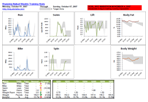
Click here for a PDF version of my dashboard.

Assessment

Apart from getting sick at the end of week, I had a good week. I stuck to plan very well.

This next week was a planned rest week anyway, so in some ways the sickness is well timed. I plan to do nothing most of the week, but I will try for a 50-mile bike-ride in Connecticut on Saturday weather permitting.

I’m still working on my winter goals, but they are looking like I what I outlined last week:

  1. Be able to swim 1km without stopping by 3/1/08
  2. Be between 163 and 168 lb with a 32 inch max waist by 3/1/08

I have a potential swimming partner lined up for the winter – now we just need to find a 25 yard pool that doesn’t require membership of a gym to use (since I already have membership in another gym).

Plan

Plan for next week:

  • Rest.
  • Continue calories under control (but not crazy cutting).
  • Weather permitting, do 50 mile bike ride in CT on Saturday.
  • Do smile.

As a reminder, I get to decide on October 24th whether to try to run the marathon anyway, or take my guaranteed spot next year. Let me know your thoughts.

Presentation Notes

No changes to data presentation this week. As with last week, data is presented in SOAP Note format.

– Art
Help me raise money for people suffering from cancer

Nude Numbers (#17)

For reference, here’s last week’s data. Curious what this post is about? I’m tracking my training progress for the New York Marathon. Click here for why.

Summary

I’m still a likely “no shot” for the NYC marathon but I’m keeping some hope alive. I tried Yoga for the first time this week and liked it. And I’d love your thoughts on what my winter Fitness goals should be. Read on.

Subjective Data

As I mentioned last week, my running days are over for the foreseeable future. My foot hurt most of the week, but by Sunday I was able to walk 4-5 miles without being in a lot of pain. I had a light cardio week where I didn’t swim (didn’t feel motivated to get into the water), did some weight work, and tried Yoga for the first time in my life. All in all, it was an enjoyable week but I’d still like to be on the road…

Objective Data

Click here for a PDF version of my dashboard.

Assessment

I’m kind of in limbo at the moment; I’m pretty sure the marathon is shot, but I’m unwilling to call it until I have to (Oct 24). Therefore the key focus this week was maintain some cardio-endurance, and work on weights (and the six pack challenge). Given the challenge, I’ve started cutting body fat again just to see if I have a shot at winning (which led to a very funny dinner conversation with some friends on Friday when I passed on dessert). On the suggestion of a friend, I tried Yoga for the first time; it was fun, challenging, and relaxing. I’ll have to do that again.

I’m also starting to think about my post-November-4th/winter fitness goals. Here’s what I have so far, let me know what you think:

  1. Be able to swim 1km (80 laps) without stopping by March 1st (starting at 5 laps between breaks now): Basically get my swimming form down for a triathlon in the spring.
  2. Be between 163lb and 168lb with a 31-32 inch waist by March 1st (starting at 155-158 and 31 inches right now): Weight training and weight gaining for the winter – the challenge here is gain the muscle without the fat, which shows up as belly-fat on me. That works out to around 0.5 lbs a week of muscle gain.

I did a series of tests on Wednesday to baseline my measurements (bodyfat, dimensions, and max-weights) for the winter. (I’ll put together a new dashboard based on whatever goals I ultimately pick in the next few weeks so you can play along at home if you’re interested.)

The timing of the test was fortuitous. I was feeling down about the marathon (likely) being shot and I almost cancelled the (previously scheduled) test. But afterwards, and especially when comparing my results to my August 2006 test results, I looked at things in perspective. Sometimes, especially when one of my big goals looks shot, I lose faith, but the numbers reminded me that (a) I’ve made a lot of progress in the last 15 months and (b) this is a process, not an event.

Plan

Plan for next week:

  • Keep weight cutting (through November 5th‘s 6-Pack Charity Challenge);
  • Do some spinning, yoga or swimming.
  • Keep weight training going at current pace.
  • Come up with another draft of goals for the winter.
  • Don’t run.
  • Do smile.

As a reminder, I get to decide on October 24th whether to try to run the marathon anyway, or take my guaranteed spot next year. Let me know your thoughts.

Presentation Notes

No changes to data presentation this week. As with last week, data is presented in SOAP Note format.

– Art

Help me raise money for people suffering from cancer

I Was Wrong

Whoops

Last week, in a post about the most important thing a manager does, I made a silly comment in a foot note about managing a potential SARS outbreak:

“My guess was quarantine the hospital. Wrong. If you want to know why, e-mail me and I’ll tell you because I’m too lazy to write it in a footnote that no one reads.”

Many e-mails later, I see now that I was wrong, and I apologize. It appears people do sometimes read the footnotes(1). I’m sure the apology is more important than the actual explanation, so I’ll end it at that(2).

– Art

I’m running the NYC Marathon on November 4th for Team Continuum. Click here to donate

(1) I had thought no one read the footnotes because I was not reprimanded by the Pope or the Anti-Defamation-League for my footnotes in this article. Is it possible the Pope doesn’t read my blog?

(2) OK just kidding. Here goes:

To refresh your memory, the scenario was as follows:

You are a local government mayor in Indonesia. You have read about SARS in the local paper but there are no cases in Indonesia. Suddenly you get a phone call from a local hospital where the head of the hospital informs you they have a patient who seems to have SARS-like symptoms. What’s the first thing you do?

So, why should the mayor not quarantine the hospital?

Technicalities

First the lame (but correct) answer: He shouldn’t quarantine the hospital because he is not an epidemiological expert, and therefore doesn’t know if this is the best first step to take in fighting an epidemic. The best first thing the mayor should do is (a) ask the head of the hospital how he can best help and (b) ask to be kept in the loop.

But that’s lame, as it allows me to sidestep the question (not that the Supreme Court is against that form of argument to sidestep an argument).

To make it more interesting, suppose you are the local chief of the WHO, you are in fact an epidemiological expert, and you’ve been given the authority by local governments to take whatever actions you want to protect the population (highly unlikely, but go with me here…). In that case, why wouldn’t you immediately quarantine the hospital?

Generalities

First the general answer. When faced with a crisis we often think action is most valued, but more often than not action without thinking results in making the situation worse. Crisis managers are taught, when first dropped into a situation, to take as much time to think through the problem and listen to those around them as prudent before taking a step.

This is why first-aid classes teach you to first look around a collapsed body and think about why he or she collapsed before approaching them; what if they tripped on a live wire and you get fried while trying to save them? (Note: don’t spend minutes doing this, but do spend at least 5 seconds.)

This is why firefighters will first assess a burning building for likely causes of a fire before commencing fighting it; what if they just poured water onto an oil fire? (Note: they don’t spend days doing this, but they do spend a minute or two).

So, if you’re our WHO expert the first words out of your mouth should never be, “quarantine the hospital”. A better answer is, “tell me what’s going on here, and how can I help?”

Specifics

Ok, even that answer is lame because it gives general (but good) reasons. Now, here’s the specific reason why you probably don’t want to quarantine the hospital.

In this specific case where an entire nation (Indonesia) has not had a case yet, quarantining the hospital is unlikely to make the situation better, and may make the situation worse.

Why Quarantining Probably Won’t Make Things Better

Well, given that the local head of the hospital called you with the diagnoses, you could assume (but should check) that the patient (let’s call him Patient Zero) is already in isolation. Most medium sized and large hospitals worldwide have good procedures for handling contagious diseases, and therefore your chances of the hospital being a major site of future contagious infections is very low. And to be brutally frank, you should care a lot more about future infections than about current infections!

What if the patient is not in isolation? While rare, in this case it may be prudent to ask the doctors to put him in isolation and/or quarantine the hospital, but you’ve got to weigh the benefits of doing this against the costs of doing it — And the big cost is it distracts you from the most important job at hand when you only have one case: find out as much about Patient Zero as you can.

Did he just land on an airplane? If so that’s bad (because he was on a small metal tube with lots of other people) but also good (because those people are trackable). If so, start tracking down the people on the plane. They are likely to cause future infections!

Is he a farmer who normally only interacts with his animals? If so that’s good (it means he most likely has contracted something SARS-like but not SARS) but also bad (it could still be SARS in which case how the hell did he get it, or it could be something worse). Make sure you’ve got a team headed out to his farm to quarantine it (not the hospital!) and that you’re working up Patient Zero as efficiently as possible. This will help you determine if and where future infections come from.

Why Quarantining May Make Things Worse

Well, quarantining a hospital is both an epidemiological move and a political move. In the context of SARS, where people are scared about the unknown, and a fast move like that could either reassure people that authorities are on top of things, or scare them unnecessarily resulting in (at the very least) economic damage or (worse case) massive panic. If you’re dealing with a medium sized hospital with isolation procedures for a disease that you know how it transmits (in this case water vapor), your chances of SARS spreading are highest amongst people not already in the hospital.

Therefore you should not quarantine the hospital, but you should find all people who’ve been in contact with Patient Zero and bring them to the hospital.

What’s The Right Thing To Do?

So the right thing to do in this situation is (a) stop and think, (b) ask questions and listen, (c) think again and then (d) act. More specifically, if the team is not doing everything they can to track down the path of infection and path of interaction of Patient Zero, you should concentrate on that before you quarantine the hospital.