Monthly Archives: October 2007

Nude Numbers (#20)

For reference, here’s last week’s data. Curious what this post is about? Click here to find out.

Summary

I did OK with my plan for the week, but I had a big decision to make. And I’ve made it. Read on for more (and do click the links… they’re fun J ).

Subjective Data

I did some (not much) weight lifting, tried some spinning, and went to see a physical therapist. Why? Because the pain from my run last Saturday did not subside as quickly as I would have liked. I also went back to my ortho-specialist to see what he thought and had an MRI. The result: nothing is broken, but I have a bad sprain and lots of bruising in my right foot.

My eating wasn’t great later in the week, and my numbers show it.

Objective Data

Click here for a PDF version of my dashboard.

Assessment

I had dinner on Thursday with my friends Jim and Sudipta (who by the way has a great new kids book on sale now… The Mine-O-Saur. Check it out). And during the conversation I asked them for their advice on whether to run or not. I thought Jim’s response is a good candidate for quote of the month:

You’re not Kenyan – the marathon is not a life defining event for you. If you injure yourself permanently during the run, it will become a life-defining event. Don’t make this a life defining event!

Well, facts are facts. I had a stress fracture, but now I have nerve pinching, swelling and bruising in my right foot. I get sharp piercing pain any time I stand up after sitting for 45 minutes or more. I could try to run the marathon on Sunday of next week, but odds are that (a) the pain would become unbearable late in the race and (b) I’ll permanently injure myself by re-breaking the stress-fracture or doing something else stupid as my body compensates over 26 miles to avoid the pain.

So, this morning I notified Team Continuum that I would not run, and have been guaranteed a spot in next year’s marathon. I’m going to take at least 6-8 weeks off running, and then work with a physical-therapist to slowly ramp up again. I’d like to target doing a marathon in the April or May timeframe of next year (and then maybe I do NY next year, maybe not…) – let me know if you have suggestions for one to do.

Also, thanks to everyone for their suggestions (public and private) on what to do. I really appreciate the feedback and support. In case folks are wondering on the breakdown of “live to fight another day” vs. “go for it!” the breakdown was:

Live to Fight Another Day

Go For It

20+ (I stopped counting…)

0

Telling, no?

Plan

I’d be lying if I said I wasn’t disappointed – I am. But when God gives you lemons, you find a new God. Whoops, I mean, you regroup and start again. So, the plan for this week is continue my new weight lifting routine, do some spinning, continue physical therapy, and then… get ready for Mexico. J and I are off to Mexico for 5 days next week (so, no updates next week). When I return, there will be a new format for tracking the metrics on my winter goals, which to remind you are:

  1. Be able to swim 1km without stopping by 3/1/08. This is really about form and balance for me.
  2. Gain 5-10 pounds from my 11/5/07 weight while keeping a 32 inch max waist by 3/1/08 (I’m expecting my 11/5 weight to be around 153-158).
  3. For weight lifting, increase my 1RM by 5% on average across the board by 3/1/08 from my 10/30 1RMs (1RM = 1-Rep-Maximum).

Presentation Notes

No changes to data presentation this week. As with last week, data is presented in SOAP Note format.

– Art

Help me raise money for people suffering from cancer

Growing Individuals: Get Over Yourself

(4b of 5 in The Rules of Naked Management)

Last week I talked about my general framework for why you need to make sure team members grow in their roles. This week I’ll go through some of the techniques I use.

Self-Importance

Before I talk about people on your team, let’s talk about you. Who has been the most important person in your career to-date? Who has had the most influence on what you’ve done and what jobs you’ve taken? Whose advice have you followed the most? Who’s been your best ally and who have you asked for the most input on career directions?

Without a doubt I’ve been the most influential person on my career (and not always in a good way). Sure I’ve had mentors who’ve suggested paths, but often I’ve ignored their advice – but I’ve never ignored myself.

Who’s the second most influential person? For me, that’s my wife. She’s listened to my cheers, my complaints, my dreams and my plans. She’s pushed me to take certain directions and (assuming I’ve agreed) I’ve favored her advice over anyone else’s.

Who’s the third most important? For me, it’s been my friends and peers. I’ve compared myself to where they’ve taken their careers. I’ve kvetched with them about my plans, my frustrations, and my dreams. I’ve done it at work, but also over dinner, out hiking, heck, anywhere my friends gather. We often talk about work and their stories about their careers definitely influences where I want to take mine.

In fact, you have to get pretty far down the list before one my mentors shows up. That’s not to say mentors aren’t important – they are critical and I’ve had some absolutely stellar mentors. But in reality I pay way more attention to me, my spouse, and my friends.

And I’m typical of most employees.

Get Over Yourself

First time managers often think they should take a very active role in growing their employees (or at least I did), and can find themselves devoting lots of time to it. It leads to things like career maps, ladder-levels, “mandatory training”, soul-searching on weekends about how you can improve individuals on your team, giving constant “constructive” feedback about ways to “grow”, and often leads to frustration on the part of both the manager on the employee. The manager thinks the employee is ignoring good advice. The employee thinks the manager is pushing some bullshit agenda on them that isn’t where they want to go. Eventually both manager and employee abdicate any responsibility for career growth, and instead talk (in bitter sarcastic terms) about following bullshit processes – and that’s the best outcome.

The manager is at fault here – the employee is following the advice of more important people, and the manager mistakenly thinks his advice should come first.

Given that, the first rule of growing individuals is: get over yourself. At best as a manager you are the 4th or 5th most important person advising your employee on their career (assuming most of your employees have at least 3-4 friends). Your advice, especially your unsolicited advice, is likely to be in competition with more important people and therefore not followed.

So stop giving it!

Instead focus your management powers on managing your employee’s relationship with their most important advisor – themselves. Make sure they are asking themselves where they want to go, make sure they are following the advice they lay out on their own, and only step in to help with the how when asked.

Once you do this, the amount of time you spend on “growing individuals” drops drastically, but the quality of the interaction increases drastically. You become the person an employee reports their career-growth progress to, not the person actually taking the steps to grow their career. The employee takes more ownership because it’s their own steps. You can put metrics around how they take their steps and hold them accountable. And you’ve delegated responsibility for growing the employee to the most qualified person imaginable – your employee.

The next few articles will talk about the 4 remaining steps I do to grow someone’s career, but the most important of them is the first: get over yourself. You’re not as important as you think you are, so spend the amount of time commensurate with your importance.

I’ll continue the rest the week after next

– Art

Nude Numbers (#19)

For reference, here’s last week’s data. Curious what this post is about? I’m tracking my training progress for the New York Marathon. Click here for why.

Summary

I did one “last chance” run to see if my leg could take the mileage on Saturday. Results: 17 mile run, but I’m in a lot of pain now and back in my restraining-boot. So, I need to make a hard call by end of this week: surrender and fight another day, or go for broke in two weeks? Send me your thoughts!

Subjective Data

This was a rest week which was good since I had a slight cold. I did two spinning classes, no weight lifting, but my bike ride on Saturday didn’t pan out. So, instead I decided to try my luck running again (stupid me, I know). The good news is I got 17 miles done in 3:03:00 (although I had to walk the last mile). The bad news is, like my run 2 weeks ago, I’m in a lot of pain.

That said, I’m in slightly less pain than 2 weeks ago even though I did over 2x the mileage… hmmm…

Eating was very on target all week, and the numbers show that.

Objective Data

Click here for a PDF version of my dashboard.

Assessment

The rest was good. The diet-control was good. On that front, not a lot to change.

On the run, I learned a bunch of things:

  1. Going at a super slow pace actually makes things worse, not better. I did the first 4 miles at a 12-minute-mile pace and it really sucked. I need to run at my natural pace, which means a 9-10 minute mile pace with breaks.
  2. Tighter laces earlier in the run actually seems to help.
  3. I need to stop every 1-2 miles and walk for at least 60 seconds to let the pain subside (that’s what kills my overall times). If I do the marathon, that’s what I’ll need to do.
  4. It hurts more if I stop moving J
  5. But it hurts A LOT while I run. Specifically, sharp piercing pain on the top of my right foot when kicking off that is consistent with severe tendonitis.

Plan

This is the week I need to make my big decision: to go or not go for it. I have to decide by Friday, although I’m hoping to stretch it to Sunday since I’m having breakfast with my aunt from Ireland on Sunday and she’s run a bunch of marathon’s before (I’d like her advice).

The plan this week is to resume lifting on my old schedule, keep eating under control (still shooting for that Six-Pack Challenge), and do some spinning to maintain cardio (later in week once my foot heals from Saturday’s run).

As a reminder, I get to decide on October 24th whether to try to run the marathon anyway, or take my guaranteed spot next year. Let me know your thoughts.

I’ve decided my final goals for the winter will be all about swimming and lifting:

  1. Be able to swim 1km without stopping by 3/1/08. This is really about form and balance for me.
  2. Gain 5-10 pounds from my 11/5/07 weight while keeping a 32 inch max waist by 3/1/08 (I’m expecting my 11/5 weight to be around 150-155).
  3. For weight lifting, increase my 1RM by 5% on average across the board by 3/1/08 from my 10/30 1RMs (1RM = 1-Rep-Maximum. I did a re-measure of those 2 weeks ago).

I’ll create a new tracking dashboard for this after the marathon.

Presentation Notes

No changes to data presentation this week. As with last week, data is presented in SOAP Note format.

– Art

Help me raise money for people suffering from cancer

The Rules for Growing Individuals

(4a of 5 in The Rules of Naked Management)

Last week I talked about how to use your entire Naked Team to hire new people. This week I talk about how to why you also need to grow the members of your team.
Farming

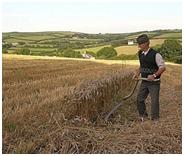
I recently finished The Omnivore’s Dilemma(1), a book about how the food we eat is produced. There is a section in the book that details a “healthy” farm called Polyface based in Virginia. Polyface uses the natural tendencies of nature to create a farm that produces some of the best eggs, beef, chicken and produce of any farm in the country. This form of farming, in particular its reliance on harnessing the innate tendencies and cycles of crops and animals, is very similar to managing a Naked Team. Managing Naked Teams is all about recognizing what natural energies motivate most people, and using transparency to channel that natural energy towards your team’s goal.

But it’s an imperfect analogy: While growing and running naked teams your team will quickly gain momentum, your people will get more and more confident and your stars will start realizing they can do even more. Like a successful crop on a farm left unattended, your team will start expanding outside its area (or at least want to). Your star employees will want to take on new challenges. The same thing happens on a farm but the good farmer harvests his crops right before things start getting overcrowded and thereby keeps a stable healthy system running.

Unlike a farm, it’s generally frowned upon if you harvest or cull your team to keep it at a stable level.

Harvesting

Here’s the problem: The consequences of not harvesting your team are just as serious as not harvesting on a farm. On an un-harvested farm, crops overcrowd themselves and start dying. Some aggressive crops spread into other areas (like weeds). And disease spreads rapidly in the confined and overcrowded herds. On a team that is running naked but needs to expand outside its area to keep everyone growing, either some team members quit out of frustration at not being able to keep moving in their careers (the best case situation), or they resign themselves to immobility, get bitter, and poison the team (the worst case).

How do you solve that problem? You do two things, one obvious and the other not so obvious.

On the obvious front, you weed your teams, removing the poisonous attitudes and the folks who don’t believe in the strategy you’re following. Get rid of them and quickly! That’s all I’ll say on that.

But on the non obvious front, you must ignore the natural instinct of most managers and instead, you actively harvest the best from your team.

This is the last step to running naked teams. First you focus on the team itself; then you use the team to help add more people to the team; and finally you aggressively grow and remove the stars on your team to keep your “crops” rotated and your harvests high.

The Joy of Farming

Harvesting your team, or actively removing your best team members and replacing them with new team members, is one of the most powerful tools in your bag of manager tricks. If you do it, you get the following benefits:

  1. You get to control the timing and attitude of when your stars leave. That’s right; your stars are going to leave anyway because they want to keep growing, but if you focus on moving them, you get much more control over when that happens.
  2. You force your team to be more resilient and less dependent upon 1-2 key people. Once the star leaves, you have to train other (up and comers) to do the job. If you’re regularly recycling your top team members it’s easy to convince your stars to maintain transition materials as a condition of your help. And it keeps your focus on training and recruitment which means you think more about the “how” you do things than “what” you do, which increases resilience.
  3. You increase morale on your team. When your team sees (through your actions) that you’re actively pushing and promoting the stars, they feel more loyalty to you because they’ve seen your results, and they feel better about the team because they know they’ll move on. They may not be stars yet, but you’ve given them the best possible reason to try: you’ll promote them off the team if they achieve it.
  4. You raise the execution level of your entire team. This one is less obvious, but I’ve found that when a high-performing star leaves, especially one who has been on the team for a long term, there is a period of pain (usually 3 months) as people start to fill the hole, but then the team starts executing better than when the star was there. Why? Because folks who you never let try something new when the star was on your team, now try new things. They have the knowledge of seeing what the star did, but they try new evolutions on that theme because they are new people. And after 3-months they’ve either returned to exactly what the star did (because the pain is too high if they don’t), or their mutation on the star’s way of doing things is actually better. Ergo your team gets better, not worse.

Most management tool books tell you to get rid of poisonous team members (which I echo) but to do everything in your power to keep your stars. I disagree. Do everything you can to promote your stars into new roles. It’s true that it does come at a cost; usually for me 3 months of pain as the team adjusts to life without a promoted star. But I’ve been on excellent teams that didn’t harvest their stars, and the consequence was always a team that ended up bitter, ineffective, and full of hubris about how good they were (anyone else have the same experience?). Three months of pain is nothing compared to years of snarky bitter old-timers.

Don’t’ get me wrong; I’m not advocating that you get rid of all your stars tomorrow. Instead I’m advocating that you plan and actively push out your stars on a schedule that your organization can maintain, but never let a year go by without losing one star!

The Rules of Farming

So assuming I’ve convinced you that focusing on growing the individuals on your team, in particular the stars, is worth your while, How do you do it and still get your day job done? The good news is that most first time managers actually spend far more time on employee growth than they should(2).

I have found a way that for me has been very effective, but also very efficient on my time. It consists of the following rules:

  1. Get Over Yourself
  2. Be the Sandman
  3. Remember Michael Jordan
  4. Crack the Whip
  5. Fire Your Stars

I’ll explain next week

– Art

(1) It was highly recommended by several people I respect, and it’s a good read. I really hadn’t appreciated the importance of corn to my diet before. My biggest issue with the book is its descriptions of life on Polyface farm, a healthy farm in Virginia. I know from firsthand experience what it takes to keep a farm like Polyface going; due to the nature of farming in rural Ireland in the 70’s and 80’s, most farms ran de-facto healthy with crop rotation, multiple types of livestock, and self-sustaining fertilizing (i.e. manure) – artificial fertilizers didn’t become prevalent until the mid 80’s. I grew up on such a farm. Pollan’s view of Polyface doesn’t suggest it’s easy work, but the style of the writing certainly romanticizes the work, skimps on details of exactly how taxing the labor is, and suggests those who choose not to enter the field are morally and spiritually inferior to those who do engage in the work. It’s certainly within his rights to advance his thesis this way, but it makes me question the other parts of his thesis as well; what details that might make his thesis less strong did he omit? Are there positives to the corn-based-us-ecology that he left out? Who knows? It’s a popular book, not a doctoral thesis, so you get what you pay for. Despite all that, I will continue the chain of recommendations and recommend that people read this book if they would like a good non-fiction read for the winter. Definitely food for thought.

(2) This is partially because of good intentioned HR policies like developing career maps. First time managers often want to do such a good job with their first employees that they actually create full career maps. There are few better examples of complete wastes of time in the history of management. The actual HR policy is well intentioned (it’s that managers need to spend some time on growing their employees), and HR departments recognize that most managers don’t do it on their own, but the one-size-fits-all approach leads to just bullshit paperwork. But the main reason first time managers spend too much time on this is because they break the first rule of growing individuals: they have not gotten over themselves.

Nude Numbers (#18)

For reference, here’s last week’s data. Curious what this post is about? I’m tracking my training progress for the New York Marathon. Click here for why.

Summary

I’m still a likely “no shot” for the NYC marathon but I’m keeping some hope alive. Good week last week, although I got sick (flu?) towards the end. This week the plan is for lots of rest. Woo hoo!

FYI – for some reason my blog was shut down over the weekend, but is back now.

Subjective Data

With the exception of running (which I’m still not doing), I had a good week. My weight workouts were hard and good. I did more spinning and got a short bike ride in. I still haven’t resumed swimming yet, which I’m not happy with, but my motivation to get in the water is lower now that fall is here.

My eating was mostly good all week – although Saturday and Sunday were bad. I think I have a cold or flu as well. On Saturday I was dazed all day, and on Sunday was coughing and had aches.

Objective Data

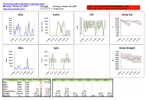
Click here for a PDF version of my dashboard.

Assessment

Apart from getting sick at the end of week, I had a good week. I stuck to plan very well.

This next week was a planned rest week anyway, so in some ways the sickness is well timed. I plan to do nothing most of the week, but I will try for a 50-mile bike-ride in Connecticut on Saturday weather permitting.

I’m still working on my winter goals, but they are looking like I what I outlined last week:

  1. Be able to swim 1km without stopping by 3/1/08
  2. Be between 163 and 168 lb with a 32 inch max waist by 3/1/08

I have a potential swimming partner lined up for the winter – now we just need to find a 25 yard pool that doesn’t require membership of a gym to use (since I already have membership in another gym).

Plan

Plan for next week:

  • Rest.
  • Continue calories under control (but not crazy cutting).
  • Weather permitting, do 50 mile bike ride in CT on Saturday.
  • Do smile.

As a reminder, I get to decide on October 24th whether to try to run the marathon anyway, or take my guaranteed spot next year. Let me know your thoughts.

Presentation Notes

No changes to data presentation this week. As with last week, data is presented in SOAP Note format.

– Art

Help me raise money for people suffering from cancer